Stationary Bike Calorie Calculator
Estimate indoor cycling calories with a bike-specific blend of adjusted MET burn, power output, cadence, resistance, and interval intensity so recovery rides and hard classes stop looking the same.
📌Real Presets
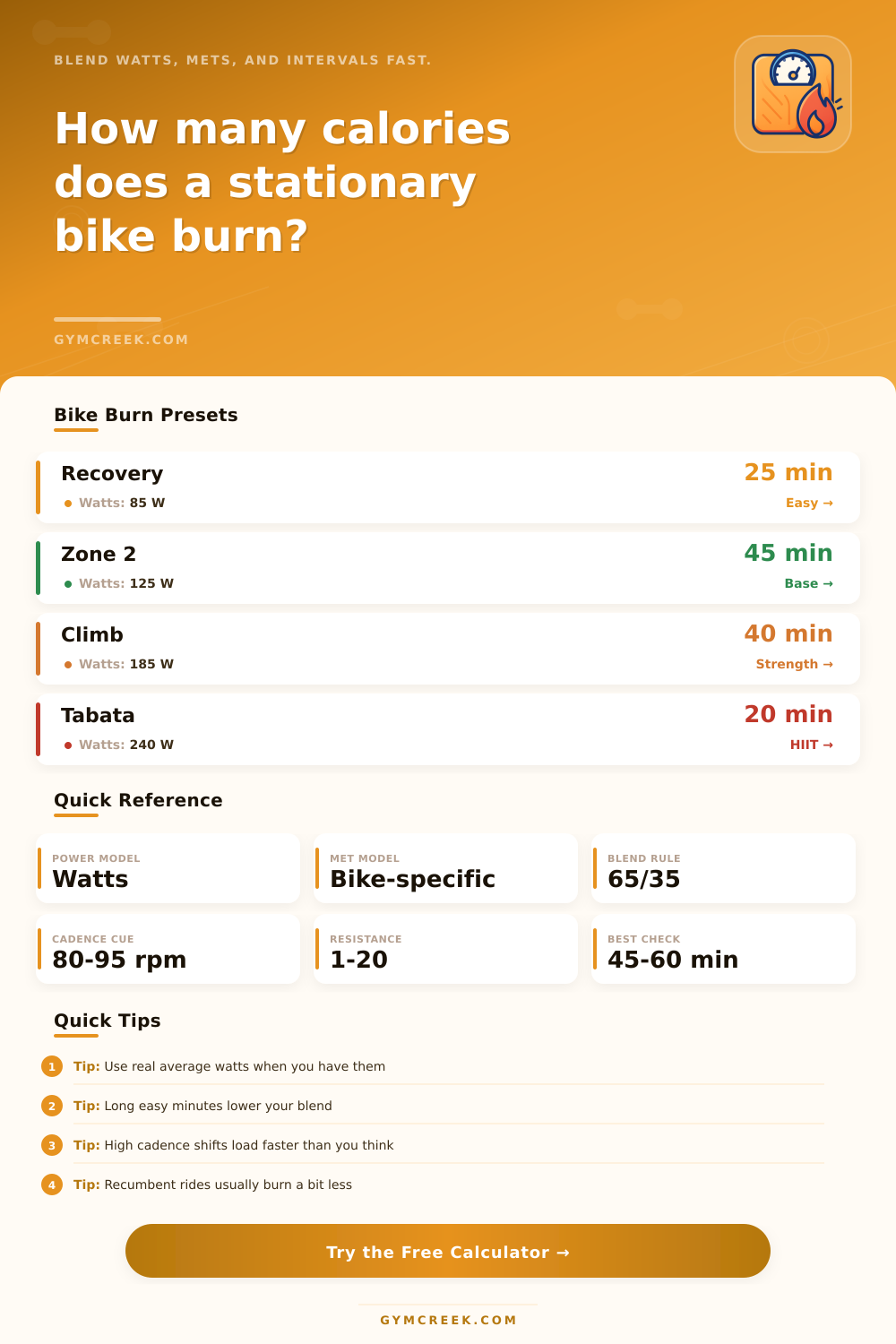
Each preset loads a believable indoor bike session with real watts, cadence, and work-to-easy pacing so you can compare a steady ride against a harder class in one click.
⚙Ride Inputs
Indoor cycling calorie snapshot
Enter ride details to compare the MET model with the power model.
📊Session Metrics
📑Reference Tables
| Duration | Total kcal | Kcal/hour | Read |
|---|---|---|---|
| 20 min | --- | --- | Quick |
| 30 min | --- | --- | Short |
| 45 min | --- | --- | Base |
| 60 min | --- | --- | Long |
| Profile | Base MET | Bonus rate | Best fit |
|---|---|---|---|
| Recovery | 3.8 | 1% | Easy flush |
| Steady | 5.8 | 2% | Zone 2 |
| Tempo | 7.6 | 3.5% | Long build |
| Threshold | 9.2 | 5.5% | FTP work |
| HIIT | 11.4 | 8% | Short surges |
| Cadence | Typical feel | Load cue | Use |
|---|---|---|---|
| <70 rpm | Heavy | Torque | Climbs |
| 70-79 rpm | Grounded | Strength | Seated work |
| 80-95 rpm | Balanced | Cardio | Most classes |
| 96-110 rpm | Quick | Leg speed | Spin-ups |
| Level | Feel | Console cue | Typical use |
|---|---|---|---|
| 1-4 | Light | Chat pace | Warm-up |
| 5-8 | Moderate | Smooth | Base work |
| 9-13 | Challenging | Push | Tempo |
| 14-20 | Very hard | Grind | Climbs and sprints |
💡Coaching Tips
Calorie tracking on indoor cycling machines are often inaccurate due to the use of generic formulas to calculate calories burned that dont account for an individuals physiology. Many individuals looks at the number of calories burned on indoor cycling machines. However, that number is not always accurate because the bikes often do not account for the different types of bike or the power output of each individual on the bikes.
In order to understand how many calories an individual burns on an indoor cycling machine, it is first important to gain an understanding of how factors such as power output, cadence, bike types, and MET values impact the number of calories burned. Power output are one of the major factors that impact the number of calories burned by an individual on an indoor cycling machine. Power output is typically displayed in the number of watts that the individual produces on the cycling machine.
Why Indoor Bike Calorie Counts Are Often Wrong
The average watt output should be used rather than the peak watts output of an individual on a cycling machine. An individual will burn more calories if they have a higher average watt output because higher watt output require the individual to expend more energy. The relationship between watts and calories burned also considers the efficiency with which individuals pedals.
The average pedaling efficiency of individuals is approximately twenty percent. Cadence, or the rate at which an individual pedals, also impact the number of calories that that individual burns on the indoor cycling machine. If an individual peddles at a high cadence, they will burn more calories than if they cycled at a low cadence.
High cadence increases the heart rate of an individual because the body require more oxygen to produce energy at a high rate of pedaling. A low cadence allows an individual to require more resistance in cycling in order to maintain the same watt output. Even if an individual holds the watts constant while cycling, changing the cadence will still have an impact on the body and the rate at which it burn calories.
The type of bike that is used also have an impact on the number of calories that are burned by an individual. For instance, bikes that require an individual to stand in an upright position require the individual to use more core muscles than bikes that provide more support to the individual, like recumbent bikes. Because more muscles are required to stand in an upright position relative to bikes that support the body, more calories will be burned on indoor cycling machines of that category than on bikes of the other category.
Additionally, bikes that incorporate features like weighted flywheels, like spin bikes, or bikes that incorporate fan resistance, like air bikes, require different amounts of physical effort from the individual to function effective. MET (Metabolic Equivalent of Task) values is another of the factors that relate to the number of calories that an individual burns while cycling on an indoor cycling machine. If the number of watts that an individual burns on an indoor cycling machine is not available, one can use the MET values of the types of cycling as an estimation parameter for the number of calories that are burned.
MET values are often used to estimate the level of intensity of an activity. For cycling, MET values can be applied according to the type of ride that is performed on an indoor cycling machine. For instance, intervals during which an individual increases the incline and the rate at which they cycle will have higher MET values than an easy ride.
An easy cycling machine may have a low MET value because the body does not have to exert much energy to cycle at a low intensity, whereas high MET values will be displayed for high-intensity interval training on the indoor cycling machine. Another factor that impacts the number of calories that are burned on an indoor cycling machine is the use of interval training on that bike. Afterburn, or the continued burning of calories after cycling has stopped, occur as a result of increased metabolism during cycling.
Incorporating intervals during which the individual burns a high number of calories will increase the total number of calories that are burned during that session. Easy cycling for periods of time during a cycling session will have the opposite effect on the total number of calories that are burned. During these easy minutes, the individual will burn fewer calories than when cycling at high rates.
These easy minutes will impact the total average number of calories that are burned per minute during the cycling session, so they should be accounted for when an individual determine how many calories they will burn during a cycling session on an indoor cycling machine. Other factors that impact the number of calories that are burned on indoor cycling machines include the muscle mass of the individual, their posture when cycling, and their efficiency with cycling. An individual who has more muscle mass will burn more calories during a cycling session than an individual with less muscle mass.
The muscles require more energy to maintain and move. Individuals in poor postures will use more energy to maintain their pose while cycling than individuals in good cycling stances. An individual who is efficient in cycling will burn fewer calories than an individual who is inefficient in cycling techniques because the efficient cyclist will waste less energy with each revolution of the pedal.
By considering each of these factors individually, an individual can more accurately determine the number of calories that are burned during a cycling session on an indoor cycling machine. To calculate the number of calories burned by an individual on an indoor cycling machine: use the combination of watts and MET values. Use watts if the cycling machine displays information about the power output of the individual.
If the bike does not include a screen displaying the output of the individual’s power, then MET values will be used to calculate the number of calories that are burned during that session. By understanding each of these individual factor, it is possible to gain a more accurate understanding of the energy that is expended by an individual during indoor cycling on an indoor cycling machine.