
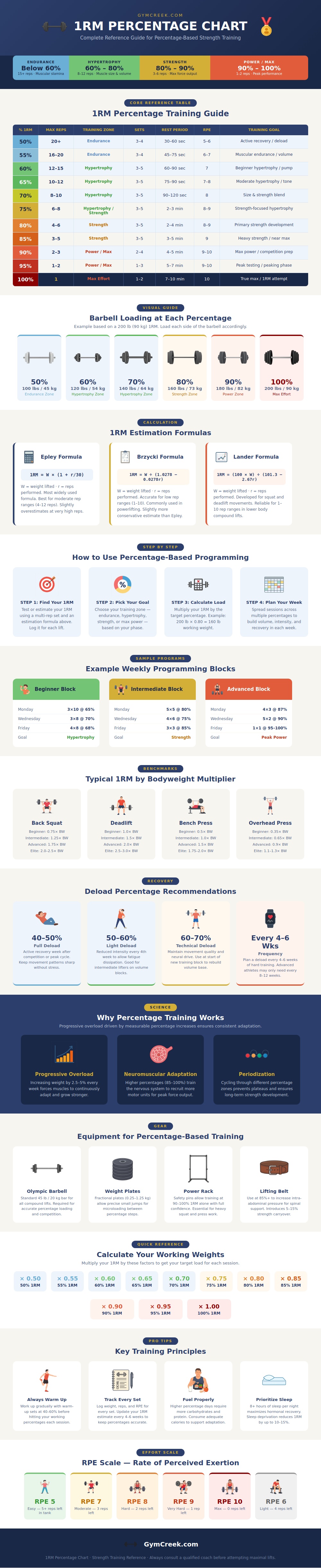
A one-rep max percentage chart is a training tool that can help organize weightlifting training. Specificly, an one-rep max percentage chart allow people to choose weights based on specific training goals. Using a one-rep max percentage chart removes guesswork from lifting by providing a mathematical way to determine the weight that should be lifted for specific training goals.
To use the chart, the lifter first have to determine their one-rep max. The one-rep max for a given exercise is the heaviest weight that a person can lift for one single repetition. The lifter should not attempt the one-rep max directly, as lifting a maximum weight can lead to injuries to the muscles and joints used in that lift. To find a one-rep max for a given exercise, an approximation can be made by lifting a weight for several repetition, and then using a formula to estimate one-rep max based on the number of repetitions performed.
How to Use a One-Rep Max Percentage Chart
Such estimation formulas works by calculating the one-rep max of an exercise based on the fatigue cause by performing that exercise. Once the lifter knows the one-rep max, a training zone can be selected. Zones correspond to the desired physical outcome from training.
For instance, if the training goal is to build endurance or stamina for a particular exercise, weights below sixty percent of the one-rep max should be used. Using weights below sixty percent of the one-rep max is also useful for selecting weights to use during recovery week from intense training. For those who want to maximize muscle growth (hypertrophy), people can use sixty percent to eighty percent of the one-rep max.
For those who wish to increase there maximal strength, weights between eighty percent and ninety percent of the one-rep max should be used.
These percentages require the lifter to perform fewer repetition with the weights, and to take longer rest period between lifting sets. Training performed between these percentages allows the lifter to gain more maximal strength then endurance. For those who wish to increase their power or compete in a strength competition, lifters should utilize weights at ninety percent of the one-rep max or higher.
Training with these weights is very intensely, however, so they should only be used occasionally in a training program. One-rep max percentage charts also provide recommendation for lifting rest periods between sets. Short periods of rest are used to increase metabolic stress to the muscles during lifting, leading to muscle growth.
Longer periods of rest allow the muscles to rebuild their energy stores for lifting of maximal strength. Many people that attempt to lift weights for endurance or strength rest for too short a period, however; resting for sufficient amount of time is required to lift another set of the same exercise. The Rate of Perceived Exertion (RPE) scale can also be used to adjust the weights lifted in a weight training program.
On this scale, individuals rate the difficulty of lifting at specific percentage of their one-rep max. Using the RPE scale is helpful for adjusting the weight lifted if an individual’s estimated one-rep max isnt accurate. For instance, an RPE of eight or nine indicate that the lifter has one or two repetitions left in their muscles for that particular exercise. A deload period can be taken every four to six week in a training program, during which the weights lifted are dropped to forty or fifty percent of a one-rep max. Taking deload periods allows the body time to recover from the intense training program while maintaining the lifting technique develop during training.
To see improvements in strength and muscle mass, individuals have to incorporate the principle of progressive overload into their lifting program. Progressive overload suggest that as the body adapts to lifting weights, the weights should be increased. For example, weights should be increased by between two and five percent each week.
Increasing the weights that are lifted allows the muscles to adapt to increased load, leading to an increase in both muscle and nervous system strength. Individuals should maintain a logbook to track there lifting data. Additionally, to enable the body to recover after lifting weights, it is important that each individual incorporate enough carbohydrates into their diet and get enough sleep each day.
Avoiding periods of prolonged training in a specific training zone can prevent the body from reaching a strength or muscular endurance plateau.
