🏋 Barbell Weight Calculator
Calculate total loaded barbell weight, plate combinations & estimated one-rep max
| Plate (lbs) | Weight (kg) | 2 Plates Added (lbs) | Notes |
|---|---|---|---|
| 45 lbs | 20.4 kg | +90 lbs | Most common Olympic plate |
| 35 lbs | 15.9 kg | +70 lbs | Less common in most gyms |
| 25 lbs | 11.3 kg | +50 lbs | Standard bumper size |
| 10 lbs | 4.5 kg | +20 lbs | Fine-tuning increments |
| 5 lbs | 2.3 kg | +10 lbs | Common accessory plate |
| 2.5 lbs | 1.1 kg | +5 lbs | Small increment plate |
| 1.25 lbs | 0.57 kg | +2.5 lbs | Micro loading plate |
| 0.5 lbs | 0.23 kg | +1 lb | Fractional plate |
| Total Weight | Weight (kg) | Plates Per Side (45 lb bar) | Lift Context |
|---|---|---|---|
| 95 lbs | 43.1 kg | 1x 25 lb | Warm-up / beginner bench |
| 135 lbs | 61.2 kg | 1x 45 lb | 1 plate bench / squat |
| 185 lbs | 83.9 kg | 1x 45 + 1x 25 | Intermediate press |
| 225 lbs | 102 kg | 2x 45 lb | 2 plate bench milestone |
| 275 lbs | 124.7 kg | 2x 45 + 1x 25 | Advanced bench |
| 315 lbs | 142.9 kg | 3x 45 lb | 3 plate squat milestone |
| 405 lbs | 183.7 kg | 4x 45 lb | 4 plate milestone |
| 495 lbs | 224.5 kg | 5x 45 lb | Elite deadlift territory |
| Formula | Equation | Best For | Accuracy |
|---|---|---|---|
| Epley | W x (1 + Reps/30) | Lower rep ranges (1-10) | High |
| Brzycki | W x 36 / (37 - Reps) | Reps under 10 | High |
| Lombardi | W x Reps^0.10 | Higher rep ranges | Moderate |
| O'Conner | W x (1 + 0.025 x Reps) | General use | Moderate |
Calculating the total weight on a barbell is an important task to be performed by those who wish to calculate their training data with accuracy. If an individual dont include the weight of the barbell in the calculation of the total weight being lift by an individual, they will have an incorrect understanding of the strength that is being lifted. The total weight that is placed on a barbell is the weight of the barbell, the weight of the plate that are placed on the barbell, and the weight of the collars that are used to secure those plates to the barbell.
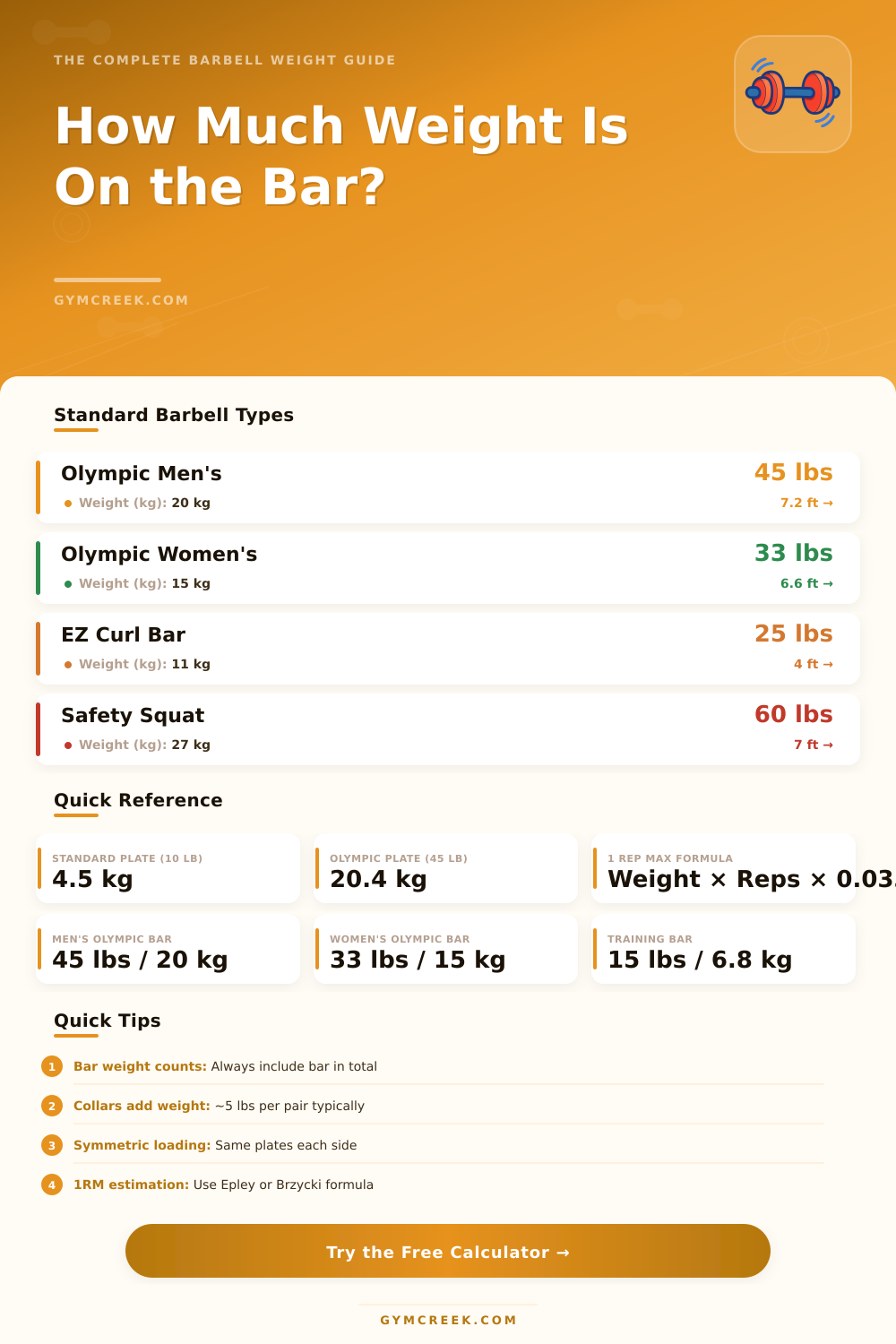
An individual must first identify the weight of the barbell in order to calculate the total weight that is being lifted. The weight of the barbell is the foundation of the total weight that must be calculated. Standard mens Olympic barbell weigh 45 pounds, and are constructed to be able to handle heavy loads.
How to Calculate the Weight on a Barbell
Women’s Olympic barbells weigh 33 pounds, and are constructed to be more easy for women to manage with their often-lighter strength. Other types of barbells include EZ curl bars, which weigh 25 pounds, and safety squat bars, which weigh 60 pounds. Because there is different weights for each type of barbell, it is necesary for an individual to know the weight of the barbell that is being utilized in the exercise.
Additionally, an individual use collars to secure the weights to the barbell, and they can weigh between one and five pounds, depending upon the type of collars that are utilized. It is important for the barbell to be loaded in a way that ensures the barbell remains balanced when being utilized by an individual. Loading the weights unevenly on the barbell may result in the barbell tipping from the individual, and can lead to the individual losing control of the barbell.
The most common weights for Olympic plates are 45 pounds each; two such plates will add 90 pounds of weight to the barbell. However, there is also 25 pound plates, 35 pound plates, 10 pound plates, and 5 pound plates. Additionally, fractional plates, such as 1.25 pound plates or 0.5 pound plates can be utilized for small increments in weight to the barbell.
Using fractional plates allows an individual to make small increments in the weight of the barbell, and small increments in weight allow individuals to progress steady in the strength that they possess with that particular barbell. An individual can estimate there one-rep max through the use of mathematical formulas. Performing a one-rep max test for each workout can lead to fatigue in the nervous system.
The one-rep max for an individual is the amount of weight that the individual can lift once during that exercise. One example of a mathematical formula that can be used to estimate the one-rep max is the Epley formula. The Epley formula can be used to calculate an individuals one-rep max if the individual has performed five repetitions of a specific weight.
Because these formulas are calculated as statistical averages, the estimated one-rep max will not necessarily be the same than the actual one-rep max that the individual can lift. However, the estimated one-rep max is still useful in providing an individual with a benchmark for the strength that they can develop during each training session. It is also necesary for an individual to log the total weight that they utilized during their workout.
If the weight of the barbell or the collars are not included in the total weight that an individual logs, then that logged weight will not reflect the total weight of the exercise. If such inaccurate data is logged, then an individual will not have an accurate understanding of their progress in increasing strength. Therefore, it is important for an individual to account for the different weight of other bars if they are to use different gyms or weights during their workout.
In any case, the total weight that must be calculated is the weight of the barbell, the weight of the weight plates, and the weight of the collars that secures those plates to the barbell. You should of accounted for the barbells weight to avoid mistakes. It isnt easy to track everything if you are lving a busy lifestyle and dont keep track of the weight plates.
The total weight should of been calculated by the trainee.