Cycling Gear Ratio Calculator
Model how one chainring and one cassette cog change rollout, gear inches, and cadence-driven speed before you swap parts for a climb, race, commute, or trail day.
📌Real Presets
Each preset loads a believable bike setup so you can compare cadence, rollout, and wheel speed without rebuilding the numbers from memory.
⚙Gear Inputs
Cycling gear snapshot
Pick a chainring, cog, wheel, and cadence to see how the gear rides.
📊Ride Metrics
📑Reference Tables
| Cadence | Km/h | Mph | Feel |
|---|---|---|---|
| 60 rpm | --- | --- | Load |
| 75 rpm | --- | --- | Build |
| 90 rpm | --- | --- | Cruise |
| 105 rpm | --- | --- | Attack |
| 120 rpm | --- | --- | Spin |
| Bike | Pairing | Ratio | Bias |
|---|---|---|---|
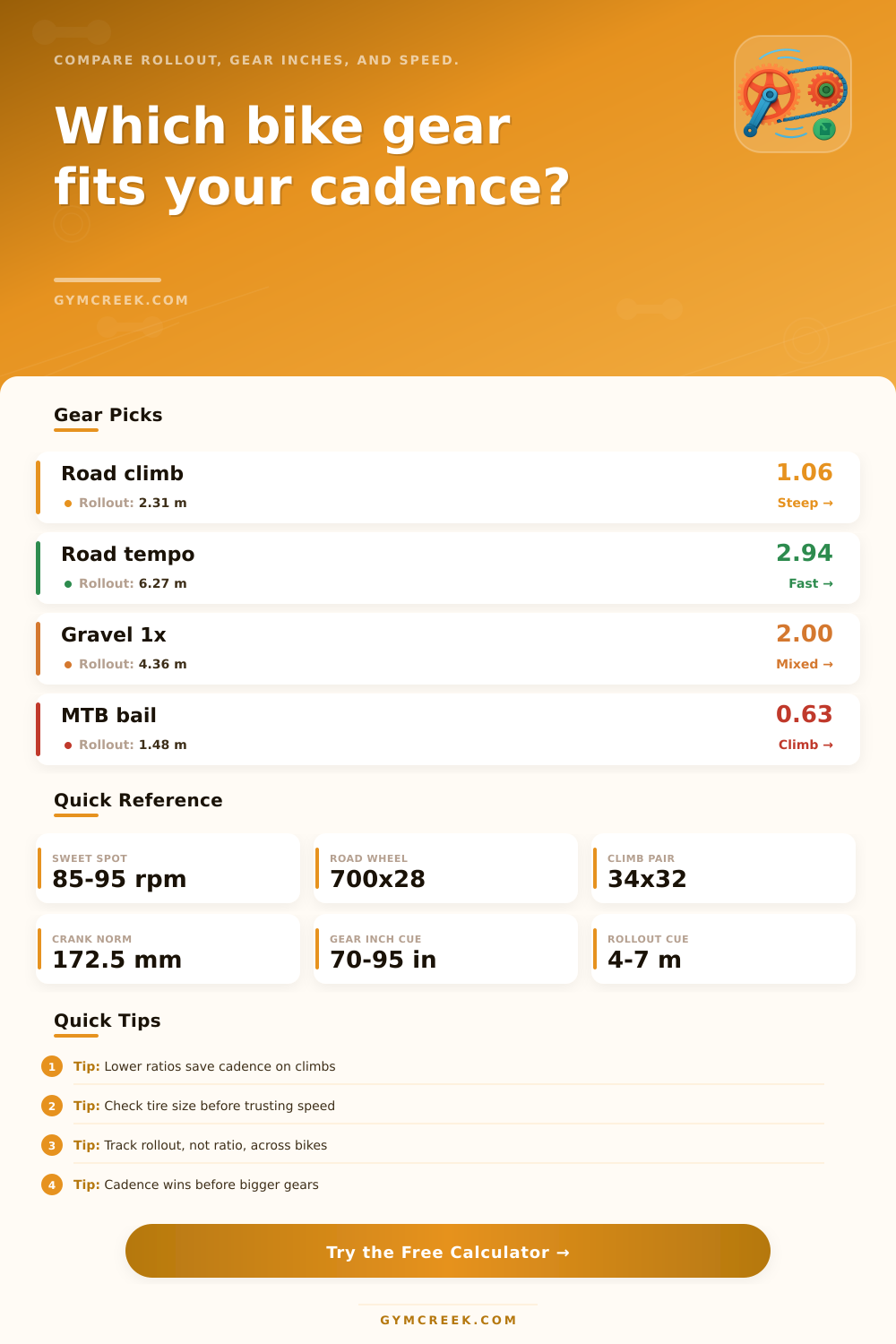
| Road climb | 34 x 32 | 1.06 | Easy spin |
| Road race | 52 x 14 | 3.71 | Fast flat |
| Gravel all | 42 x 21 | 2.00 | Mixed dirt |
| MTB rescue | 32 x 51 | 0.63 | Steep up |
| Zone | Inches | Typical use | Feel |
|---|---|---|---|
| Low | <45 | Loaded climbs | Spin safe |
| Mid | 45-70 | Trail and gravel | Balanced |
| Road | 70-95 | Fast tempo | Sporty |
| High | 95+ | Sprints down | Big push |
| Wheel | MM | Inches | Context |
|---|---|---|---|
| 700 x 28 | 2136 | 84.1 | Road |
| 700 x 40 | 2200 | 86.6 | Gravel |
| 29 x 2.4 | 2350 | 92.5 | MTB |
| 20 x 2.4 | 1615 | 63.6 | BMX |
💡Practical Tips
Bicycle gears are a system that allows your legs to create movement for the bicycle. By using an incorrect gears for your terrain, you will find it more difficult to ride the bike and will fatigue more quick. Using the correct gear for your terrain will make it easier to ride the bike and will allow you to ride without tiring quick.
The first of the main concept of bicycle gears are gear ratios. The gear ratio is calculate by dividing the number of teeth of the front chainring by the number of teeth of the rear cog. For instance, a gear ratio of 50 divided by 17 is 2.94.
How Bicycle Gears Work and How to Choose Them
This ratio indicate the number of times the bicycle will turn with every revolution of the pedals. However, this does not take into account the size of the wheel or the distance the bicycle will travel. The distance that the bicycle travel with one revolution of the bikes wheel is known as the rollout.
The rollout will take into account the size of the tires and the air pressure in those tires. Cadence is the rate at which a person pedals the bicycle, measured in revolutions per minute (RPM). Many cyclist aim for a cadence between 85 and 95 revolutions per minute when they ride.
A cadence of 85 to 95 RPM allow individuals to move efficient without tiring quick. However, if a cyclist increases their cadence to 110 RPM, they will be able to travel faster, especially on hills or during time trials. However, traveling at 110 RPM will result in fatigue in the leg after long periods of cycling.
The speed that the bicycle can travel is calculated by multiply the cadence by the rollout of the wheel. Therefore, at a cadence of 90 RPM in a specific gear, a cyclist will be traveling at a certain number of kilometers per hour. However, if the cyclist change to a lower gear at the same cadence, the speed will be lower.
Another concept in cycling is the circumference of the wheel. The circumference of the wheel will dictate the rollout of the wheel. For instance, a 700×28 road tire will have a different circumference than a 40c gravel tire.
The gravel tire will have a larger circumference due to the width of the tire. The cyclist should measure the circumference of the wheel to account for the number of revolutions that the tire make and the air pressure in those tires. Additionally, the length of the chain or crank arm impacts the gain ratio of the bicycle.
One of the other metrics used by many cyclists is the gear inches. This metric account for both the gear ratio and the circumference of the wheel. For road cycling, the target gear inches is between 70 and 95.
A gear inches between 70 and 95 are deemed efficient for the bicyclists. For distances below 45 gear inches, the bicycle is using its low gear to negotiate steep hills. For gear inches above 95, the cyclist is using high gear to sprint on flat areas.
These setting can be adjusted to the terrain and fitness of the cyclist. Bicycle gears can be adjusted for different types of cycling. For instance, a cyclist that is descending a steep hill may use a 34-tooth chainring with a 32-tooth cog to maintain a steady 85 RPM.
A mountain bike rider on flat terrain may use a 34-tooth chainring and an 18-tooth cog to maintain a steady 25 kph. A cyclist that commute to work may use a 46-tooth chainring and an 18-tooth cog to make it easier to start and stop the bicycle. A touring cyclist may use a 30-tooth chainring and a 34-tooth cog to move at a steady pace while carrying heavy luggage.
Some of the mistake that many cyclists make when determining their gears include relying on the gear ratio instead of the cadence, or relying on speed readouts from the computer that ride instead of the terrain. To get a better sense of the true speed of the bicycle without outside variables, many individuals will track the number of meters traveled with 100 revolutions of the pedals. Many bicycles has presets that help to indicate the various gear ratios for different types of cycling.
Additionally, individuals should model their gear according to there own cadence, specifically there steady cadence. The steady cadence will dictate the number of revolutions that an individual can maintain over a long distance without tiring.