USMC Marine PFT Calculator
Score a Marine Corps PFT with age-banded pull-up or push-up rules, the current plank table, and run or row logic that reflects the 46+ option and 2026 combat-arms screening.
📌Presets
Each preset loads a plausible for-record PFT setup, including push-up cases, altitude running, and the 46+ rowing path.
⚙Score Builder
Marine PFT snapshot
Enter your event choices and calculate the total score.
📊Fitness Metrics
📑Reference Tables
| Age | M Pull | F Pull | Push Cap |
|---|---|---|---|
| 17-20 | 20 | 7 | 82 / 42 |
| 21-25 | 23 | 11 | 87 / 48 |
| 26-30 | 23 | 12 | 84 / 50 |
| 31-35 | 23 | 11 | 80 / 46 |
| 36-40 | 21 | 10 | 76 / 43 |
| 41-45 | 20 | 8 | 72 / 41 |
| 46-50 | 19 | 6 | 68 / 40 |
| 51+ | 18 | 4 | 64 / 38 |
| Score | Time | Score | Time |
|---|---|---|---|
| 100 | 3:45 | 70 | 2:28 |
| 90 | 3:20 | 60 | 2:02 |
| 80 | 2:54 | 50 | 1:36 |
| 75 | 2:41 | 40 | 1:10 |
| Age | Run M/F | Row M/F | Note |
|---|---|---|---|
| 17-20 | 18:00 / 21:00 | N/A | Run only |
| 21-25 | 18:00 / 21:00 | N/A | Run only |
| 26-30 | 18:00 / 21:00 | N/A | Run only |
| 31-35 | 18:00 / 21:00 | N/A | Run only |
| 36-40 | 18:00 / 21:00 | N/A | Run only |
| 41-45 | 18:30 / 21:30 | N/A | Run only |
| 46-50 | 19:00 / 22:00 | 19:35 / 22:35 | 46+ row |
| 51+ | 19:30 / 22:30 | 20:00 / 23:00 | 46+ row |
| Band | 1st | 2nd | 3rd |
|---|---|---|---|
| 17-26 | 225 | 175 | 135 |
| 27-39 | 200 | 150 | 110 |
| 40-45 | 175 | 125 | 88 |
| 46+ | 150 | 100 | 65 |
💡Tips
The Physical Fitness Test is utilized as a means of measuring the operational readiness of a persons. There is several physical abilities that must be measured as part of the Physical Fitness Test, such as upper body power, core endurance, and cardiovascular fitness. Each of these physical abilities can be test in different ways.
For instance, upper body power can be measured through tests of either pullups or push-ups. Core endurance can be measured through a plank hold test. Finally, cardiovascular fitness can be tested through either a 3 mile run or a row test.
How the Physical Fitness Test Works
Should a soldier fail to meet the minimum requirement for any of these categories, their score for the entire Physical Fitness Test will be zero. Each of these categories have different scoring standards based off the age of the individual being tested. For example, there are 8 different age bands for the Physical Fitness Test, ranging from ages 17-20 to ages 51 and older.
Each age band has different minimum and maximum requirement for each of these physical tests. For instance, a 20-year-old male must perform 20 strict pull-ups to earn his maximum points for that category, but a male between the age of 46 and 50 only needs to perform 19 pull-ups to earn his maximum score. Age bands are incorporated into the Physical Fitness Test to allow each individual to remain in the military for a longer periods of time.
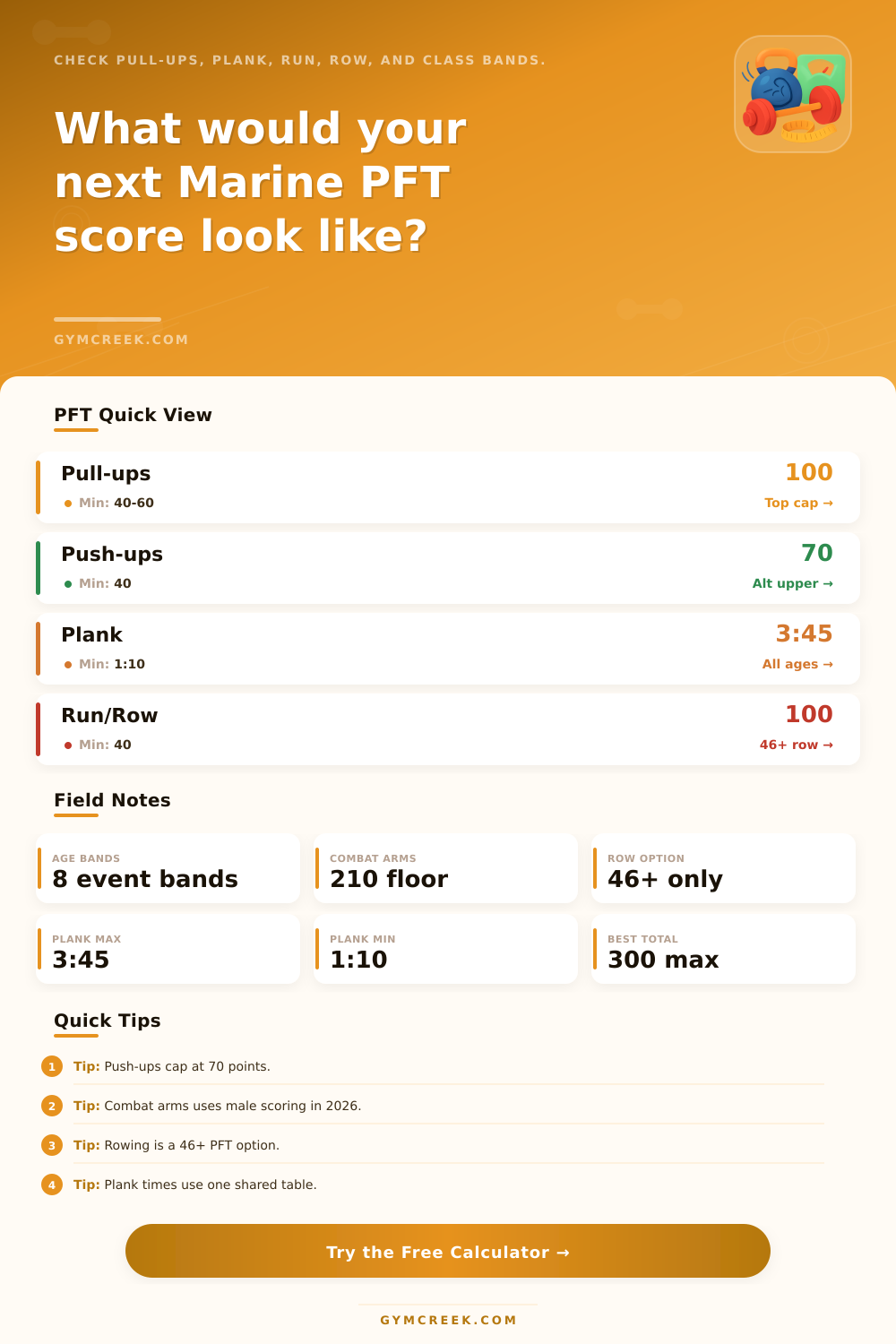
For the upper body strength test, a soldier can choose between performing either pull-ups or push-ups. Pull-ups earns a soldier a maximum score of 100 points, but push-ups are limited to a maximum of 70 points for that category. Thus, each soldier must ensure that he chooses the exercise that will earn him the most points.
Additionally, the number of pull-ups that a soldier can perform has changed with age, so each soldier must also be aware of this alteration in the scoring requirements. The core endurance test for soldiers consist of a plank hold test, which has replaced the crunch test for Marines. The soldier performs the plank hold test by measuring how many second a soldier can hold a plank position.
The requirements for all ages are the same. For instance, any soldier who can hold a plank for 1 minute and 10 seconds will earn 40 points for this category of the Physical Fitness Test. A soldier who can hold the plank for 3 minutes and 45 seconds will earn the maximum number of points for this test.
A plank exercise is an isometric exercise, meaning that the soldier must hold his muscles in a static position. Cardiovascular endurance is tested through either a 3-mile run or a row test. Each soldier can choose his preferred test for this category.
However, soldiers who are 46 years of age or older may opt for the row test instead of the 3-mile run. This option is made available to older Marines because rowing is less likely to strain a soldier’s joint. Additionally, if a soldier runs the 3-mile run at an altitude of 4,500 feet or higher, the score for that category will be adjusted in relation to the thin air that can make it more difficult for a soldier to run long distance.
Additionally, the minimum times to complete the 3-mile run increases with a soldier’s age. There are special rules that will apply to female Marines in combat arm positions that will begin in 2026. Female Marines in combat arms units will use the same Physical Fitness Test scoring tables for males for their score.
Additionally, these female Marines will need to score at least 210 points for each category of Physical Fitness Test in order to pass. This score ensures that these female Marines meets the same physical requirements of their male counterparts in combat arms positions. Each soldier can use strategies to increase their total score on the Physical Fitness Test.
For instance, a soldier can determine which events earns the most points for an individual, such as increasing a plank hold rather than increasing the number of pull-ups that is performed. Additionally, increasing a soldier’s speed on the 3-mile run will earn the soldier more points than increasing his upper body strength. Thus, each soldier should track their score in each category of the Physical Fitness Test to determine where they earn the most points.
Finally, each persons birthday will change their age band within the military, which will change the requirements for that individual for the Physical Fitness Test.