Training Volume Calculator
Measure weekly tonnage, hard-set totals, and adjusted workload across strength, hypertrophy, and deload blocks.
💪Preset Training Blocks
🔧Training Inputs
Weekly training volume snapshot
Enter a working load and set pattern to calculate volume, frequency, and adjusted workload.
📊Volume Metrics Grid
📑Reference Tables
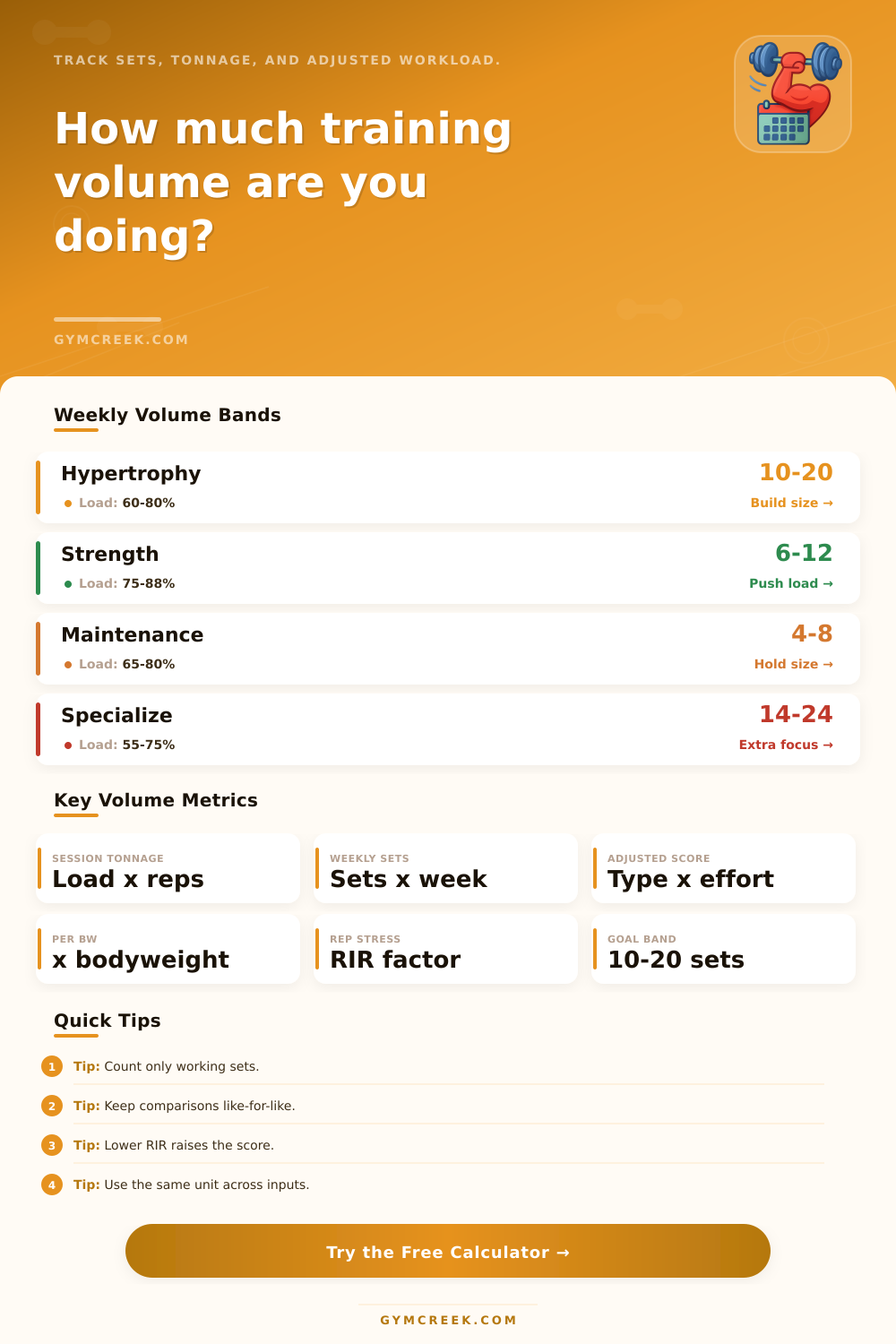
Volume landmarks by goal
Weekly set targets help explain whether the block is a low-fatigue hold or a high-volume growth phase.
| Goal | Sets | Load | Use |
|---|---|---|---|
| Hypertrophy | 10-20 | 60-80% | Build size |
| Strength | 6-12 | 75-88% | Push load |
| Maintenance | 4-8 | 65-80% | Hold size |
| Specialize | 14-24 | 55-75% | Extra focus |
Exercise type multipliers
Each movement family carries a different fatigue cost, so the adjusted score can compare apples to apples.
| Type | Mult | Fatigue | Best use |
|---|---|---|---|
| Compound | 1.00x | High | Main lift |
| Secondary | 0.88x | Med | Variation |
| Machine | 0.82x | Low | Stable path |
| Isolation | 0.66x | Low | Small lift |
Rep zones and volume cues
Rep ranges change whether the block behaves like strength practice, hypertrophy work, or lighter joint-friendly work.
| Reps | % 1RM | Use | Cue |
|---|---|---|---|
| 1-3 | 85-95% | Peak work | Low reps |
| 4-6 | 75-88% | Strength | Heavy sets |
| 7-10 | 60-80% | Hypertrophy | Classic volume |
| 11-15 | 45-70% | Accessories | High density |
Formula reference
These equations drive the calculator and keep the results repeatable when comparing two blocks or two athletes.
| Metric | Formula | Output | Why |
|---|---|---|---|
| Session tonnage | Load x reps x sets x ex | One session | Immediate work |
| Weekly tonnage | Session x weeks | Week total | Block compare |
| Adjusted score | Tonnage x factors | Weighted load | Fatigue aware |
| Volume / BW | Weekly / BW | Relative load | Size compare |
💡Practical Tips
Use the same lift pattern when comparing blocks.
Lower RIR should increase the adjusted score.
Training volume refer to a total amount of work that an individual perform during there training sessions. Training volume is calculate by multiplying the load that an individual performs with the number of repetitions that they performs and the number of sets that they perform. Training volume is important to understand as it determine whether the individual is building muscle or becoming excess fatigue.
If an individual performs too little training volume, they wont be able to build muscle. However, if an individual performs too much training volume, they will eventually stall in there progress and experience excessive fatigue. Although training volume is a number, there are different level of fatigue that can be created from different types of exercises.
What Is Training Volume
Compound lift, like squats, will create a higher level of systemic fatigue than isolation exercises, like machine chest presses. This is because compound lifts require a higher number of muscle group to work at the same time during the exercise. Thus, an individual’s raw tonnage has to be calculated in the context of the type of exercise that they perform.
Another factor that can influence training volume and the ability to recover from that type of exercise is the frequency with which an individual train that muscle group. If an individual trains a muscle group twice a week, they provide enough time for there body to rest in between training sessions. However, if they train that muscle four time a week, they may overload their central nervous system.
The effort that that an individual put into their sets will influence the impact of there training volume. For instance, if an individual performs their sets with zero reps in reserve, they will be placing more stress on their body than if they performed their sets with two reps in reserve. An individual can use a volume calculator to organize their training by selecting the exercise types that they will perform, their training goals, and the number of times that they will reach failure with each exercise.
If an individual select a compound movement, like a deadlift, their volume calculator will indicate that the exercise has a higher fatigue score than if they used an isolation movement like a curl. Thus, the calculator will allow them to compare, for example, a strength training block to a hypertrophy training block. The adjusted score provided by the calculator will take into account the different type of exercises that they are performing.
A person can also refer to tables that list the training volume targets that they should of had according to their training goals. If an individual aim to develop muscle, they will have a target for training volume with moderate load and a specific number of sets. If that individual’s goal is to gain strength, they will use heavier loads and perform fewer set.
Individuals aiming to maintain their current level of muscle will perform even less volume with their training. Individuals who aim to specialize in a specific muscle group will increase the training volume for that muscle group but will use lighter weights so that they do not damage the joints within their body. The different repetition range that an individual uses for their exercises will have an impact on the body.
For instance, if an individual performs a few repetitions, like one to three, they are building peak power. If an individual performs moderate repetitions, such as seven to ten, they are using those repetitions for hypertrophy training. Finally, if an individual is performing higher repetitions for their exercises, they are performing those exercises as accessory exercise.
An individual may make a few mistake when calculating training volume. One of the mistakes is to include warm-up sets in their training volume calculation. Warm-up sets dont use the same amount of tonnage as there training sets.
Another mistake is to use different unit of measurement when calculating training volume. For instance, an individual might use kilograms for one movement but pounds for another. Finally, an individual might ignore the number of reps in reserve.
A set with zero reps in reserve will place more stress on an individual’s body than a set with two reps in reserve. An individual can adjust their training volume according to their physical self and there lifestyle. For instance, if an individual experience joint pain, they should adjust their training volume to reduce the stress on that joint.
An individual’s nutrition is also important if they wish to increase their training volume. They must consume enough protein to aid in the recovery of their muscle. If an individual tracks their training and calculate an adjusted score for training volume, they can make precise adjustment to their training frequency and their effort with each exercise to meet their training goals.