Grip Strength Percentile Calculator
Rank dominant and average handgrip force by age and sex, compare both hands, and see how your test stacks up against adult norms.
📌Presets
Each preset loads a real grip scenario and refreshes the unit labels before you calculate.
⚙Grip Inputs
Grip percentile snapshot
Enter both hands, bodyweight, and age to see the percentile, balance, and next target.
📊Fitness Metrics Grid
📑Reference Tables
| Age | P25 | P50 | P90 |
|---|
| Age | P25 | P50 | P90 |
|---|
| Protocol | Factor | Note | Use |
|---|---|---|---|
| Reference seated hydraulic | 1.00 | Matches norm curve | Best fit |
| Standing hydraulic | 0.99 | Slight stance drift | Field test |
| Seated digital | 0.98 | Usually close | Clinic |
| Standing digital | 0.97 | More variable | Lab |
| Band | Range | Read | Target |
|---|---|---|---|
| Below avg | P1-P24 | Build | 40-49 |
| Average | P25-P49 | Solid | 50-59 |
| Strong | P50-P74 | Good | 60-79 |
| Elite | P75-P99 | Rare | 80-99 |
💡Tips
Grip strength is the amount of force that an individual can generate with there hands. Grip strength is a vital measurement of an individual’s overall health because grip strength is associated with physical strength and the ability of an individual to last into old ages. Several studies has demonstrated that individuals who exhibit weak grip strength have a higher risk of falling, having heart issue, and showing more fast signs of aging.
Therefore, grip strength can be used to determine the physical vitality of an individual. Grip strength has several factor associated with it. For example, age is one of the primary factors that impact grip strength.
What Is Grip Strength and Why It Is Important
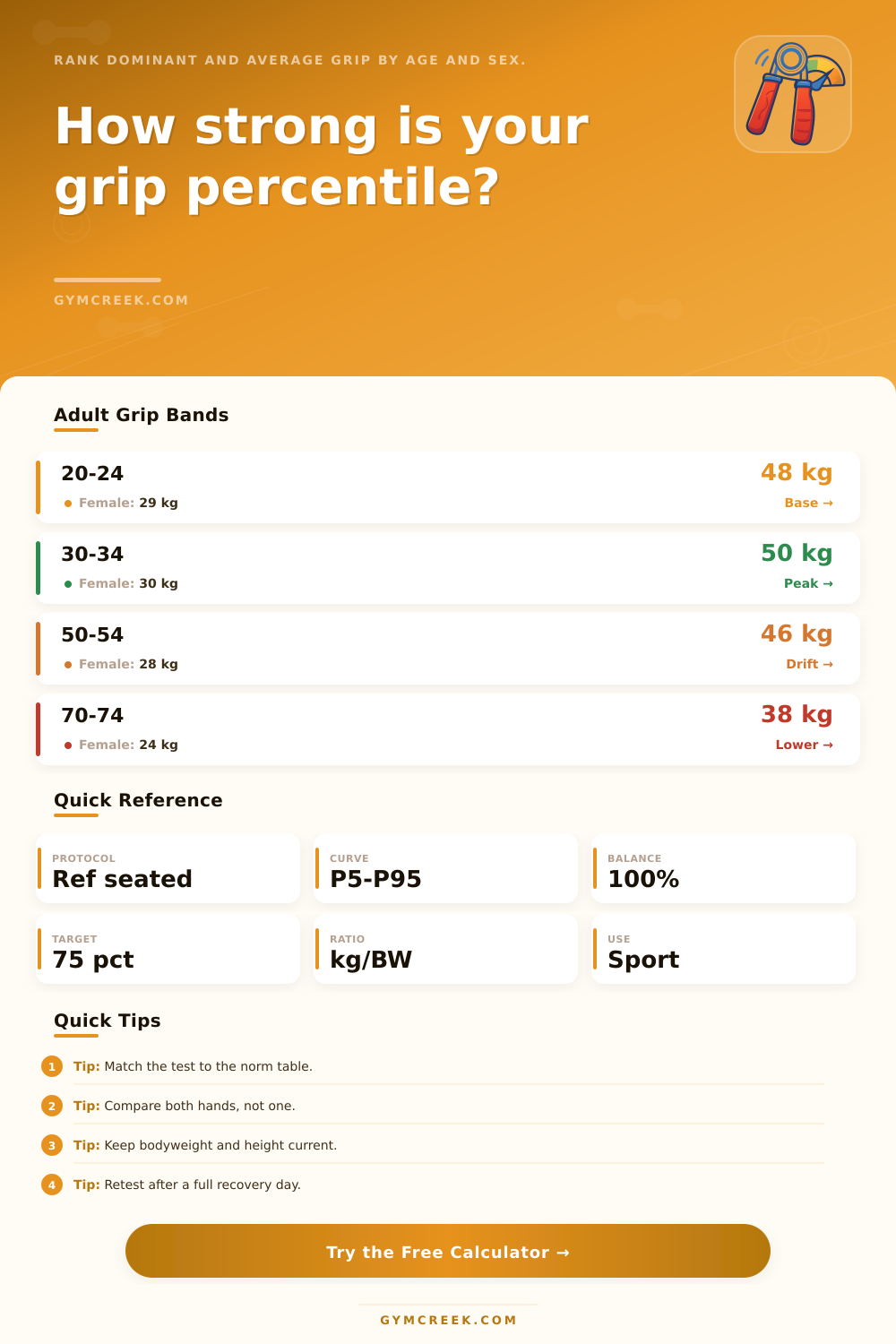
Grip strength reach its peak strength in an individual’s early 30s. After an individual reaches there early 30s, their grip strength weakens by 1% to 2% every year. Another primary factor associated with grip strength is the sex of an individual. Women typically possess less grip strength than men.
The grip strength of a woman is 60% to 70% of the grip strength of a man due to the difference in the muscle mass and bone density between each sex. To compensate for these factors, tools exist that adjust for the age and sex of an individual so that they represents their grip strength as a percentile. To gain accurate measurement of grip strength, an individual must follow the proper procedures when testing their grip strength.
The most common tool to test grip strength is a seated hydraulic dynamometer. For this test, an individual should have their elbows at a 90-degree angle and should not use their body to perform the test. For standing tests or digital dynamometers, an individual will have 2% to 3% less grip strength reading than those who performed the seated test.
To ensure accuracy in the measurement of grip strength, an individual should follow this protocol. Depending on the goals that an individual desire from their grip strength, their grip strength should be measured differently. For instance, a combat sport athlete should aim for a higher grip strength percentile then the average individual seeking to improve their health.
Another factor that an individual should analyze after measuring their grip strength is their hand balance. An individual’s non-dominant hand should have 90% to 100% of the grip strength of their dominant hand. Any difference in grip strength between a dominant and non-dominant hand may indicate an old injury or a repetitive motion that has worn down the non-dominant hand.
For individuals who perform sports or undergo physical rehabilitation, balance between both hands is essential for providing the body with optimal strength. Additionally, the grip strength of an individual relative to their body weight can demonstrate the efficiency of an individual’s grip strength. The stronger the body weight of an individual, the more grip strength is required to have the same relative grip strength as an individual of a light body weight.
Using the percentile values of an individual’s grip strength can provide a more accurate understanding of their strength than their absolute grip strength value. Grip strength below the 25th percentile indicates that an individual should increase their grip strength through the performance of exercise that improve grip strength. An individual with a grip strength at the 50th percentile has a solid grip strength that is capable of completing most everyday task.
Grip strength values above the 75th percentile are considered to be elite in comparison to other individual of similar age and sex. Therefore, grip strength values can be used to provide individuals with goal to encourage them to increase their grip strength. There are several reason for measuring an individual’s grip strength.
Grip strength is one of the best predictor of all-cause mortality because grip strength is a correlation to the strength and function of the bodys systems. Grip strength can be used to determine if an individual is experiencing sarcopenia after the age of 50. Athletes can use grip strength to measure fatigue.
Additionally, individuals who spend most of their days at their desk may exhibit weaker grip strength and poor metabolic health. Although grip strength declines with age, it can be strongly conditioned to provide an individual with strength that resists the effect of age. To ensure that the grip strength of an individual is accurately measured, there are some mistake that should be avoided.
For starters, an individual should avoid testing their grip strength if they are experiencing fatigue or if they have recently performed physical exercise. In these states, the measurements of grip strength will be masked from the true potential of an individual’s grip strength. An individual should retest their grip strength when they are rested.
An individual should test both of their hands during a single session. Inputs for body weight and height should be provided when measuring an individual’s grip strength as these values contribute to the interpretation of the grip strength value. Finally, the average percentile should be used rather than the strength of one hand alone to provide a complete description of an individual’s grip strength.