FFMI Potential Calculator
Estimate current FFMI, height-adjusted FFMI, and the bodyweight needed to reach a chosen target lean-mass profile.
📌Presets
Each preset loads a realistic body-fat profile, goal style, and target FFMI before you calculate.
⚙Potential Calculator
FFMI potential snapshot
Enter your stats and calculate current FFMI, adjusted FFMI, and the bodyweight required for your target.
📊FFMI Compass
📑Reference Tables
| FFMI | Band | Look | Use |
|---|---|---|---|
| 18.0-19.4 | Lean | Flat | Base start |
| 19.5-20.9 | Fit | Dense | Recomp |
| 21.0-22.4 | Athletic | Full | Build |
| 22.5+ | Dense | Huge | Upper end |
| Formula | Inputs | Output | Use |
|---|---|---|---|
| FFMI | Lean, h | Current | Base check |
| Adj FFMI | + 1.8m | Neutral | Compare |
| Lean mass | Wt, BF% | Kg lean | Core base |
| Target wt | Lean, BF% | Goal wt | Finish line |
| Scenario | Height | FFMI | Note |
|---|---|---|---|
| Desk recomp | 178 cm | 21.1 | Steady cut |
| Tall bulk | 193 cm | 22.4 | Big frame |
| Mini cut | 165 cm | 19.6 | Lean down |
| Ceiling check | 180 cm | 23.0 | Upper view |
| Goal style | FFMI | BF% | Use |
|---|---|---|---|
| Snapshot | 20-21 | 12-15% | Current view |
| Lean build | 21-22 | 10-12% | Add slowly |
| Cut target | 19-20 | 8-12% | Dry finish |
| Ceiling check | 22-24 | 10-15% | Upper plan |
💡Tips
The Fat-Free Mass Index, or FFMI, is a mathematic formula that calculates an amount of lean muscle mass that an individual has in relation to there height. Many peoples use the FFMI to determine the amount of muscle that an individual has because the amount of muscle mass that a person possess can be dificult to measure. A person’s total body weight can be measured on a scale, but that total weight incorporates both lean muscle mass and body fat.
The FFMI allow a person to understand their muscular development in comparison to their frame size. The basic calculation for the FFMI is an individual’s lean body mass divided by their height in meters squared. This calculation dont account for the individual’s height.
What is the Fat‑Free Mass Index (FFMI)?
Instead, individuals use the adjusted FFMI that feature a correction factor that accounts for how different the individual’s height is from the average height of 1.8 meters. An individual who is much taller or shorter than average has a different skeletal structure from the average human being. By use the adjusted FFMI, the measurement of lean muscle mass becomes more accuratey across the population.
The body fat percentage measurement is a critical component of the FFMI because this percentage determine the amount of lean body mass that an individual has. The FFMI will only be as accurate as the body fat percentage estimation of an individual. If an individual underestimate their body fat percentage, their FFMI will indicate that they have more lean muscle mass than they truly has.
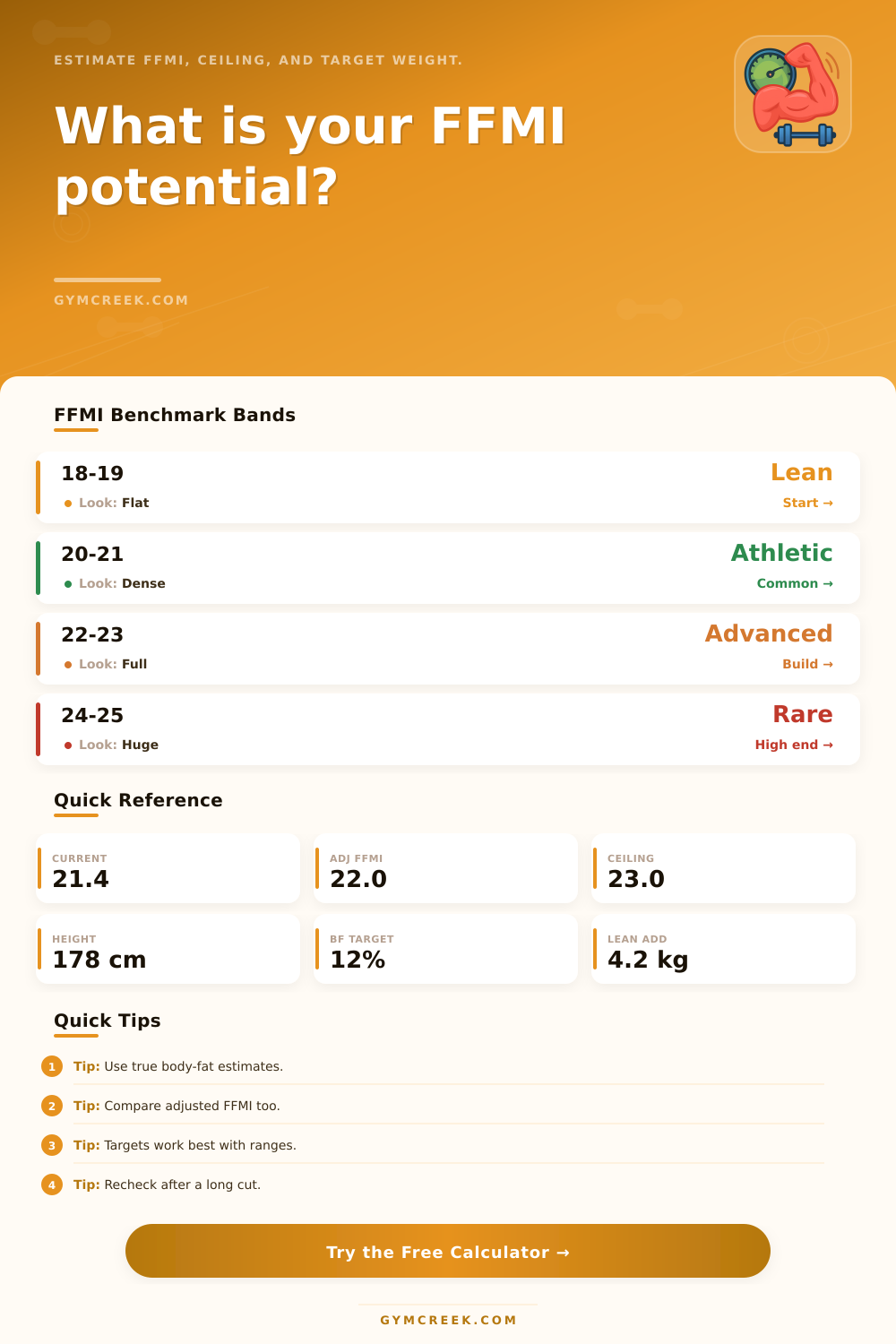
To ensure that an individual’s FFMI remains accurate over time, they must use the same method to measure their body fat percentage as the way in which they measure their lean body mass. The FFMI can be categorized into different ranges of lean muscle mass and muscularity. An FFMI score under 19 indicate that the individual is lean but possesses low muscle density.
An FFMI between 20 and 21 indicate a person has an athletic level of muscle density. For individuals who have an FFMI between 22 and 23, they has an advanced level of muscle fullness. For natural lifters, an FFMI above 24 is rare.
An FFMI above 25 is extreme difficult for most individuals to attain without the chemical assistance of steroids. Women has different hormonal profiles than men. Women use different scales to calculate their muscle fullness, and their FFMI ranges between 18 and 20 to have the same muscular appearance as men.
A person can use the Fat-Free Mass Index (FFMI) to set specific physical goal. A person can calculate their current FFMI to determine where they stand in terms of muscular strength. Additionally, by calculating the body weight that they want to achieve with their desired body fat percentage, they can determine the weight that they should aim to have when they reach their desired FFMI.
The difference between the person’s current FFMI and their target FFMI will show the lean mass that they need to gain to achieve their goal. There are a few factors that could potentially influence the accuracy of the Fat-Free Mass Index. The water that is retain in the body from consuming high amounts of sodium or carbohydrates will influence the total weight that a person weighs.
The changes in a person’s total weight will change their Fat-Free Mass Index calculation. Additionally, as individuals age, their metabolism change, which impacts their ability to maintain a high Fat-Free Mass Index. The genetics of an individual will also play a role in their Fat-Free Mass Index because the genetics determine their bone thickness and where their muscles are innated on their body.
Finally, individuals needs to use their Fat-Free Mass Index as a guide. An individual should of compare the Fat-Free Mass Index with the strength that they can produce in relation to their muscle mass. The more higher the Fat-Free Mass Index of an individual, the more physical strength that they will exhibit.
The Fat-Free Mass Index provides a mathematical map of how strong an individual can be based off their current lean mass. Additionally, the Fat-Free Mass Index allow an individual to track their progress over time regarding their training program.