Swimming Pace Calculator
Convert swim time into pace per 100m or 100yd, compare pool splits, and project benchmark swim times for training or race planning.
Swim pace profile
Enter your pace or swim time and the calculator will project benchmark splits and pool laps.
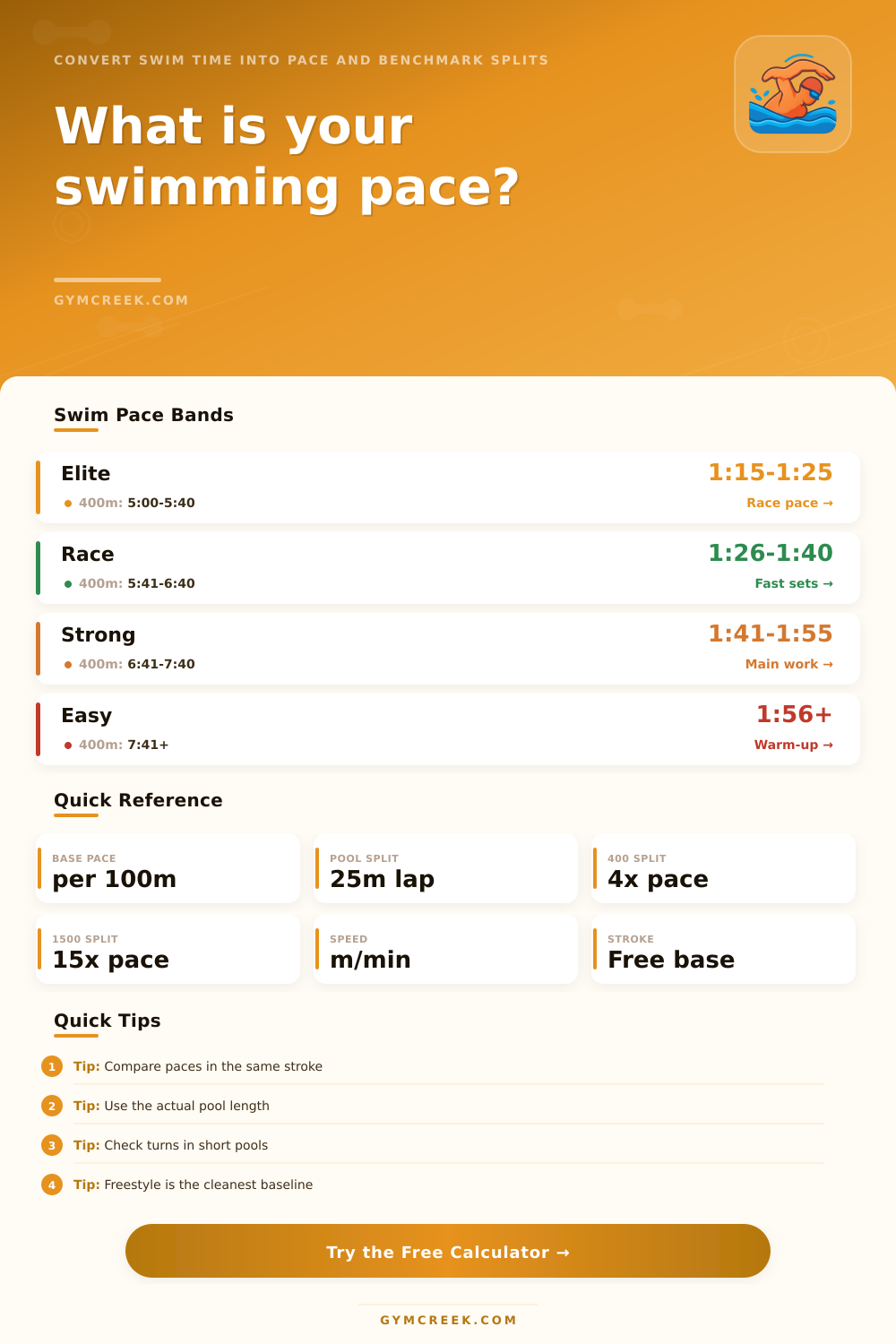
| Band | Pace/100 | 400 split | Use |
|---|---|---|---|
| Elite | 1:10-1:25 | 4:40-5:40 | Fast sets |
| Race | 1:26-1:40 | 5:41-6:40 | Hard work |
| Strong | 1:41-1:55 | 6:41-7:40 | Main set |
| Easy | 1:56+ | 7:41+ | Warm-up |
| Session | Typical pace | Typical split | Note |
|---|---|---|---|
| 100 sprint | Fast | All-out | Short reps |
| 400 test | Steady hard | Even pace | Benchmark |
| 800 CSS | Controlled | Repeatable | Threshold |
| 1500 swim | Aerobic | Even effort | Distance pace |
| Stroke | Factor | Speed note | Test use |
|---|---|---|---|
| Freestyle | 1.00x | Baseline | Best for pace |
| Backstroke | 1.05x | Usually slower | Comparable |
| Butterfly | 1.10x | High demand | Very short reps |
| Breaststroke | 1.18x | Most drag | Technique work |
| Formula | Inputs | Output | Use |
|---|---|---|---|
| Pace | Time, distance | Seconds/100 | Main split |
| Time | Pace, distance | Total seconds | Projection |
| Lap split | Pace, pool | Per length | Pool pacing |
| Speed | Distance, time | Units/min | Compare work |
Use this swimming pace calculator to turn swim time into pace, benchmark splits, and pool-lap estimates so you can compare workouts, test sets, and race targets with less guesswork.
Pace is the measurement of how long it takes a person to swim a specific distance. This is an essential tool for swimmers as it allows them to compare there different workouts. Knowing their pace will allow a swimmer to see how they is improving or staying the same in there distance performances.
Pace also allows a swimmer to understand their threshold or the level of effort that they can perform without getting to tired too quick. A pools length will play a significant role in how fast a person can swim. A 25-meter pool will have more walls and turns than a 50-meter pool.
What Swim Pace Means and Why It Matters
Because of this, a swimmer will take more turns and might be able to swim at a faster pace in a shorter distance. The swimmer must use the proper technique when turning the pool to maintain an even pace. The stroke that a person uses will also affect the pace that they can swim at.
Freestyle is an efficient stroke. However, butterfly will create more resistance in the pool and require more effort to swim at a faster pace then freestyle. Breaststroke also creates more resistance in the water than freestyle, and therefore, a swimmer will likely have a slower pace with breaststroke than freestyle.
When logging swim performances, the swimmer must log the type of stroke used for valid comparisons between swim performances. The intent of the workout a swimmer trains in will determine the pace at which they should be swimming. For sprint workouts, a swimmer will have to use a very fast pace for a short distance and for brief periods.
Threshold workouts will use a pace that a swimmer can sustain for longer periods. Aerobic cruise workouts will use a slower pace to swim longer distances. Knowing the intention of the workouts will allow a swimmer to use pace to ensure that they are training in an apropriate intensity for that workout.
If the workouts intention is to improve a swimmers threshold pace, they should train in threshold pace. If the intention is to recover from intense workouts, the pace should be much slower. A swimmer can use the concept of pace to make projections for their future races.
If a swimmer knows their pace for a 400-meter race, they can use this information to project their pace for a 1500-meter race using the four basic concept of mathematics. Knowing a swimmers pace in meters per minute will allow the swimmer and their coach to understand the swimmers speed in different strokes. Pace bands are another tool that can assist a swimmer or coach.
These bands will categorize the swimmers pace into different levels of speeds. These speeds are not strict categories that a swimmer should aim to swim within, but they do provide coaches and swimmers with an understanding of what pace is appropriate for what goal that a swimmer sets for themself. Swimmers make several mistake when using the concept of pace to track their performances in the pool.
One of the mistakes is ignoring the effect of the length of the pool on their pace. For example, a swimmer could easily train with a faster pace in a 25-meter pool than they can in a 50-meter pool. Another mistake is mixing meters and yards.
These are two different measurements of distance. If a swimmer mixes these measurements when calculating their pace, they will get incorrect results. The effect of fatigue on a swimmers pace is another mistake that many make.
When a swimmer is too tired to maintain proper technique with their strokes, their pace will slow. By maintaining session notes and comparing their pace when they are not tired to when they are fatigued, a swimmer can account for this effect on their performances. By using pace as a guide for training, a swimmer can effectively build their speed and reach their goals for racing competitions.