Carb Cycling Macro Calculator
Plan high-carb and low-carb days around training, then keep weekly calories, protein, and fats anchored to a clear target.
📌Presets
Each preset loads a real carb cycling setup and updates the unit labels before you calculate.
⚙Calculator
Carb cycling snapshot
Enter your stats and calculate the daily split.
📊Macro Metrics
📑Reference Tables
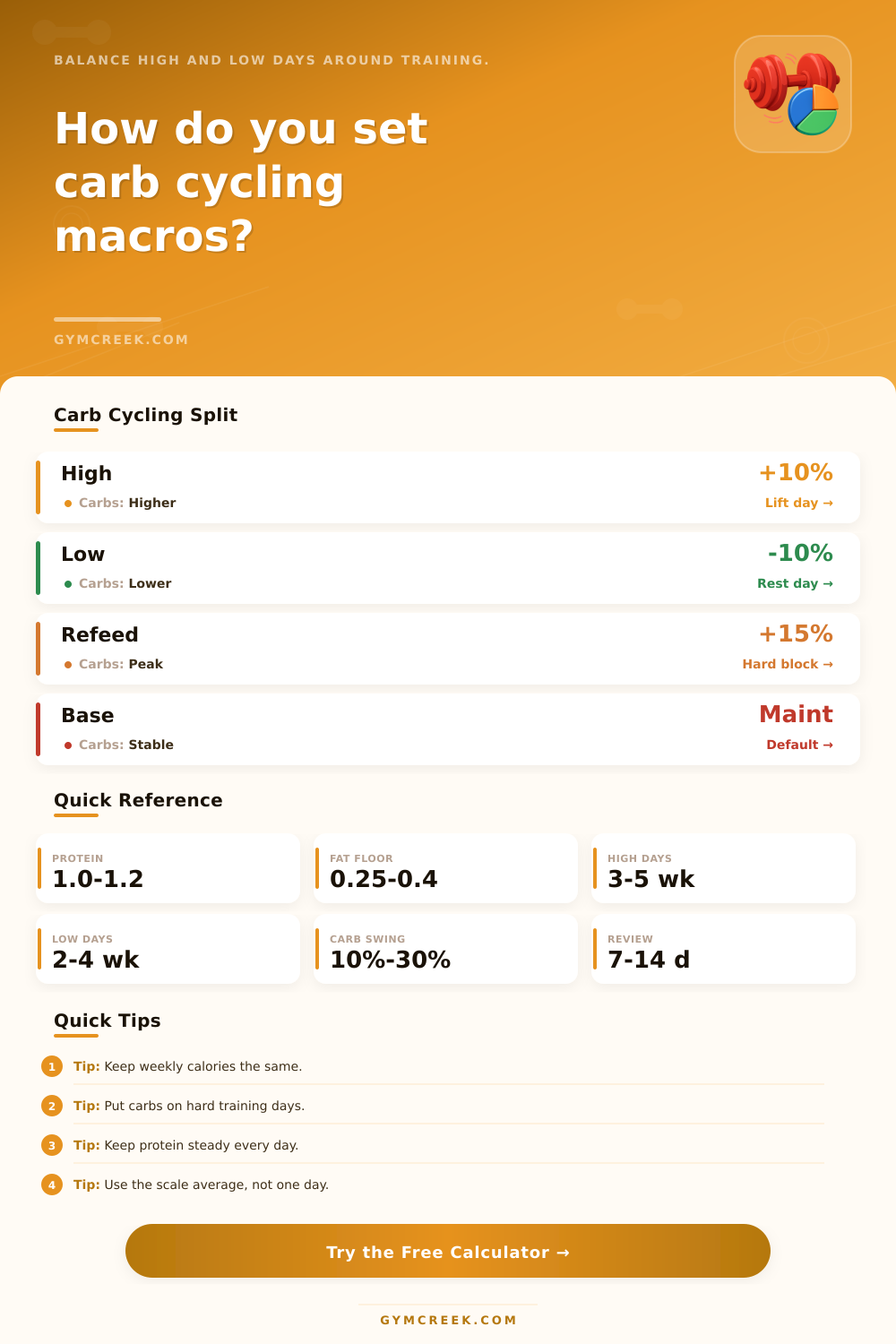
| Day | Calories | Carbs | Use |
|---|---|---|---|
| High | +10% | Higher | Lift day |
| Low | -10% | Lower | Rest day |
| Refeed | +15% | Peak | Hard block |
| Base | Maint | Stable | Default |
| Activity | Factor | Steps | Note |
|---|---|---|---|
| Sedentary | 1.20 | <5k | Desk day |
| Light | 1.375 | 5-8k | Some walk |
| Moderate | 1.55 | 8-12k | Train often |
| Very act | 1.725 | 12k+ | Busy week |
| Macro | Imperial | Metric | Why |
|---|---|---|---|
| Protein | 1.0-1.2 | 2.2-2.6 | Muscle hold |
| Fat | 0.25-0.4 | 0.6-0.9 | Hormone support |
| High days | 3-5 | 3-5 | Fuel lifts |
| Low days | 2-4 | 2-4 | Restore balance |
| Style | Bias | Carbs | Best for |
|---|---|---|---|
| Cut | -10% | Tighter | Fat loss |
| Recomp | -5% | Balanced | Slow change |
| Maintain | 0% | Stable | Hold weight |
| Performance | +5% | Higher | Hard sessions |
💡Tips
Carb cycling involve changing the amount of carbohydrate consumed on different days within a seven-day period. Specifically, carb cycling involves consuming more carbohydrates on days that involve intense physical training, and involves consuming less carbohydrates on days when a person rests from or performs low-intensity physical activity. The goal for individuals who attempt to carb cycle is to provide fuel to the muscles that are perform during training sessions while also encouraging the loss of body fat on days when no physical activity is perform.
Because of these benefits, individuals who carb cycle are able to manage there energy and body composition level over a seven-day period. The biological reasoning behind carb cycling relate to the way that the body utilizes energy. When an individual performs session that include the lifting of heavy weights, the glucose that those muscle use depletes the glycogen reserves that are stored within those muscles.
How Carb Cycling Works
In order to replenish those glycogen stores, the individual that is performing these exercises should consume carbohydrates. Additionally, consuming these carbohydrates will lead to an increase in hormones like leptin. On days off from exercise, an individual consumes fewer carbohydrate so that there calorie intake is lowered.
Because an individual who carb cycles can control the total weekly calories and carbohydrate intake, that person can fuel there performance with carbohydrates on performance days, while losing body fat on days off from exercise. To implement a carb cycling program for a particular individual, that individual must first establish there training schedule. For instance, if an individual trains four times each week, their body will be cycling there days so that their training days will have higher carbohydrate intake, while their rest days will contain less carbohydrate consumption.
The protein that the individual consumes should remain the same each day, as protein is necessary to preserve muscle mass. One gram of protein is recommended to be consume per pound of body weight each day. Additionally, fat intake should contain a minimum amount of fat, with a quantity of at least a quarter gram of fat per pound of body weight each day.
These ratio should not be changed for the individual, or they may feel low energy or not experience any change in body composition. The activity level that an individual performs will impact there Total Daily Energy Expenditure (TDEE). For individuals who sit at there desk for most of there day, BMR is multiplied by a factor of 1.2 to calculate there TDEE.
For individuals who perform moderate level of training each day, their BMR should be multiplied by a factor of 1.55 to calculate there TDEE. If an individual underestimates there activity level, their calculated TDEE may be too low; they may unknowingly consume all of the energy that they require to sustain there body and performance in the gym. An individual’s goal will impact there TDEE as well.
For instance, if the goal is to change body composition, TDEE may be set to a slight calorie deficit; however, if the goal is to increase strength and performance in the gym, a calorie surplus may be incorporated into there high-carbohydrate training days. The difference between high-carbohydrate and low-carbohydrate day can be anywhere between 15 and 20 percent. Preestablished plans or “presets” can be established for individual bodies and goals.
For instance, a powerlifter who is attempting to gain body weight may consume carbohydrates on five training days per week. Additionally, an individual who is dieting may consume less carbohydrate on days off from training. Additionally, if an individual knows there lean body mass, they can calculate there protein intake based off this information; however, if they are not knowledgeable of there lean body mass, they may have to use the standard equation that relates body weight to protein intake.
In order to be successful in utilizing carb cycling as a method for changing body composition, an individual must monitor the outcome of there program. For instance, the average daily calories that are consumed can be used to base the entire seven-day cycle; high-carbohydrate days may contain 10 percent more calories than the average daily calories, while low-carbohydrate days will contain fewer calories than the average daily calorie intake. High-carbohydrate days will provide fuel to the muscles that are perform during training, while low-carbohydrate days will allow the body to burn fat and burn fewer calories.
Additionally, the total carbohydrates that are consumed each week should be monitored. Additionally, the carb cycling program should be reviewed every seven to fourteen day. During these periods, the individual should evaluate there energy and lifting performance.
If the individual feels that there energy is low or that there lifting performance has decline, they should increase there carbohydrate intake or include a refeed day in there program. Common mistake may occur while the individual is attempting to carb cycle. For instance, many individuals may focus to much on there weight on the scale each day.
It is possible that the individual will lose some water weight on low-carbohydrate days, but there focus should be upon there weekly average weight. Additionally, the individual should not reduce the protein that is consumed on low-carbohydrate days; the protein intake should be maintained to allow for the preservation of muscle mass. Additionally, it is not recommended for the individual to consume high amounts of carbohydrate on days off from intense training.
Finally, the fat that the individual consumes should not be dropped to levels below the minimum; low fat intake may lower testosterone levels. Carb cycling can be adjusted according to the type of individual that is participating in the process. For instance, women may choose to cycle carbohydrates according to the phases of there menstrual cycle.
Additionally, lifters of any age may adjust the type of carb cycling plan that they use; older lifters may utilize the carb cycling plan with an emphasis on fat intake. Endurance athletes may use a carb cycling plan that includes a moderate amount of carbohydrates on both high and low days; this would bridge the gap between high and low days. Additionally, since the body is capable of adjusting the carb cycling plan according to how they feel and perform in the gym, an individual of any strength can use this plan for body composition.