Training Max Calculator
Estimate a true one-rep max, compare formulas, and see the training max and rep equivalents from any real working set.
📌Preset Lifts
Each preset loads a real barbell scenario and recalculates the numbers immediately.
⚙Calculator
Training max snapshot
Enter a max or rep set to calculate the usable max, training max, work set, and next cycle jump.
📊Training Metrics Grid
📑Reference Tables
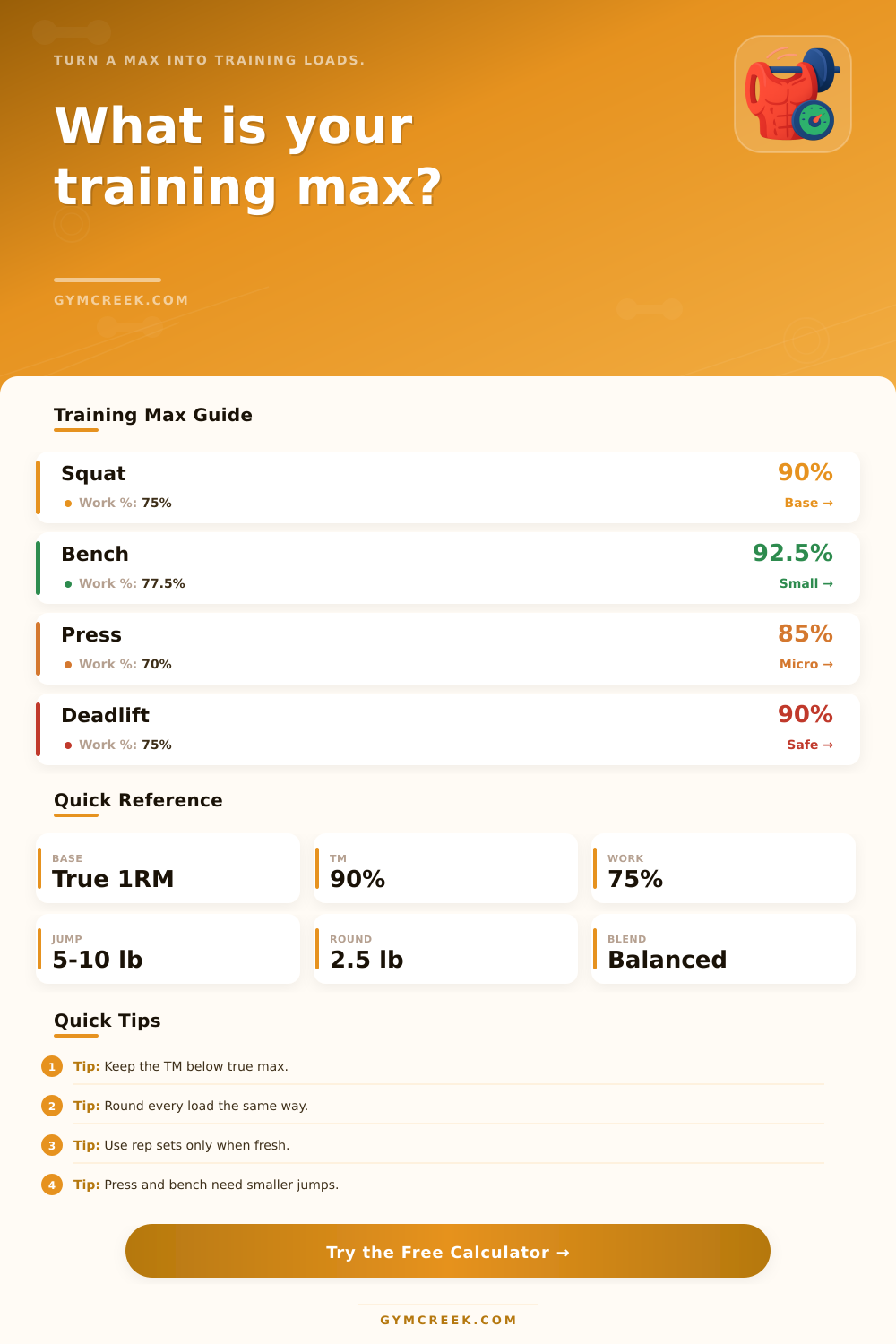
| Lift | Common TM | Smarter TM | Note |
|---|---|---|---|
| Squat | 90% | 85-90% | Base |
| Bench | 92.5% | 87-92% | Small |
| Press | 85% | 80-85% | Micro |
| Deadlift | 90% | 85-90% | Safe |
| Reps | Epley | Brzycki | Use |
|---|---|---|---|
| 1-3 | Low spread | Strict | Heavy day |
| 4-6 | Best fit | Balanced | Top set |
| 7-8 | Higher | Softer | Volume set |
| 9-12 | Very high | Wide | Use caution |
| Template | TM % | Work % | Best for |
|---|---|---|---|
| Classic | 90% | 65-85% | Steady use |
| 5s PRO | 90% | 70-80% | Clean reps |
| BBB | 85% | 50-65% | Volume block |
| SSL/FSL | 88% | 55-75% | Back-off work |
| Jump | Lift | Rounding | Note |
|---|---|---|---|
| 2.5 lb | Press | Micro | Small plates |
| 5 lb | Bench | Common | Most gyms |
| 10 lb | Squat | Normal | Big lifts |
| 2.5 kg | Metric | Pair | Easy track |
💡Load Guardrails
A training max is an calculated weight that can be used to determine an individual’s training loads. A training max are different from a true one-rep max. A true one-rep max is the heaviest weight that an individual can lift for one repetition during a specific day. A true one-rep max can fluctuate from day to day depending on a variety of factors, such as the sleep that an individual gets and the food that they eats.
Because of these variable factor, a training max is more stable than a true one-rep max. A training max is intentionaly lower than the true one-rep max of an individual. By using a training max, an individual can ensure that they can perform their sets with properly form. Additionally, by using a training max, an individual can ensure that they dont burn through their strength too quickly during a training cycle.
What Is a Training Max and How to Use It
To determine a training max for an exercise, an individual can use training calculation tools that ask for information about the individual’s most recent training set for that exercise. For instance, if an individual lifted 225 pounds for five repetitions on the bench press, the training calculation tool will ask for the weight and the number of repetitions performed. Each calculation tool use a variety of mathematical formula to calculate strength.
For instance, one can use the Epley formula to calculate the one-rep max for sets with fewer repetitions. The Brzycki formula is more conservative and is often used for calculating training loads for sets with higher repetitions. The blended calculation is helpful for determining training loads for sets with higher repetitions because each of the individual formula could provide an inaccurate calculation of one-rep max for sets with more than six repetitions.
The blended formula provides an individual with a usable one-rep max that is appropriate for their training cycle. In addition to the calculation tool, an individual can make adjustments to the calculated one-rep max. For instance, if an individual performed sets with dead-stop or tempo repetitions, they should adjust their calculated one-rep max to account for the effort required to perform those repetitions. If an individual performed sets with touch-and-go repetitions, such as on the bench press, the calculated one-rep max should be adjusted to account for the lighter weight that should be used for those sets as compared to sets with paused repetitions.
The calculated one-rep max can also be adjusted to account for any fatigue or poor sleep that the individual may have experienced during the calculation period. Such an adjustment of the calculated one-rep max by a percentage of the calculated one-rep max is referred to as establishing a safety buffer. By establishing a safety buffer, an individual will not exhaust there strength on a bad training day.
The percentage of an individual’s training max that is to be utilized with different exercises can vary. For instance, exercises like squats or deadlifts can utilize training loads of between 85 and 90 percent of an individual’s training max. For exercises like the bench press or overhead press, however, an individual can utilize 80 and 87 percent of an individual’s training max. The upper body muscles fatigues more quickly than the lower body muscles, so sets for the upper body should be more conservative. Additionally, microloading can be used for exercises like the upper body.
Microloading is the addition of small amounts of weight instead of large amounts of weight. Small amounts of weight can be added, for example, 2.5 pounds instead of 25 pounds. Small amounts of weight are easier for an individual to add to sets when an individual’s form begins to break down.
After an individual has established their training max, they can utilize this number to determine their working sets for the training cycle. For instance, if an individual chooses to train with a training max, they can use 75 percent of the training max for heavy training days, and they can use 65 percent of the training max for volume training days. These percentages will allow an individual to lift a significant amount of weight, but not so much that their form begins to break down during performance of the exercises.
Additionally, an individual can increase their training max for the next training cycle by a small amount, such as 5 to 10 pounds. An individual who is novice in the strength training world can have higher increments for training max increases. Deload periods will require a more conservative adjustment of an individual’s training max.
There are a variety of mistakes that can be made when utilizing a training max. One of the most common mistake is underestimating the number of repetitions for an exercise.
If an individual performs sets with a high number of repetitions, such as nine repetitions, their training calculation tool may indicate a very high one-rep max for that exercise. The true one-rep max for that exercise may be lower than the number calculated with the training calculation tool. Another of the most common mistakes is setting a training max that is too high for an individual’s strength.
If an individual sets their training max to 95 percent or more of their usable training max, they may find that their training cycle is not realistic for that individual. A third common mistake is to jump with an individual’s current weight to a much higher percentage of their training max. Such a jump may be difficult to execute with the amount of strength that an individual has. The amount that an individual increases their weight for a specific exercise should match the amount of weight increment that an individual has in their gym.
By avoiding these common mistakes and by following the information presented in this article, an individual can effectively build strength using the method of training with a training max. They should of tried this method earlier.