Relative Strength Calculator
Compare your lift against bodyweight, estimate a true 1RM, and see how the result stacks up against common strength standards.
📌Presets
Each preset loads a real lift scenario, updates the unit labels, and recalculates the score immediately.
⚙Calculator
Relative strength snapshot
Enter your lift, bodyweight, and reps to calculate the ratio.
📊Fitness Metrics Grid
📑Reference Tables
| Lift | Novice | Advanced | Elite |
|---|---|---|---|
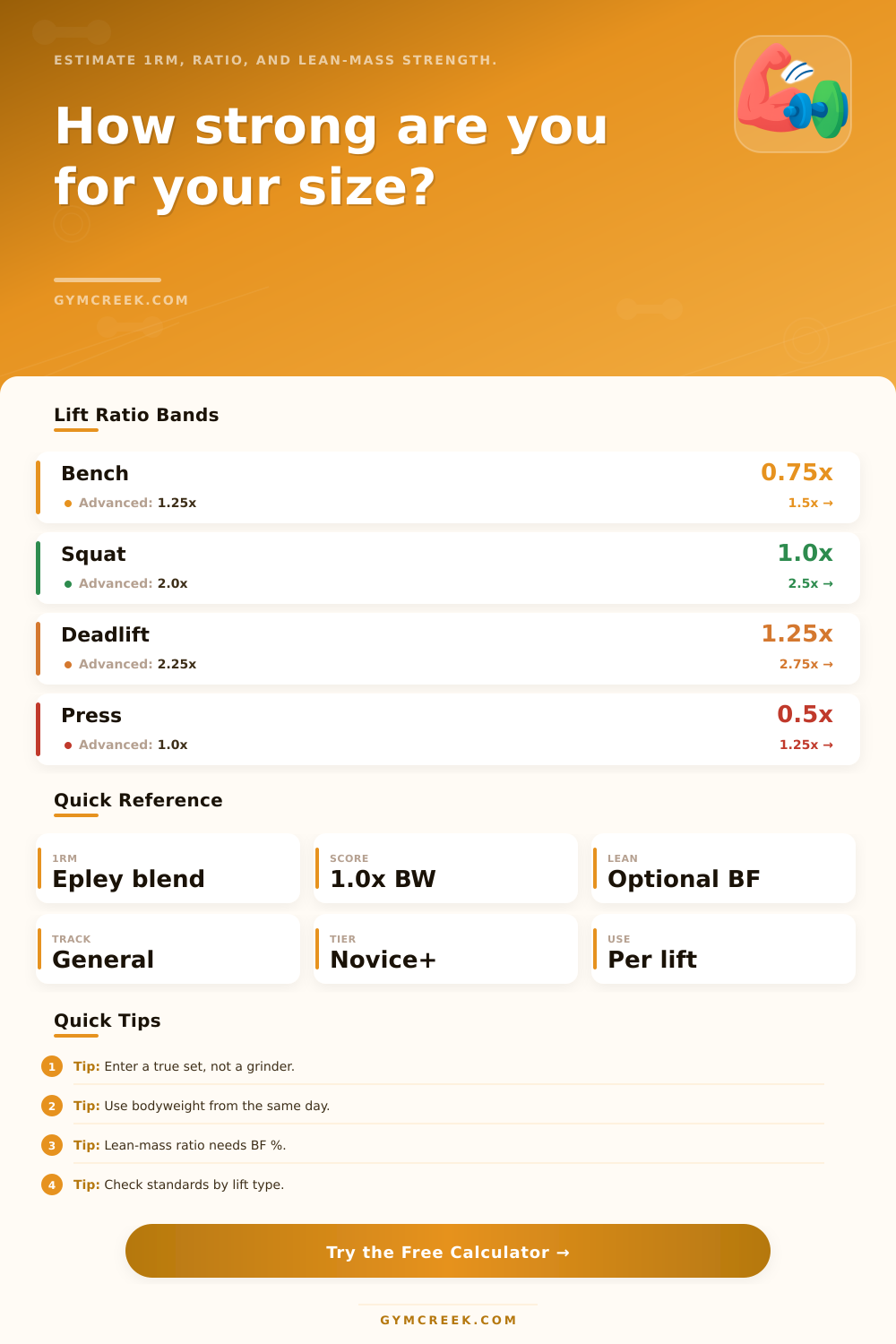
| Bench press | 0.75x | 1.25x | 1.50x |
| Back squat | 1.00x | 2.00x | 2.50x |
| Deadlift | 1.25x | 2.25x | 2.75x |
| Overhead press | 0.50x | 1.00x | 1.25x |
| Formula | Best reps | Shape | Bias |
|---|---|---|---|
| Epley | 1-10 | Fast rise | Higher |
| Brzycki | 1-12 | Steady rise | Lower |
| Lombardi | 1-8 | Soft curve | Middle |
| Blend | 2-8 | Avg view | Balanced |
| Ratio | Band | Meaning | Use |
|---|---|---|---|
| <1.0x | Below BW | Base phase | Build skill |
| 1.0-1.5x | Novice | Early progress | Steady reps |
| 1.5-2.0x | Intermediate | Solid gym lift | Hold form |
| 2.0x+ | Advanced | Strong ratio | Push load |
| Scenario | Set | Ratio | Takeaway |
|---|---|---|---|
| Desk bench check | 185x5 | 1.20x | Good base |
| Squat build | 275x3 | 1.65x | On track |
| Deadlift peak | 315x2 | 2.05x | Strong pull |
| Press focus | 115x6 | 0.78x | Needs work |
💡Tips
Relative strength is a way to measure the amount of weight that a person can lift in relation to their body weight. Unlike absolute strength, which only measure the amount of weight that an individual can lift, relative strength compare the amount of weight that is lifted to the body weight of that individual. Many individual use the concept of relative strength as it provides context to there physical strength.
For instance, an individual that weigh more will be able to naturaly lift more weight than an individual that weighs less. However, that individual may not have more relative strength compared to an individual with a lower body weight but who is more strong relative to their body weight. To determine the relative strength of an individual, it is first necessary to determine the body weight of that individual.
What is relative strength?
The body weight of the individual should be measured accurate. One can determine the body weight by weighing the individual. An individual that has high levels of body fat may have relatively lower strength compared to an individual with the same strength but with less body fat.
In this case, body fat percentage can be included in the calculations to determine the lean mass strength ratio of the individual. By calculating the lean mass strength ratio of an individual, it is possible to determine the portion of the individuals strength that come from muscle tissue. Relative strength has different standards associated with different exercises.
For instance, the standard for squat or deadlift exercises is typically higher than the strength standard for exercises like the bench press. An individual may be able to perform a deadlift of 2.5 times their body weight to be considered to have accomplished an elite level of strength in that category. However, an individual may only be able to perform an overhead press of 1.25 times their body weight to reach an elite level of strength with that exercise.
The standard for overhead press exercises is lower than other exercise because the muscles of the shoulders tend to fatigue more quick than the leg muscles. Therefore, the standards for relative strength for different exercises can be used to compare the relative strength of an individual to others performing the same exercise. An individual dont have to lift their maximum strength to calculate their relative strength.
Instead, one can calculate the one rep maximum (1RM) strength of an individual by perform a certain number of repetitions of an exercise that is less than their maximum strength for that exercise. For instance, an individual can perform five repetitions of a certain exercise with a given weight, and use a mathematical equation to calculate their 1RM for that exercise. Formulas like the Epley formula or the Brzycki formula can be used to calculate an individual’s 1RM if they perform between two and eight repetitions of the exercise.
These formulas can be used to help prevent injuries to the individual by eliminating the need for the individual to lift their maximum strength to calculate their relative strength. Factors like the training age and gender of the individual can impact the relative strength of an individual. An individual that has trained for many years will have a different training age than an individual that has trained for few months.
With strength training, the training age of an individual may be an indicator of whether or not that individual has plateaued in their strength gains. An individual’s gender can also have an impact on their relative strength. Due to the biological differences in men and women, men may naturaly have more relative strength than women.
Therefore, different standards can be used to compare the relative strength of individuals according to their gender. Additionally, an individual’s goals for there strength may differ from other individuals. For instance, the strength goals of a powerlifter may vary from those of a gymnast or an individual that aim to develop muscle hypertrophy.
Relative strength can be used to compare an individual’s strength to their previous measurements of relative strength. By measuring their relative strength over time, it is possible to determine whether an individual is increasing their strength. If an individual’s relative strength is increasing, but their body weight is increasing at a more fast rate, then their body weight is increasing without increasing their relative strength.
By measuring relative strength, it is possible to discover any weakness in an individual’s muscle groups. Additionally, measuring relative strength allows an individual to set goals for there future workouts. Thus, by focusing upon relative strength, an individual can develop more efficient and powerful physical strength.