Reverse Dieting Calculator
Map a controlled calorie ramp after a cut, then watch maintenance, macros, and scale drift settle into a cleaner pattern.
📌Preset Scenarios
Each preset loads a real reverse-diet pattern and updates the unit labels before you calculate.
⚙Calculator Inputs
Reverse dieting snapshot
Enter your cut-end numbers to map a cleaner climb back toward maintenance.
📊Fitness Metrics Grid
📑Reference Tables
| Phase | Calories | Focus | Check |
|---|---|---|---|
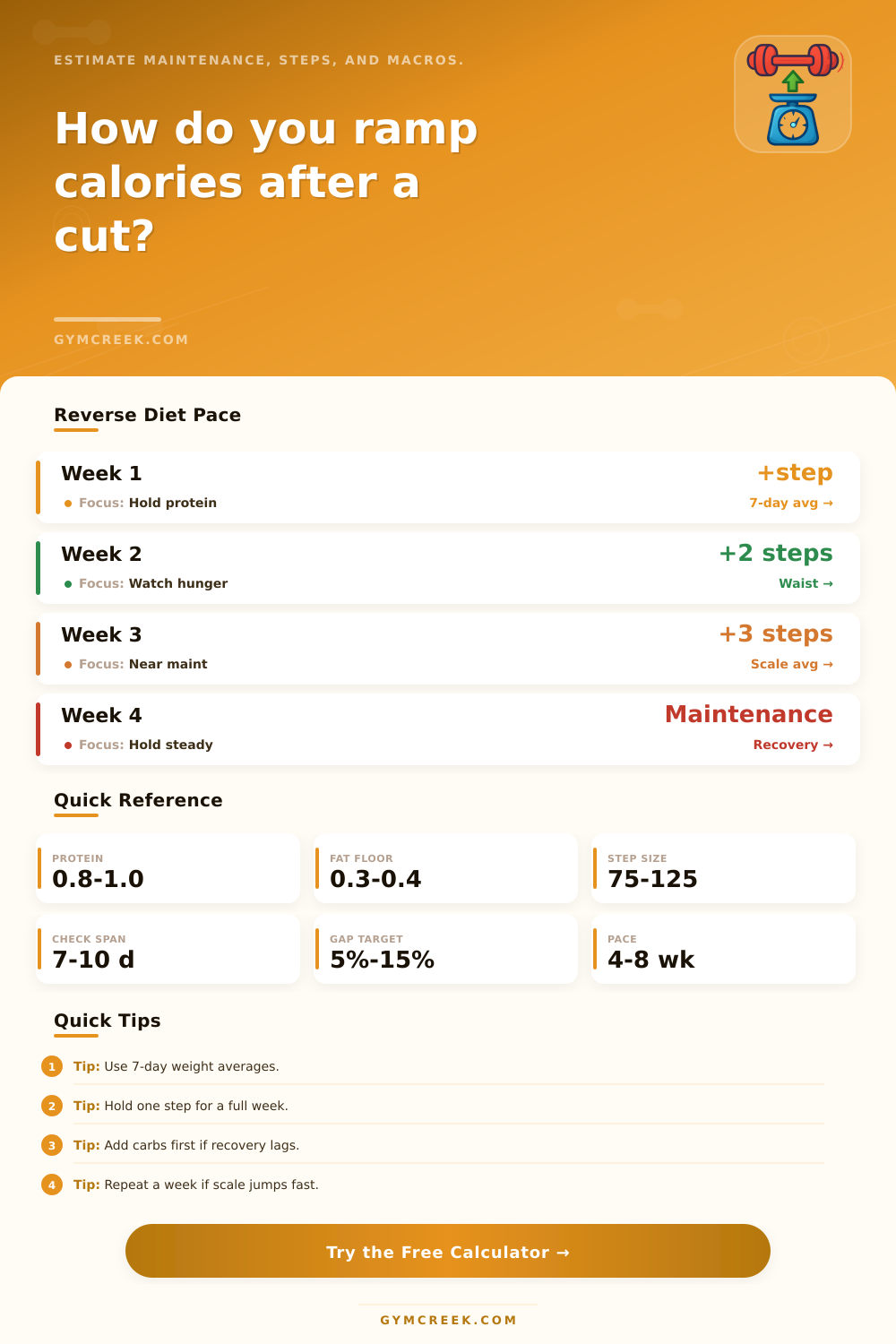
| Week 1 | Current + step | Stabilize hunger | 7-day avg |
| Week 2 | + another step | Watch recovery | Waist trend |
| Week 3 | Near maintenance | Hold carbs steady | Scale trend |
| Week 4 | Maintenance | Lock the range | Performance |
| Activity | Factor | Typical pattern | Use when |
|---|---|---|---|
| Deskbound | 1.20 | Low steps | Mostly seated |
| Light move | 1.375 | Walks and lifts | Some daily activity |
| Moderate | 1.55 | Training 3-4x | Regular gym work |
| Hard week | 1.725 | Heavy sessions | High output load |
| Macro | Imperial | Metric | Why it matters |
|---|---|---|---|
| Protein | 0.8-1.0 g/lb | 1.8-2.2 g/kg | Muscle retention |
| Fat | 0.3-0.4 g/lb | 0.6-0.9 g/kg | Hormone support |
| Carbs | Remainder | Remainder | Training fuel |
| Fiber | 25-35 g | 25-35 g | Hunger control |
| Trigger | Action | Reason | Next step |
|---|---|---|---|
| Scale flat | Add step | Adaptation lag | Hold 7 days |
| Gain too fast | Repeat week | Water or glycogen | Review average |
| Gym feels flat | Shift carbs | Fuel training | Keep protein fixed |
| Still hungry | Slow ramp | Digestion load | Extend hold |
💡Tips
Reverse dieting is a method that individuals use to increase there caloric intake after they have experienced a period of calorie restriction. When an individual have finished with a calorie deficit period, that individual may wish to return to their maintenance calories for the body. If an individual rapidly increase their calories during this period, the body may store water and glycogen which can lead to a rapid weight gain.
If, however, an individual increases there calories too slow, they may experience low energy and performance during there workouts. Reverse dieting allows for an individual to slowly increase there caloric intake to allow the body to adapt to the newcaloric intake. Many individuals make the mistake of treating the end of a calorie deficit period as if it were a bulking phase.
How to Reverse Diet Safely
If an individual double there intake of carbohydrates, for example, they may experience a rapid increase in weight. While the muscle refilling there glycogen stores causes the increased weight, the rapid increase in weight can be difficult for individuals to accept. Reverse dieting, therefore, gradually increase the calories that an individual consumes, such as fifty to one hundred calorie each week.
During a calorie deficit period, the body decreases its expenditure of energy, and the thyroid output decrease. By adding calories slowly to the diet, the thyroid and activity level of the body can naturally increase without the body storing additional fat. Macronutrients must also be managed during the reverse dieting phase.
Protein should be high, between zero point eight and one gram of protein per pound of body weight. Fats should be at a minimum of zero point three to zero point four gram of fat per pound of body weight, as too low of fat intake can lead to low testosterone and increased hunger. The remaining calories should be filled with carbohydrates to ensure that an individual has enough fuel to perform there training and workouts.
An individual’s activity level and biology will impact the number of calories that an individual burn each day. An individual that is sedentary will burn fewer calories than an individual that is more active. An individual’s age and sex can also impact the number of calories that an individual burns each day.
Formulas, such as the Mifflin-St Jeor equation, can help calculate an individual’s caloric needs. Finally, an individual’s body fat percentage can help determine how many calorie lean mass burns. A person should of use the average caloric intake from the final week of a calorie deficit as the starting point for reverse dieting rather than using the theoretical estimate for TDEE.
A person should use a specific pace when reverse dieting to avoid excessive fat gain. A person should aim to gain between zero point one five and zero point three pound each week. If a person notices that their weight gain is occurring at a faster rate then this suggestion, then they are increasing there calories too quick.
If a person wants to minimize the visual change to there body when reverse dieting, they should slow the rate at which they are increasing there calories. However, if a person is looking to improve there gym performance, they may increase the rate at which they are increasing there caloric intake. A person should not weigh in each day to determine caloric intake while reverse dieting as there sodium intake and sleep quality can impact there weight.
Instead, they should use the average of there seven-to-ten day weight to determine there caloric intake. In the first week of reverse dieting, a person should focus on there hunger levels. In the second week, they should begin to monitor there waist measurements as they increase there carbohydrate intake.
During the third and fourth weeks, they can use there average weight and there gym performance to determine if they have reached there maintenance calories. If there gym performance is dropping, they should increase there carbohydrate intake. If they are experiencing high level of hunger, they should maintain there current calories intake for another week.
If there weight is increasing at a rapid rate, they should return to there current calorie intake for one more week. Various factor can impact a persons results while reverse dieting. For instance, poor sleep can create increased feeling of hunger.
Women may experience increased water weight due to there hormonal cycles. Those who lift weights often may require increasing there fat intake in there diet. For runners and athletes who can perform high-intensity workouts may need to adjust caloric intake for carbohydrate replenishment.
A person may need to adjust there calories intake based off these factors. If a person finds that there scale does not change with an increased caloric intake, they may need to continue to increase the calories they consume as there metabolism has yet to catch up. If the person feels that there gym performance is decreasing, they should increase there carbohydrate intake while maintaining the same intake of protein in there diet.
Reverse dieting allows a person to transition from consuming fewer calories than they need to lose weight to consuming an amount of calories that allow them to maintain there current weight.