Fat Free Mass Calculator
Estimate fat-free mass from direct body fat, Navy tape measurements, or a blended method so you can compare body composition and track change cleanly.
| Method | Inputs | Formula cue | Best use |
|---|---|---|---|
| Direct BF | Weight, BF% | FFM = W x (1 - BF) | DEXA, calipers, scan data |
| Navy tape | Waist, neck, hip | Log10 tape equation | Circumference-based check |
| Blend | Direct + tape | Average or fallback | When both sources exist |
| FFMI | FFM, height | FFM / m2 | Size adjusted fat-free mass |
| Measure | Imperial | Metric | Placement |
|---|---|---|---|
| Weight | lb | kg | Morning average |
| Height | ft / in | cm | Stand tall, no shoes |
| Waist | in | cm | Level with navel |
| Neck / Hip | in | cm | Snug, level tape |
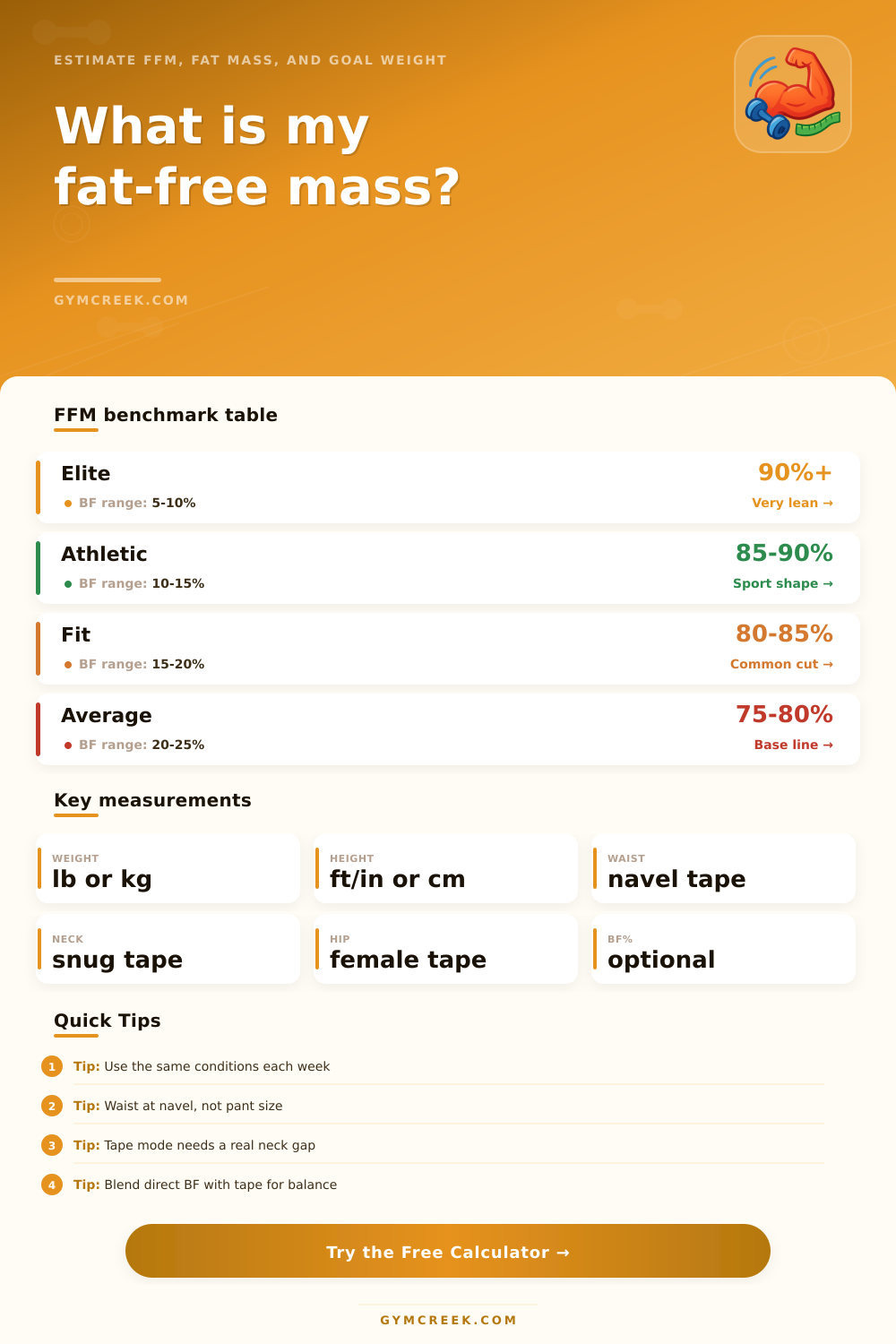
| Tier | Men BF % | Women BF % | FFM share note |
|---|---|---|---|
| Essential | 2-5 | 10-13 | Lowest safe reserve |
| Athletic | 6-13 | 14-20 | High FFM share |
| Fit | 14-17 | 21-24 | Balanced range |
| Average | 18-24 | 25-31 | Common adult range |
| Profile | Measurements | Expected FFM | Read |
|---|---|---|---|
| Cutting runner | lbm, waist, BF | Mid 130s | Light frame, lean cut |
| Strength female | kg, hip, BF | High 40s kg | Muscular lower body |
| Masters lifter | lb, neck, waist | Upper 150s | Dense adult build |
| Recomp beginner | cm, tape, BF | Varies by mode | Change over time |
Fat free mass is the weight without fat. You count it by subtracting the fat from the whole body weight. It is made up of organs, muscles and other parts that matter for growth.
Here is everything in the body that is not fat: muscles, bone, organs and water
What Is Fat Free Mass?
The body has a set ratio between fat and fat free mass. That includes muscles, cells, bones and body water. Everything that is not fat belongs to this group, although it depends most on muscles and bones.
You cannot lose fat free mass without losing muscles, bones or organs.
Occasionally you mix similar words. Historically lean body mass carried a bit of fat in the cells. Because of that you avoid this term, so you do not confuse it with other common words as lean mass, lean soft tissue or lean muscle mass.
FFMI is the abbreviation of fat free mass index. It measures muscles regarding height and weight. This index belongs to the group of body indexes, together with BMI and alike.
It helps to control the progress of strength training or diet change. For professional athletes and bodybuilders it replaces BMI to compare themslves with others.
Loss of fat free mass can cause sarcopenia, frailty and disability, especially in seniors. Physical movement helps to expand and preserve it in later life, just as increasing bone mass stops fractures.
When you lose more than 25 percent of weight through surgery or medicines, usually part of fat free mass is lost, including skeletal muscle. You commonly ignore that, which hurts metabolism and risks obesity with sarcopenia. High protein time-restricted eating together with resistance training burns fat while protecting fat free mass.
While losing weight you intend to reduce fat and preserve or expand fat free mass as muscle and bone. Expressing them as percentages of weight is not always reliable. Tall ill folks with protein-absence can have values alike to fed short people.
Good target is 2 grams protein for kilo fat free mass, for support and preserve muscles.