BMI Calculator Muscle Mass
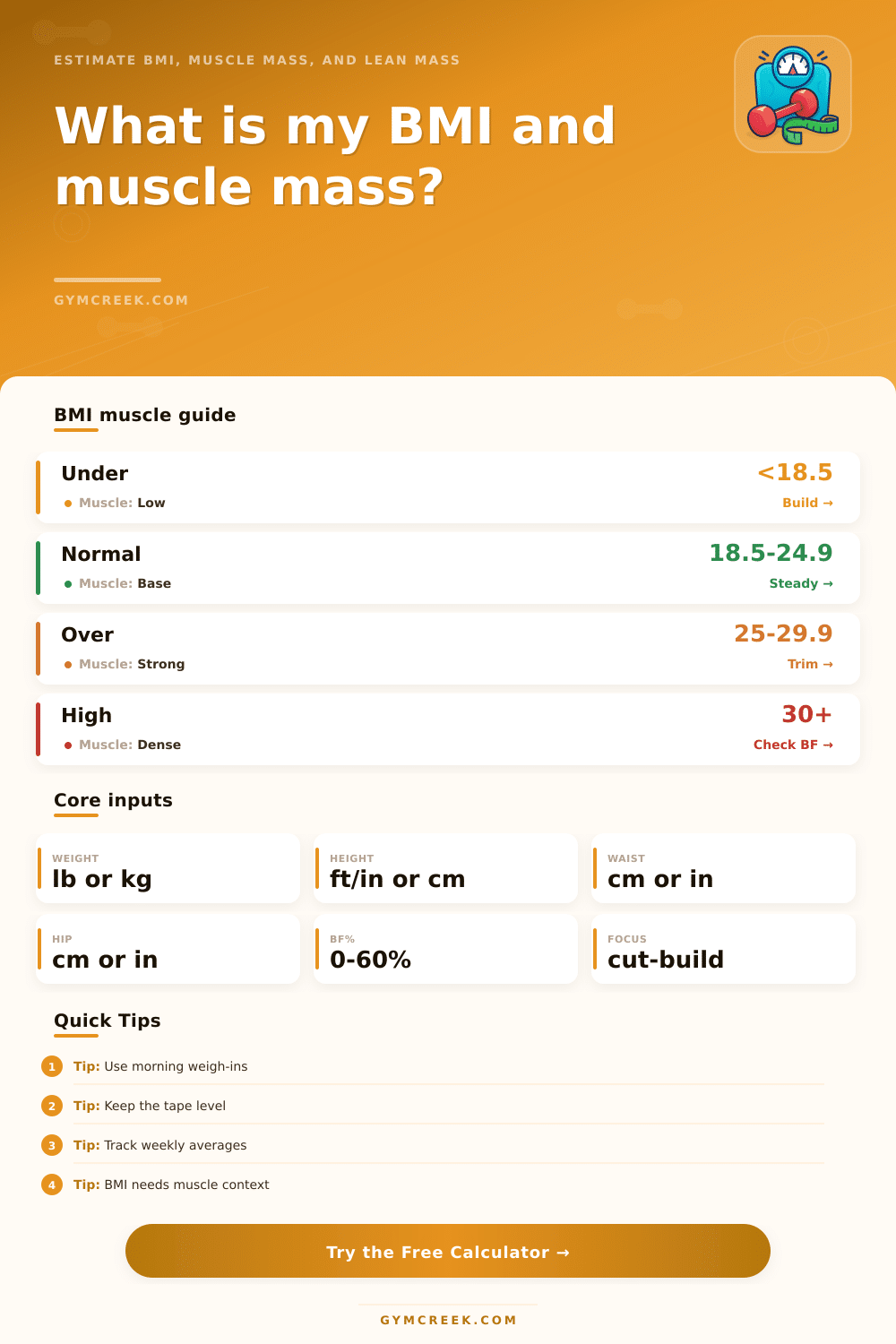
Estimate BMI, body fat context, lean mass, and muscle mass with a BMI-first calculator that blends anthropometric formulas with practical training focus.
| Band | BMI | Muscle clue | Reading |
|---|---|---|---|
| Underweight | <18.5 | Usually low | Needs fuel and size |
| Normal | 18.5-24.9 | Base to strong | Context matters here |
| Overweight | 25-29.9 | Mixed picture | Can hide muscle |
| Obese | 30+ | Varies widely | Use body fat context |
| Profile | Typical build | Muscle share | Practical read |
|---|---|---|---|
| Lean runner | Light frame | 30-36% | Strong for size |
| Balanced lifter | Moderate mass | 36-42% | Good gym base |
| Strength athlete | Dense frame | 42-48% | High output build |
| Very muscular | Heavy frame | 48%+ | Rare and dense |
| Formula | Inputs | Output | Why it matters |
|---|---|---|---|
| BMI | Weight, height | kg/m2 | Baseline size index |
| Deurenberg BF | BMI, age, sex | Body fat % | Turns BMI into context |
| Lee male SMM | Weight, waist, hip, age | Skeletal muscle kg | Anthropometric muscle estimate |
| Lee female SMM | Weight, hip, age, height | Skeletal muscle kg | Anthropometric muscle estimate |
| Conversion | Factor | Changes | Use here |
|---|---|---|---|
| lb to kg | 0.4536 | Body weight | BMI and muscle math |
| in to cm | 2.54 | Tape and height | Measure in metric |
| ft / in to cm | 30.48 + 2.54 | Height | Build BMI inputs |
| kg to lb | 2.2046 | Display only | Show both systems |
Muscle mass decides the weight and size of muscle tissue in the body. It forms part of the lean body mass that also includes skin, bones, water and organs. Skeletal muscles make up 30% to 40% of the total body mass.
They are those that attach to bones and allow many kinds of moves and activities. Skeletal muscle is for voluntary movements, while total muscle mass includes all muscle tissue, including smooth and cardiac muscles
What Is Muscle Mass and How to Build Muscle
Keeping a healthy amount of muscle mass matters for health and quality of life. Muscle helps in metabolic processes, stops injuries and supports brain activity. You commonly call muscles the engine of the body because they burn a lot of calories.
Bigger muscle mass helps to reduce body fat, strengthen the imune, improve energy and lower stress. More muscles also mean more calories burned during sport, rest or any moment.
Muscle mass and quality depends on a process of remodeling. The function of muscles bases on amount and quality of muscle protein. Aging brings loss of skeletal muscle mass, especially in the lower body after the 50th year of life.
Physical exercise indeed expands muscles.
Build muscles requires patience. The muscle increase happens slowly, and most of folks reach only 0.5 until 2 pounds in the first year of regular training. Two pounds per month surpass the possibility of natural folks.
Eating at a calorie surplus helps to get muscles. The body requires enough fuel for muscle construction. Gaining mass on calorie deficit is possible only for newcomers with excessive body fat.
Proteins are needed for muscle increase. Weightlifting creates tiny tears in the muscles. Eating protein, the body breaks it into amino acids to fix those tears.
Good goal amount is 0.8 until 1 grams of protein for pound of lean body mass.
Compound exercises as bench press, squats, deadlifts and military press best help to get mass. A program that starts at 50-60% of the maximum individual rep and progress to 80-90% for few reps build strength and muscles. Always lift the heaviest weight that you can while you reach the intended reps.
Muscle increase happens when muscles spend more time under tension. Range rep amounts, of heavy few reps until lightweight many reps, maximizes the muscle stimulus. Cycle training methods help to keep the sessions fresh and fun.
Body recomposition is a long process to turn fat into muscles. It requires attention to nutrition, training plans and lifestyle. Every body has its own makeup, so there doesnot exist a universal method for it.