Waist to Hip Ratio Calculator
Measure WHR, WHtR, and target bands from real tape values.
📋Preset starts
⚙Calculator
📈Fitness markers
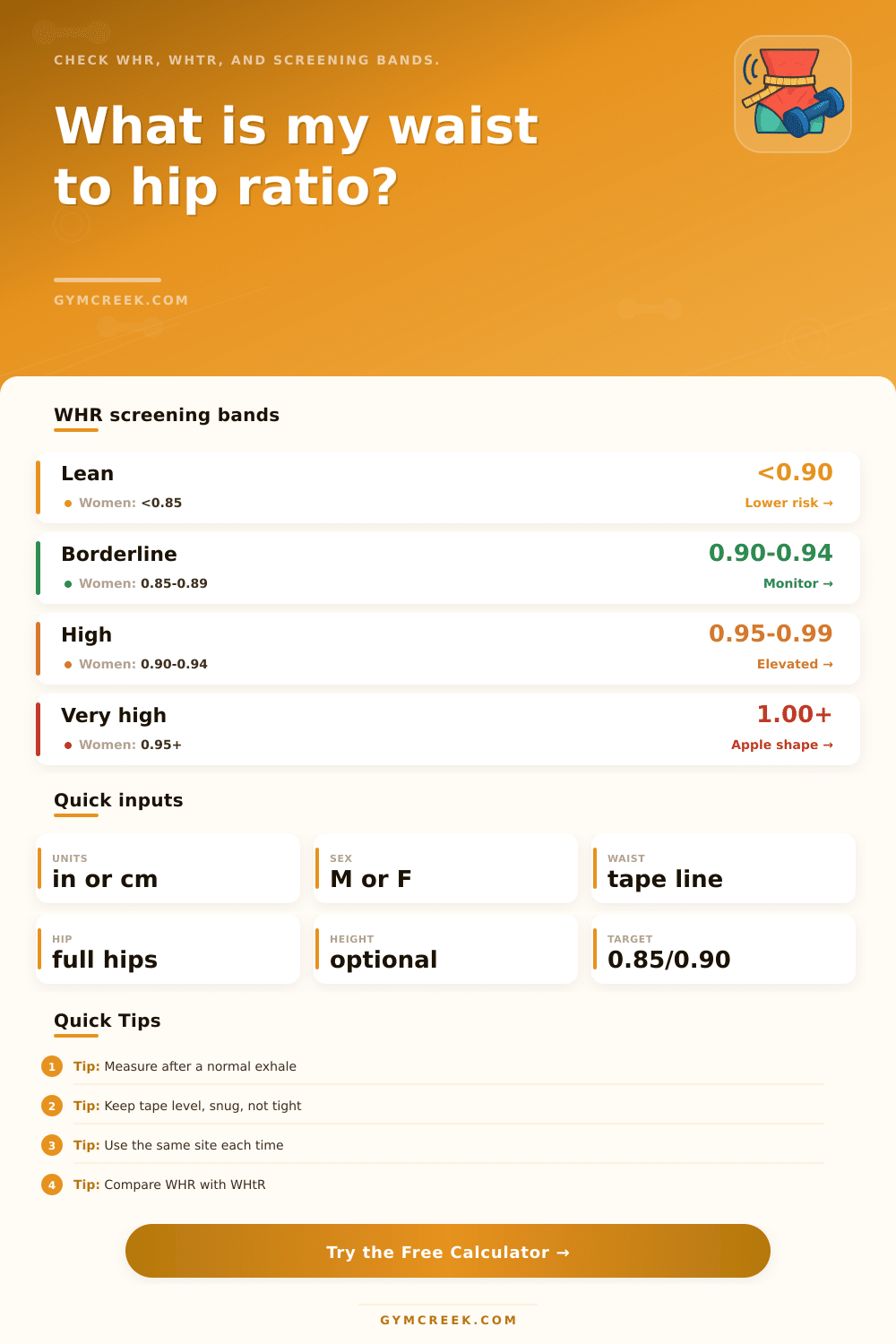
📑WHR bands
| Band | Men | Women | Meaning |
|---|---|---|---|
| Lean | Under 0.90 | Under 0.85 | Lower central load |
| Borderline | 0.90 to 0.94 | 0.85 to 0.89 | Track closely |
| High | 0.95 to 0.99 | 0.90 to 0.94 | Central gain is rising |
| Very high | 1.00 or more | 0.95 or more | Strong apple shape signal |
📝Measurement sites
| Site | Where to measure | Why it matters | Common use |
|---|---|---|---|
| WHO waist | Midpoint between last rib and iliac crest | Standardized research method | Global screening |
| NIH waist | Top of iliac crest | Used in many U.S. surveys | Clinical records |
| Hip | Fullest part of buttocks | Needed for WHR | Ratio calculation |
| Tape check | Horizontal, relaxed, after exhale | Reduces reading error | Every measurement |
📝WHtR guide
| Band | WHtR | Risk note | Use |
|---|---|---|---|
| Healthy | Under 0.50 | Common target line | Routine tracking |
| Watch | 0.50 to 0.59 | Central load is rising | Check trends |
| High | 0.60+ | Higher cardiometabolic risk | Talk to a pro |
| Simple rule | Waist < half height | Easy screen for adults | Quick check |
📝Waist cutoffs
| Reference | Men | Women | Note |
|---|---|---|---|
| U.S. high risk | >102 cm / 40 in | >88 cm / 35 in | NHLBI cutpoint |
| WHO action point | >94 cm / 37 in | >80 cm / 31.5 in | Common global screen |
| Lower caution | 94 to 102 cm | 80 to 88 cm | Watch the trend |
| Higher caution | At or above max | At or above max | Review with care |
💬Tips
⚠Disclaimer
Use this waist to hip ratio calculator to compare WHR, WHtR, and target thresholds fast. Keep the same tape points, then track whether your shape balance moves toward the target.
The waist-to-hip ratio, or WHR, shows the relation between the waist circuit and that of the hips. You count it dividing the waist circumference by the hips. For instance, if some have waist of 28 inches and hips of 35 inches, the result is 0.8 the person with 34-inch waist and 40-inch hips reach 0.85.
WHR estimates better the amount of visceral fat in the belly region than usual measures like BMI. The fat around the abdomen compared to the hips points risks for various diseases. When the proportion grows, that commonly shows fat at the waist, which can expand the chance for heart disease or diabetes.
Waist-to-Hip Ratio: What It Is and How to Measure
For you to count the WHR, you must estimate the circut of waist and hips. Measure the waist one inch above the navel or in the narrowest spot under the ribs after a full sigh. The hip circumference goes at the broadest butt part, with tape alongside the floor.
For women healthy WHR stays under 0.80, ideally under 0.75. The World Health Organization considers 0.9 or less healthy for men and 0.85 or less for women. For both sexes a report of 1.0 or more expand risk for heart disease and other problems.
Men with waist-to-hip ratio above 1.0 had 75 percent higher death rate than those with 1.0 or less.
Small waist-to-hip report says that the waist is relatively small compared to hips. Pear shaped folks with little fat around organs have very low risk, even if heavy. Apple shaped bodies on the other hand usually show high danger.
Genetics play a lead, because it fixes the pelvic width. But heavy complex lifts do that buttocks and thighs grow much more than the side abs. Increase quadriceps and shoulders help the waist seem slimmer.
Run and strength training can improve the proportion over time.
The waist-to-hip report well measures health, but once estimate it without additional control do not help a lot. During the health travel, note changes in the report and other improvements. Proportion around 0.7 commonly goes with the typical hourglass or pear pattern.