Rowing Split Calculator
Convert split pace into watts, projected race times, and watts per kilogram for 2k tests, steady rows, and training plans.
Results Snapshot
Current split, watts, race projections, and watts per kilogram update together so you can compare pacing choices quickly.
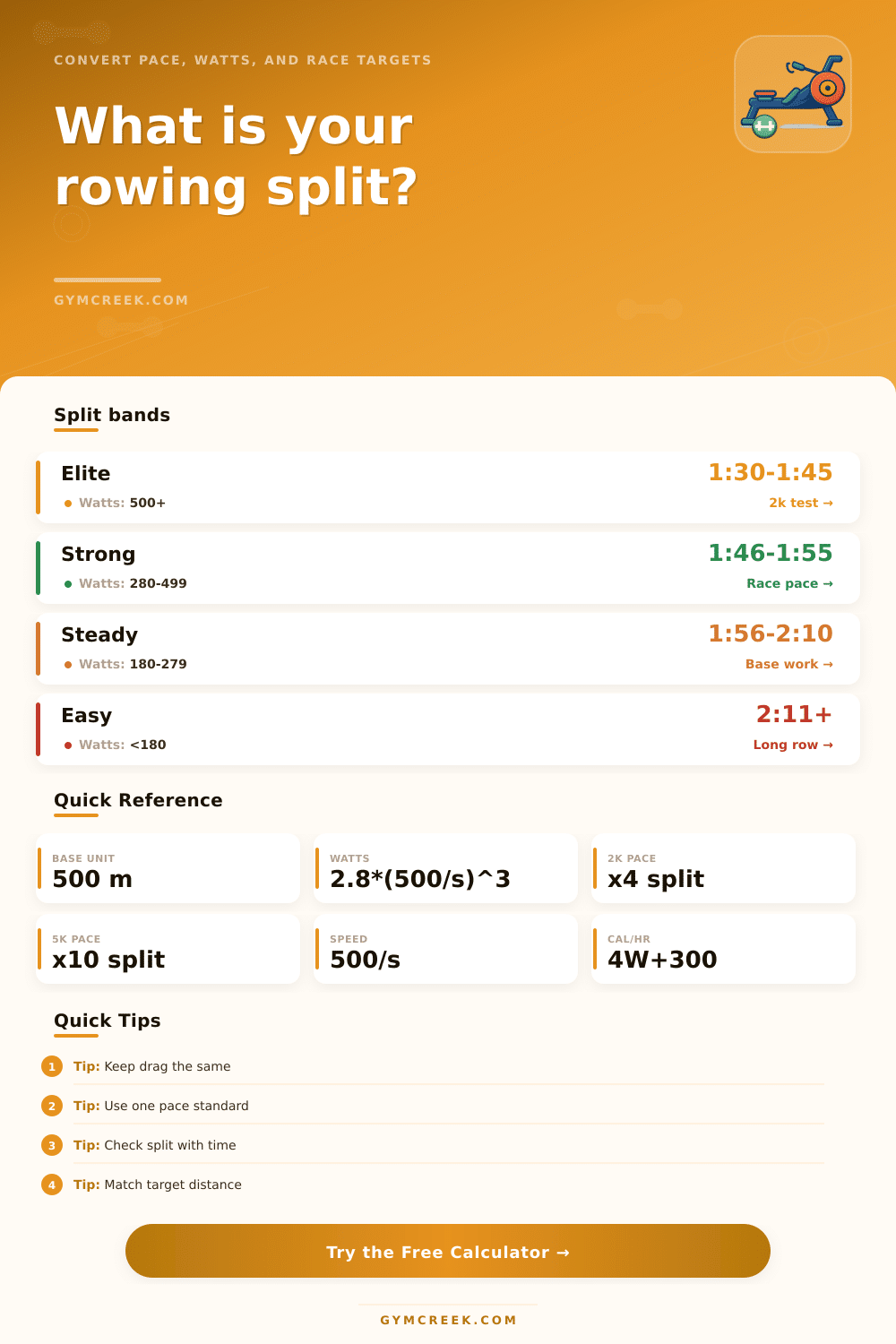
| Band | Split | Watts | Use |
|---|---|---|---|
| Elite | 1:30-1:45 | 500+ | 2k test |
| Strong | 1:46-1:55 | 280-499 | Race pace |
| Steady | 1:56-2:10 | 180-279 | Base work |
| Easy | 2:11+ | <180 | Long row |
| Session | Split | Row length | Note |
|---|---|---|---|
| 2k test | 1:40-1:50 | 2000 m | Benchmark |
| 5k row | 1:55-2:05 | 5000 m | Aerobic |
| 30 min | 2:00-2:15 | 7.0-8.0 km | Steady |
| Recovery | 2:15+ | Easy pace | Low load |
| Formula | Use | Output | Note |
|---|---|---|---|
| Watts = 2.8 * (500 / split)^3 | Split to power | Watts | Concept2 style |
| 2k time = split x 4 | Race projection | 2k finish | Same split |
| Time = distance x split / 500 | Target distance | Race time | Distance based |
| W/kg = watts / body mass | Relative power | W/kg band | Size adjusted |
Use this rowing split calculator to translate erg pace into watts, projected race times, and watts per kilogram so you can compare steady rows, benchmark tests, and race plans with less guesswork.
The split for 500 metres is one of the most important measures to understand when you use a rowing machine It shows your pace as time. The split shows how much time you need to row 500 metres. This is like a runner who says he runs an “eight-minute mile”.
The lower your split, the faster you go.
What the 500m Split Means on a Rowing Machine
The Olympic rowing race distance is 2000 metres. Many athletes split it in their minds into four parts of 500 metres each. So if the split is 1:30, it means that 1 minute and 30 seconds is needed for every 500 metres during the whole distance.
For a 2000-metre row in a 1:30 split, you need 1 minute and 30 seconds for each of the four segments of 500 metres.
In the rowing world you usually show intensity by the split for 500 metres. It shows how fast the boat would finish 500 metres at the current intensit. Sometimes you use watts or calories per hour.
The erg machine measures the power that you put in the handle and from that counts the time for 500 metres.
For most folks the pace for 500 metres should fall between 1:30 and 2:30. If it is over 2:30, that could be very slow. Even so each split works for beginners.
The main thing is to start at your current level and progress slowly. What is a good split depends on the training past, goals and the rowed distance.
In rowing you commonly measure fitness by the 2k, because it is the most common race distance. There are standards to reach as you progress, but they do not really matter unless you plan to compete. You can row fast for a short time or slowly for a long duration.
Negative splits show that you go slowly more fast during the workout. For instance start at 1:44 and lower the split for every 500 metres. If there is energy in the tank, it is good to lower it for the last 1000 metres.
Good technique helps to reach lower split times and cover more distance in less time because you avoid waste and generate more power. Technique often limits you, without it you can hardly keep a good split for a long time. Drills like legs-only rowing or the reverse pick drill help a lot with the drive sequence.
It also matters to keep the back straight, just like on a cable row machine.
Progress happens after enough time. Lowering the average split from around 2:38 to 2:12 is good improvement thanks to regular training. You can plan to lower it to 2:30, then to 2:15 and finally to 2:00, with a dream target of 1:45.
Such progress can take someyears.