🏋 Wilks Calculator for Deadlift
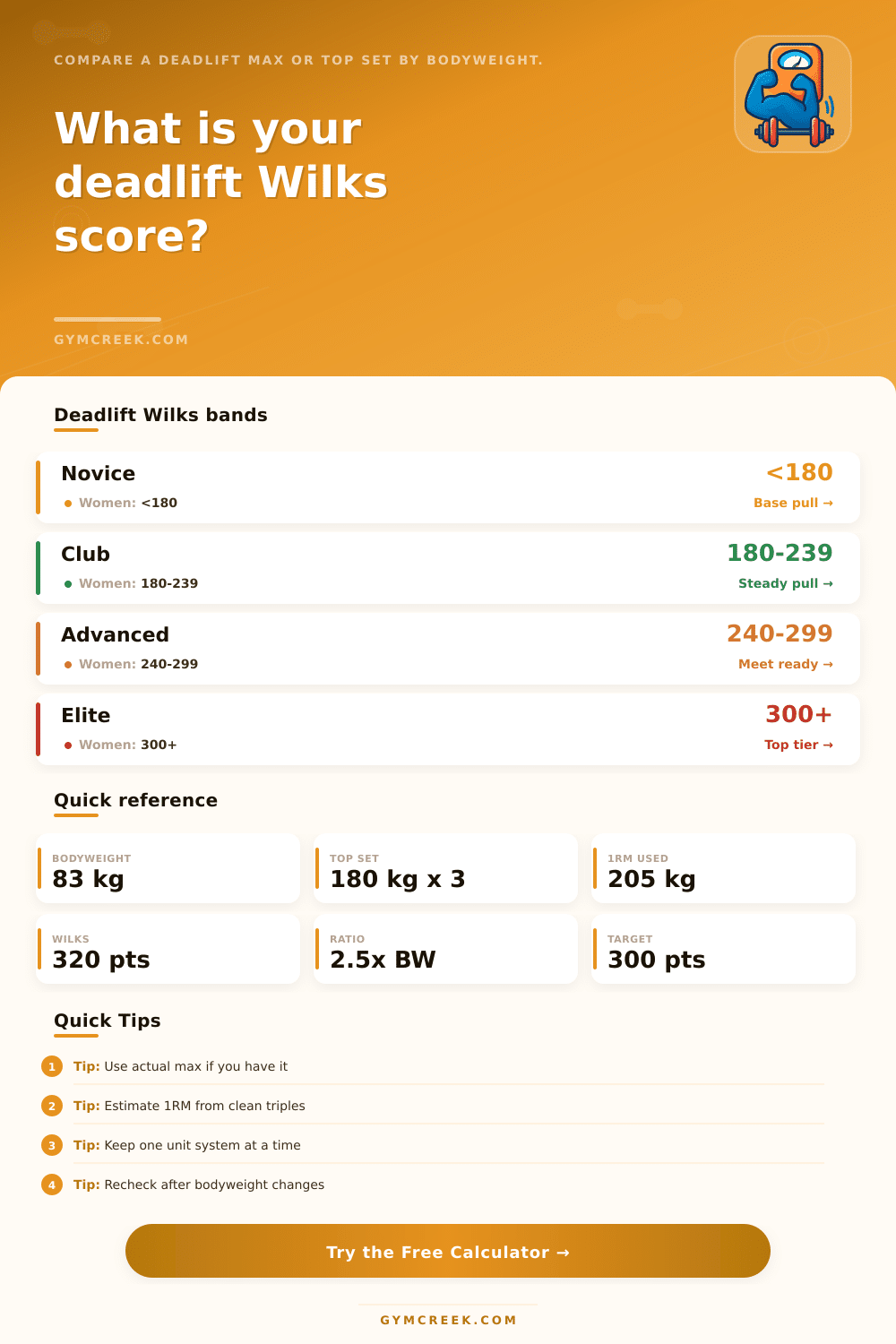
Estimate a deadlift top set, then compare an estimated 1RM, Wilks score, bodyweight ratio, and target deadlift.
💪 Deadlift Presets
Presets load clean top sets, not warmups. Use them as a deadlift starting point, then refine with your own training history.
📝 Deadlift Inputs
🏋 Top-Set Deadlift
💪 Primary deadlift set
💥 Top set projection
🔥 Target score and buffer
Enter a primary deadlift set, a top set, and a target score. The calculator turns the lift into a projected 1RM before scoring it with Wilks.
📈 Breakdown
📊 Fitness Metrics Grid
📑 Reference Tables
| Reps | Load % | Use it for | Best cue |
|---|---|---|---|
| 1 | 100% | True single | Meet max |
| 3 | 93% | Top triple | Peak work |
| 5 | 86% | Heavy set | Strength base |
| 8 | 79% | Back-off set | Fatigue check |
| Band | Men | Women | Meaning |
|---|---|---|---|
| Novice | 1.25-1.75x | 1.0-1.5x | First total |
| Club | 1.75-2.25x | 1.5-2.0x | Regular meet |
| State | 2.25-2.75x | 2.0-2.4x | Strong build |
| National | 2.75x+ | 2.4x+ | PR chase |
| Attempt | % of 1RM | Purpose | Risk level |
|---|---|---|---|
| Opener | 88-92% | Secure lift | Low |
| Second | 95-98% | Build pull | Moderate |
| Third | 100-103% | PR attempt | High |
| Reserve | 104-105% | Elite day | Very high |
| Metric | Formula | Use case | Notes |
|---|---|---|---|
| 1RM | W x (1 + R/30) | Top set | Epley style |
| Deadlift | D only | Single lift | Core score |
| Wilks | 500 x T / C | Class compare | Sex specific |
| Deadlift Wilks | 500 x T / C | Single lift | Bodyweight adj |
💬 Deadlift Notes
⚠ Disclaimer
DISCLOSURE: This post may contain affiliate links, meaning when you click the links and make a purchase, I receive a commission. As an Amazon Associate I earn from qualifying purchases.

The Wilks score is a number that estimates relative strength in powerlifting. You count it from the total weight and bodyweight. The total is made of the maximum weight in the squat, bench press and deadlift.
You multiply that total by a special Wilks coefficient that changes with bodyweight and gender. Like this you can fairly compare lifters with very different bodies
What is the Wilks score?
Before the Wilks score many powerlifting federations used other methods, as the O’Carroll and Schwartz formulas. Even now some federations apply different ones, for example the Glossbrenner or Siff coefficient. Although it is not perfect, the Wilks coefficient stays heavily used in powerlifting contests globally, especially by the International Powerlifting Federation.
You rebuke is, that it can oppose heavier men and women in the deadlift. Wilks bases on totals, so it ignores bad individual lifts. In bench press it blesses the heavy lifter, while in deadlift it favors the lightweight.
In push-pull contest that could self balance.
The Wilks coefficient lays bigger weight on absolute strength than only on relative strength regarding bodyweight. For instance, a male athlete of 320 pounds with total of 1400 pounds reaches normalized weight of 353.0. A lifter of 200 pounds with total of 1000 pounds has only 288.4.
The 320-pounder wins, although the lightweight indeed raised five times his body, while the heavy only 4.375 times.
Hence deadlifting 700 pounds at 148 pounds is much more impressve than at 300 pounds. Someone of 100 pounds, that deadlifts 300, matches to that of 300 pounds with almost 800. You simply can not compare them likewise, and hence powerlifting introduced the Wilks formula.
To count Wilks points, you multiply the coefficient by the individual or total lift. Wilks calculator simplifies that. Choose gender, units (kilos or pounds), enter bodyweight and the total of the three big lifts.
Wilks2 is a new version, that settles some problems of the original, for more precise comparisons through big bodies. Also gear matters. Wraps and a special deadlift bar add weight to the total, what strongly affects the final Wilks points.