💪 Leg Press to Deadlift Calculator
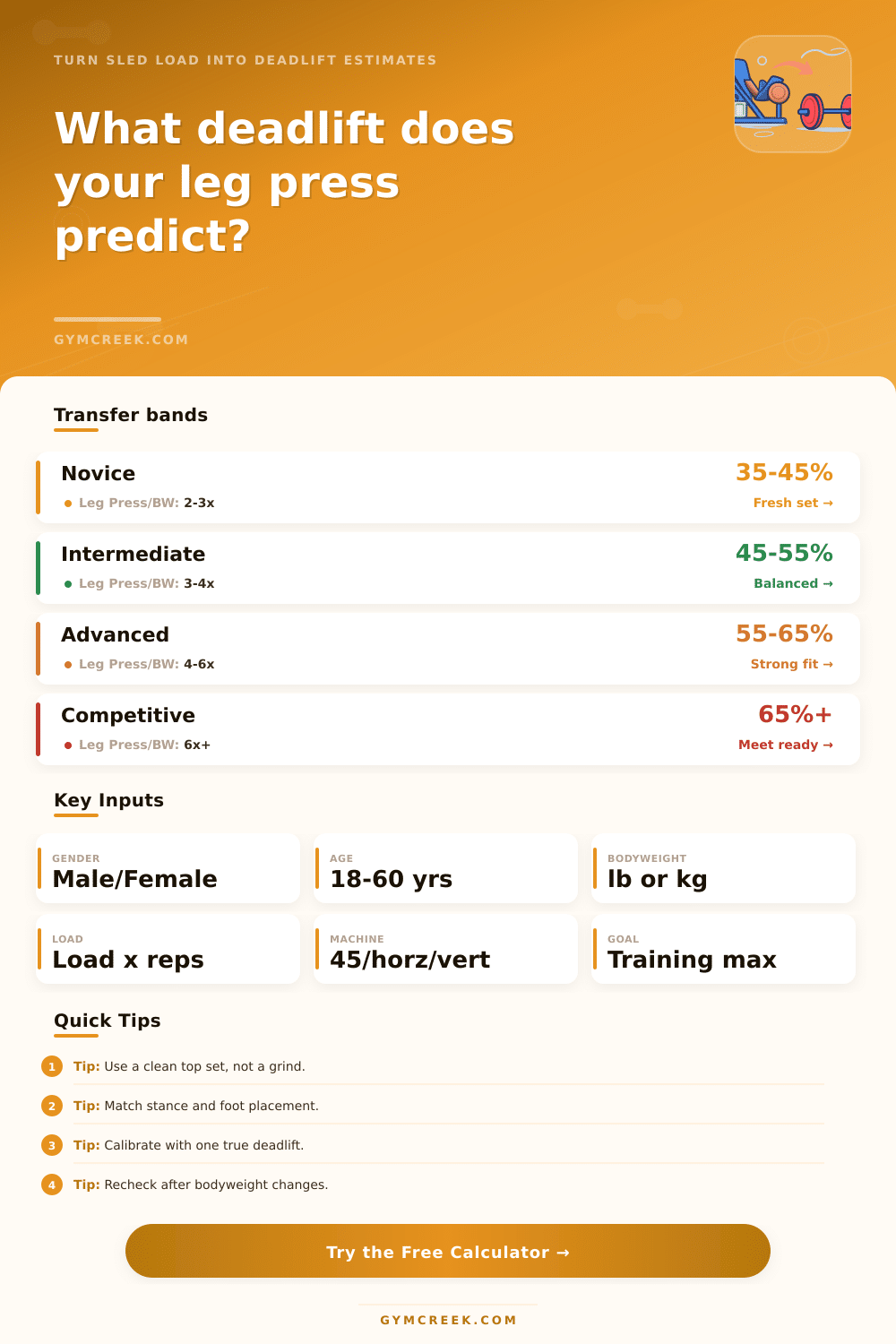
Estimate conventional, sumo, and trap-bar deadlift carryover from your leg press work using machine setup, stance, and training context.
💪 Preset Scenarios
These presets mix body types, training levels, and machines so you can see how the estimate shifts in real gym situations.
📝 Athlete Inputs
🏋 Press Setup
⚙ Machine setup
💪 Deadlift profile
🏋 Leg press top set
Use the best repeatable working set. The calculator converts that set into a projected deadlift 1RM, then adjusts for stance, machine angle, and goal.
Calculation Breakdown
📊 Fitness Metrics Grid
📖 Reference Tables
| Machine | Base factor | Angle cue | What it means |
|---|---|---|---|
| 45-degree sled | 0.60 | Near 45 deg | Most common setup. |
| Horizontal sled | 0.56 | Near 0 deg | Usually feels direct. |
| Vertical sled | 0.52 | Near 90 deg | Strict machine loading. |
| Single-leg press | 0.49 | Stable stance | More balance demand. |
| Reps | Approx % | Best use | Reliability |
|---|---|---|---|
| 1 | 100% | True max | High |
| 3 | 93% | Heavy triple | Very high |
| 5 | 86% | Strength set | High |
| 8 | 79% | Work set | Moderate |
| Style | Factor | Carryover | Best cue |
|---|---|---|---|
| Conventional | 1.00 | Baseline | Hip hinge |
| Sumo | 0.97 | Wide stance | Adductor drive |
| Trap-bar | 1.08 | More upright | Leg drive |
| Deficit pull | 0.93 | Longer ROM | Start tight |
| Profile | Setup | Expected range | Why it works |
|---|---|---|---|
| Novice builder | 45-deg, standard | Low-mid | Skill is still rising. |
| Hypertrophy phase | High reps, wide | Mid | Volume boosts carryover. |
| Power meet prep | Heavy, direct | Mid-high | Specific practice matters. |
| Return from break | Light, steady | Lower | Confidence is reduced. |
💬 Practical Tips
⚠ Disclaimer
The leg press and the deadlift are two famous exercises that work different parts of the lower body. They can not substitute one for the another. Deadlifts strongly use the hamstrings, glutes, spinal erectors, lats and core.
Rather, the leg press is a machine push move that isolates quadriceps, glutes and hamstrings while it less requires the upper body. Thanks to the back support, you can better focus on the legs
Leg Press and Deadlift: How They Help Your Legs
Powerlifters commonly use leg press in their program. It helps grow muscle in the lower body and strengthen quadriceps for squat and deadlift. Best it unrolls the leg press against the soil during deadlift.
Although it strengthens quadriceps, for squat it helps less. Heavy leg presses well answer for the first phases of deadlift.
Numbers in leg press usually are much bigger, because it specifically isolates the legs. The athlete sits flat and steady. It is normal to deadlift much less than you press with legs.
The movement scope for legs is broader here, and it more stresses quadriceps.
Leg presses do build leg muscle and force, but they bad transfer to deadlift, if you do not practice it. For good conventional deadlift, imagine that you press the ground away with the legs. That helps to lift yourself off the soil, with emphasis on hip tension instead of main knee move.
Legs move according to various modes, but the main are squat and hinge. Leg press is like squat, but at least a bit of hinge is needed. For instance deadlift, hip thrust or Romanian deadlift.
Combining leg press and deadlift, you well cover the front and back of legs. The leg press hits the quadriceps as if squat, while deadlift hits the lower back, glutes and hamstrings.
Leg press keeps legs strong during rehabilitation of lower back. It risks less injuries and is simpler to learn than deadlift. Wrong deadlift can cause severe back injuries.
You occasionally call it the little brother of the barbell squat.