🏃 RPE Running Pace Calculator
Convert your Rate of Perceived Exertion (Borg scale) to target heart rate and estimated running pace
Your RPE-Based Training Data
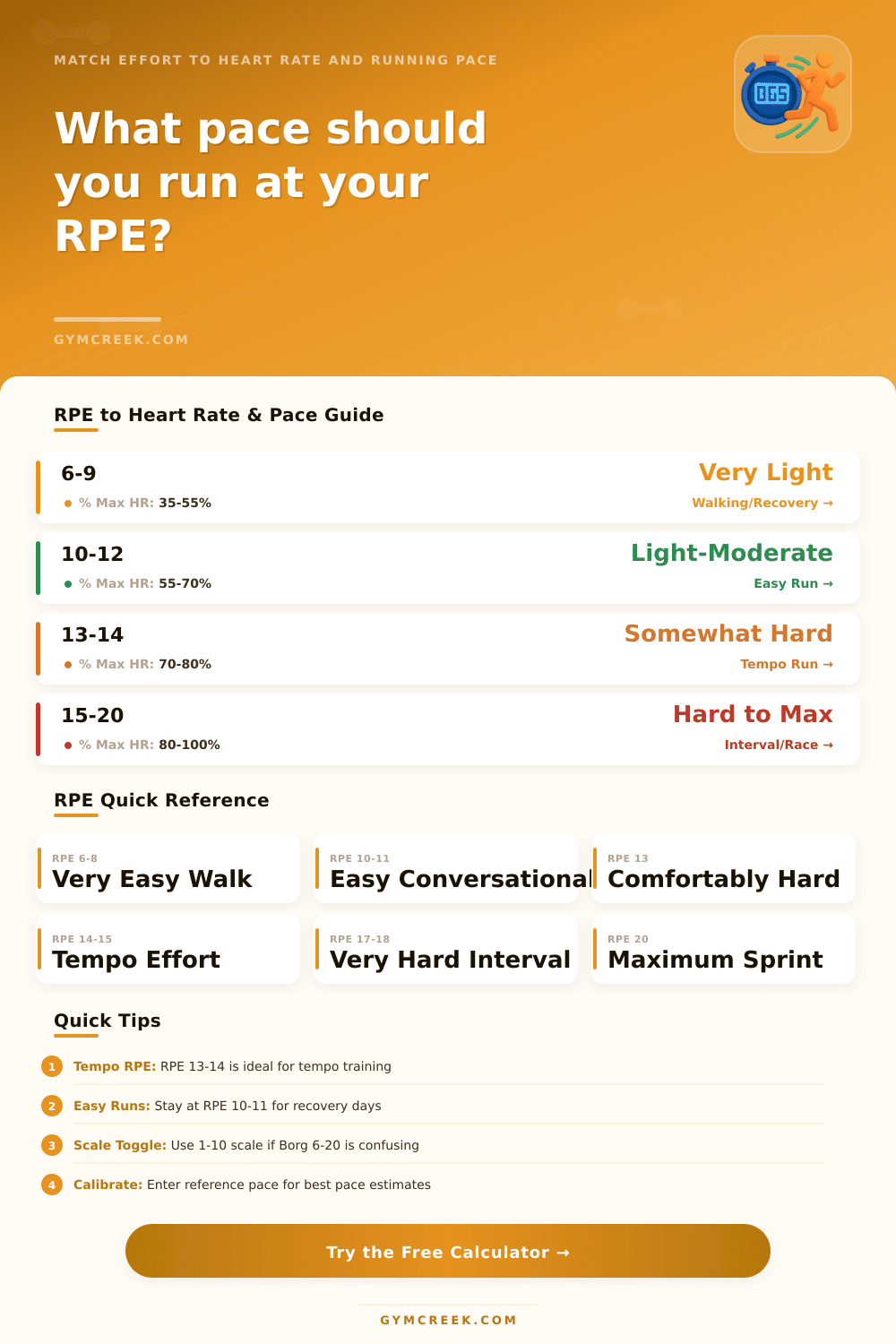
| RPE | Description | % Max HR | Typical Activity |
|---|---|---|---|
| 6 | No exertion at all | ~35% | Complete rest |
| 7–8 | Extremely light | 35–45% | Very slow walk |
| 9 | Very light | 45–50% | Leisurely walk |
| 10 | Light | 50–55% | Easy stroll |
| 11 | Fairly light | 55–65% | Easy run, conversational |
| 12 | Moderate | 65–70% | Steady easy run |
| 13 | Somewhat hard | 70–75% | Comfortable tempo |
| 14 | Between somewhat hard and hard | 75–80% | Tempo run effort |
| 15 | Hard | 80–85% | Threshold run |
| 16 | Between hard and very hard | 85–90% | 10K race effort |
| 17 | Very hard | 90–93% | 5K race effort |
| 18 | Between very hard and max | 93–95% | Hard interval |
| 19 | Extremely hard | 95–98% | Near-max sprint |
| 20 | Maximum exertion | ~100% | Absolute max sprint |
| RPE 1–10 | Borg Equiv. | Running Description | Training Use |
|---|---|---|---|
| 1–2 | 6–8 | Very easy, barely moving | Active recovery |
| 3 | 9–10 | Easy, could sing | Long slow distance |
| 4 | 11–12 | Comfortable, full sentences | Easy aerobic run |
| 5 | 13 | Comfortably hard, short phrases | Tempo warm-up |
| 6 | 14 | Somewhat hard, few words | Tempo run |
| 7 | 15–16 | Hard, one word answers | Threshold intervals |
| 8 | 17 | Very hard, breathing labored | VO2 max intervals |
| 9 | 18–19 | Extremely hard | Short hard intervals |
| 10 | 20 | Maximum effort | Sprint / race finish |
Easy running pace shows the time that one needs to cover a certain distance. A simple formula helps: one divides the time by the run distance. For instance, if 30 minutes are enough for 5 km., then the average running pace is 6 minutes per kilometer.
Such 6 min/km. Matches around 10 km./h. Runners usually plan their training and measure the output according to that running pace.
Easy Running Pace and Simple Training Tips
One does not need a special watch to measure the running pace. Average stopwatches work well. Just note how many time the first kilometer takes, and that value gives the running pace per kilometer.
Online there are also fast calculators, that are free. They measure running pace, time or distance, when one enters values for two of those numbers. Some of them include all typical contests, from 5 km.
To ultramarathon, and show expected final times and split times, if one points wanted running pace. Those tools work by multiply the running pace with the distnace, to project the whole time.
There is no single “ideal” running pace. What some person reaches in one week, can differ from the next. The running pace depends on age, sex, training level, weight and general fitness.
A chart of running pace against age usually drops during the years. New runners commonly have times more than 15 minutes per mile, and that is entirely fine to get past the initial troubles.
Running at easy running pace is comfortable and allows talking. It usually sits between 59 and 74 percent of VO2max, or 65 to 79 percent of the maximum heart rhythm. That easy running pace adjusts daily according too the feelings of the person, together with weather and ground.
One can run 80 percent of the total miles at easy running pace, and the other 20 percent at more intense speedwork-type. Regular running with balanced training brings progress over time.
Tempo running pace beats steady effort. It belongs to mid-hard range, that expert runners can keep for around 3 to 4 miles, before they must slow. Running at 5k running pace is almost without oxygen, while 10k running pace is more aerobic and steady effort.
For newcomers it matters to start with slow runs. A mix of running and hiking helps at the start. For instance, trot during a quarter of a mile, later walk during half of a mile and repeat.
The running pace should be so slow, that one does not stay without breath. Over time one extends the distance, say by 500 metres each week during the long run, to build fitness over time. Slow also means to cover longer ways.
Amateur runners are on average 14 percent slower during self-paced effort than when therunning pace is controlled outside.
Starting more slowly than planned and ending more quickly is good tactics for racing. The mind commonly urges to start too quickly, but ending without energy shows the benefit of patience. Running volume deserves thought over time, not only by distance, because fast runners cover more ground in one hour than slow ones do.