🔥 Body Recomposition Protein Intake Calculator
Calculate your protein and calorie targets to lose fat and build muscle simultaneously
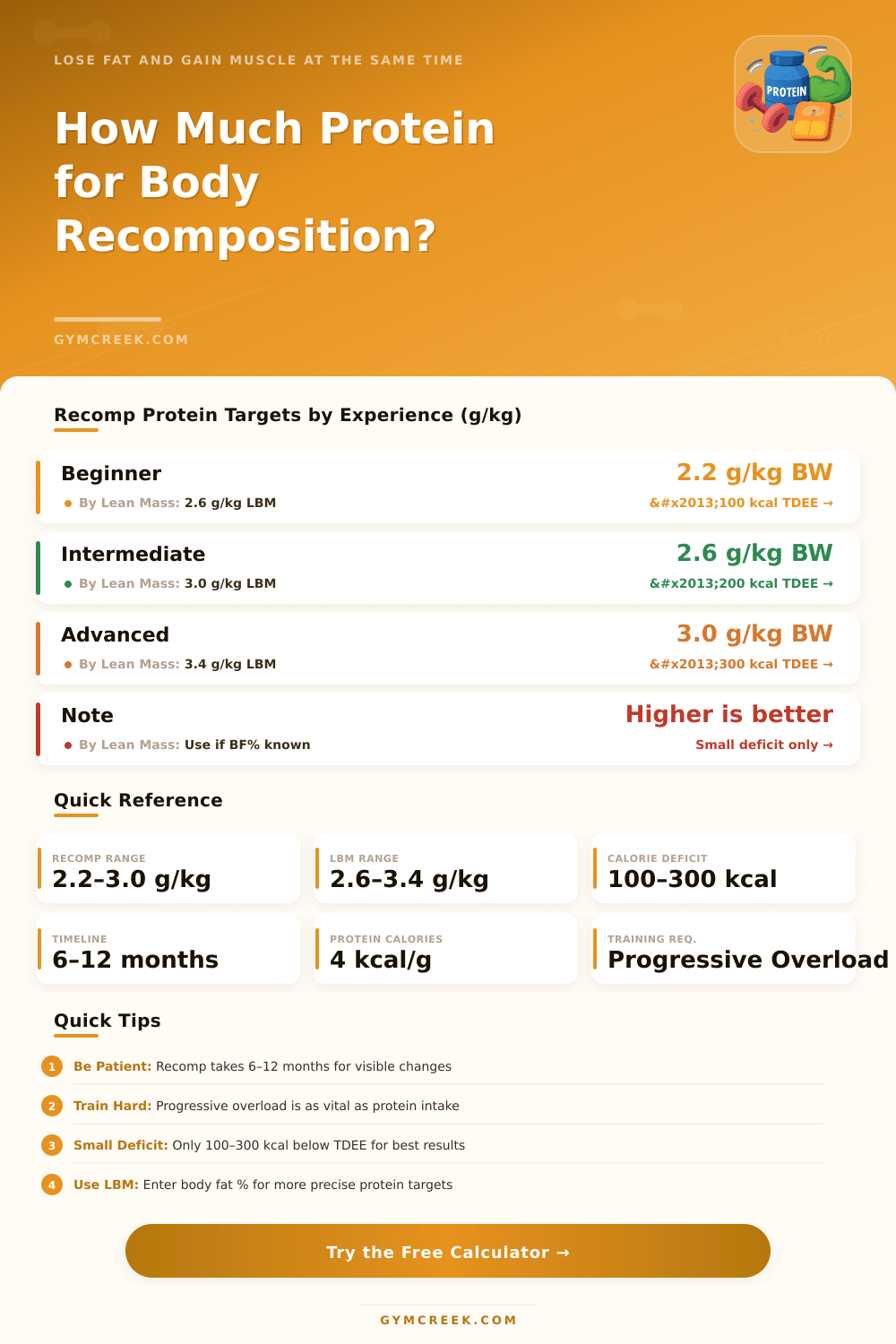
| Experience | By Body Weight | By Lean Mass (LBM) | Why Higher? |
|---|---|---|---|
| Beginner | 2.2 g/kg BW | 2.6 g/kg LBM | High anabolic sensitivity; protein directs growth |
| Intermediate | 2.6 g/kg BW | 3.0 g/kg LBM | More stimulus needed to drive adaptation |
| Advanced | 3.0 g/kg BW | 3.4 g/kg LBM | Maximizes MPS at near-genetic ceiling |
| All Levels | Min 2.2 g/kg | Min 2.6 g/kg LBM | Higher than bulk or cut alone — recomp demands more |
| Strategy | Deficit Size | Expected Rate | Best For |
|---|---|---|---|
| Minimal Deficit | –100 kcal TDEE | Very slow (0.05 kg/wk fat) | Beginners, high muscle gain priority |
| Moderate Deficit | –200 kcal TDEE | Slow (0.1 kg/wk fat) | Most recomp trainees — optimal balance |
| Standard Deficit | –300 kcal TDEE | Moderate (0.15 kg/wk fat) | Higher BF%, intermediate/advanced |
| Aggressive Cut | –500+ kcal TDEE | Fast — but muscle loss risk | NOT recommended for recomp goals |
Body recomposition is the idea of losing body fats while building muscle mass. This is an alternative to bulking or cutting, instead aiming to change your body composition. Those looking to lose fat and gain muscle want to avoid the extremes of gaining or losing weight, thus, body recomposition is an ideal process for them. There are several factor that play into your ability to achieve body recomposition. However, one of the most crucial of these factors is the intake of protein. Protein is the cornerstone of body recomposition effort.
Finding the right amount of protein for your body recomposition efforts can make a significant difference in your outcome. Too little protein can cause your body to struggle to gain muscle. Conversely, taking in too much protein can prevent you from getting the carbohydrates your workouts requires for energy. To help find the perfect protein intake for your body, a body recomposition protein intake calculator is helpful in determining the proper amount of protein your body need based on your profile.

Body Recomposition Protein Intake Calculator
Understanding Protein Needs for Body Recomposition
When losing body fat and gaining muscle, your muscles have to work through a unique process. Your body contains an essential process known as muscle protein synthesis, which forms the basis of gaining muscle. Individuals that are losing fat and gaining muscle require higher intake of protein than those maintaining their muscles or adding muscle mass. The protein that you consume ensures that the muscle protein synthesis continues in the presence of a slight calorie deficit to encourage fat loss without muscle loss.
One of the best starting points for protein intake during body recomposition is leaning body mass. This is an accurate representation of lean muscle mass in the body rather than the total body weight. Two individual that weigh 180 pounds may have significantly different rates of body fat and lean mass. By calculating the lean body mass, the outcome will provide more accurate results than using total body weight as the starting point for calculating protein needs for body recomposition.
Another essential element that can be thrown into the equation of protein requirements for body recomposition is training experience. Individuals that are just beginning to train may require less protein per pound of body weight. This is due to the newbie gains phenomenon where the body respond dramatically to new training stimuli. However, more experienced athletes that find it more challenging to gain muscle with the same training stimuli may require more protein to encourage muscle growth.
An individual’s activity level will play a significant role in their protein intake. An individual that has a physically demanding job might require more protein than someone that sits at their desk all day. However, an individual that performs intense workouts three to four times a week might require more protein than an athlete performing six days a week or someone with an intense occupation. This is attributed to the concept of total daily energy expenditure (TDEE) which determine how the body utilizes the protein consumed.
An individual’s age can also play a significant role in their body protein needs. As individuals age, their bodies develop an anabolic resistance that makes it challenging for them to gain muscle with the same protein dose they could consume when they were in their twenties. Therefore, older individuals that wish to gain muscle may require higher intakes of protein with an even distribution throughout the day to increase the effectiveness of the protein intake for body recomposition.
The way that you distribute protein throughout the day can significantly impact body recomposition efforts. Consuming protein in meals or snacks every 4 to 5 hours will ensure that muscle protein synthesis can continue throughout the day. Each meal or snack should contain 20 to 40 gram of protein. With body recomposition, there is no significant calorie surplus to even out the protein synthesis between meals. Therefore, maintaining the synthesis is crucial for achieving the desired outcome of gaining muscle while losing body fat.
An individual may ask how much protein contains calories during the body recomposition phase. The body recomposition phase typically features a deficit of 100 to 300 calories per day. The protein intake will provide a significant portion of the calories needed daily. The remainder of the calories can go to the carbohydrates needed for the workouts to perform effective as well as the fats needed for hormone production to encourage muscle growth.
One of the mistakes that many individuals make when trying to gain muscle while losing body fat is taking in too little protein yet losing too many calories. Such a combination will result in the body wasting its muscle mass. Patience is the key to body recomposition. The results of body recomposition will take significant time to manifest themselves in the mirror. Using alternate ways of measuring your progress will provide a more accurate reflection of your body’s changes during the body recomposition phase than the scale alone.
Ensure the protein source contains the essential amino acids required to stimulate muscle protein synthesis. Consuming more protein from animal sources like chicken, turkey, lean beef, fish, eggs, and dairy products will provide all the amino acids needed. Similarly, the plant-based athlete can use various plant-based protein sources or supplements containing the essential amino acids to trigger muscle protein synthesis. The body recomposition protein intake calculator above will help you determine your protein intake target. However, using alternate methods of measuring your changes will allow you to fine-tune your protein intake for best results.

Protein is just one element of the body recomposition process. The other elements include the training you use to stimulate muscle growth and the sleep you get to allow your muscles time to recover. Even the best protein intake will make no difference if an individual does not incorporate the other two elements. Body recomposition is a complete process where protein, training, and sleep work together for the best results. While protein is the cornerstone of body recomposition, the other two elements are just as crucial to seeing changes in the body.
Body recomposition is a science and an art. The body recomposition protein intake calculator is a great starting point for determining the proper amount of protein for body recomposition. However, as with any other process, the outcome of your efforts is ultimately dependent on your ability to adjust the process according to the results your body produces. Therefore, continue to train with consistency and ensure you hit your protein target most days. Give your body recomposition phase time to work to reveal a leaner and stronger physique with reduced body fat and more defined muscle.