🏋 Dumbbell Bench One Rep Max Calculator
Estimate your 1RM for dumbbell bench press using your reps and weight — per dumbbell or combined
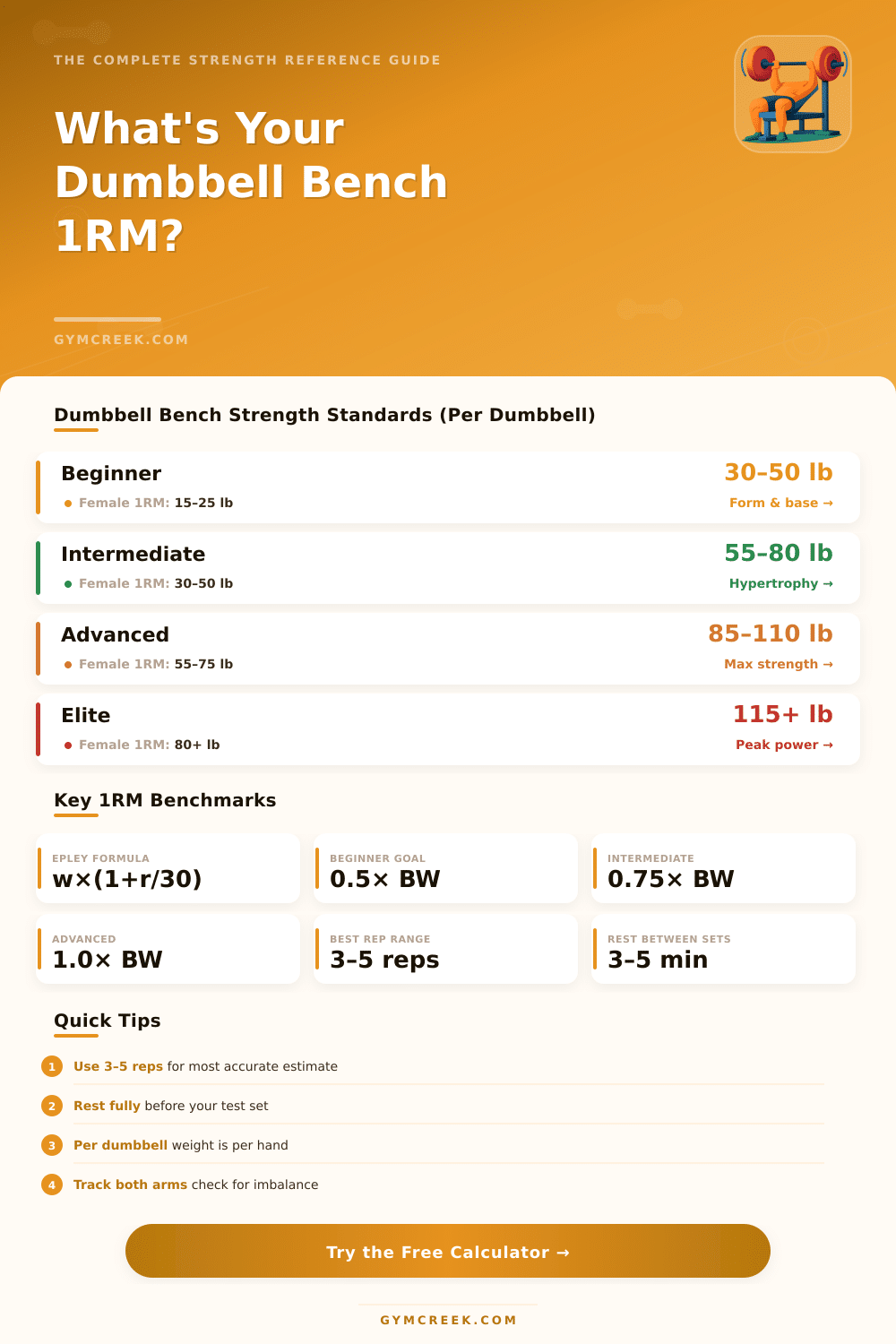
| Level | Male (lbs) | Female (lbs) | Male (kg) | Female (kg) |
|---|---|---|---|---|
| Beginner | 25–50 lb | 10–25 lb | 11–23 kg | 5–11 kg |
| Novice | 50–70 lb | 25–40 lb | 23–32 kg | 11–18 kg |
| Intermediate | 70–95 lb | 40–60 lb | 32–43 kg | 18–27 kg |
| Advanced | 95–120 lb | 60–80 lb | 43–54 kg | 27–36 kg |
| Elite | 120+ lb | 80+ lb | 54+ kg | 36+ kg |
| Reps | % of 1RM | Training Focus | RPE (Effort) |
|---|---|---|---|
| 1 | 100% | Max Strength Test | 10 / 10 |
| 2 | 97% | Near-Maximal Strength | 9.5 / 10 |
| 3 | 94% | Strength & Power | 9 / 10 |
| 4 | 92% | Strength & Power | 8.5 / 10 |
| 5 | 89% | Strength | 8 / 10 |
| 6 | 86% | Strength–Hypertrophy | 7.5 / 10 |
| 8 | 81% | Hypertrophy | 7 / 10 |
| 10 | 75% | Hypertrophy–Endurance | 6.5 / 10 |
| 12 | 70% | Muscular Endurance | 6 / 10 |
| 15 | 65% | Endurance | 5.5 / 10 |
| Formula | Equation | Best For | Rep Range |
|---|---|---|---|
| Epley | w × (1 + r/30) | General use | Any |
| Brzycki | w × 36/(37–r) | Low reps (1–10) | 1–10 |
| Lander | 100w/(101.3–2.67123r) | Moderate reps | 5–12 |
| Lombardi | w × r0.10 | Higher reps | 8–20 |
| Mayhew | 100w/(52.2+41.9×e−0.055r) | Research validated | 5–15 |
| Level | Male (× BW) | Female (× BW) | Example Male 175 lb |
|---|---|---|---|
| Beginner | 0.25–0.4 | 0.15–0.25 | 43–70 lb combined |
| Novice | 0.4–0.6 | 0.25–0.4 | 70–105 lb combined |
| Intermediate | 0.6–0.8 | 0.4–0.6 | 105–140 lb combined |
| Advanced | 0.8–1.0 | 0.6–0.75 | 140–175 lb combined |
| Elite | 1.0+ | 0.75+ | 175+ lb combined |
The Dumbbell Bench press is a version of the bench press that uses dumbbells instead of a barbell. One lowers both dumbbells until the chest, then extends the arms to press them upward. That exercise is great for the upper body, because it grows the chest muscles, strengthens them and helps with balance.
DISCLOSURE: This post may contain affiliate links, meaning when you click the links and make a purchase, I receive a commission. As an Amazon Associate I earn from qualifying purchases.

Compared to the barbell version it gives more range of motion and works the stabilizing muscles harder.
How to Do the Dumbbell Bench Press
Stability is a big difference between dumbbell and barbell bench press. The barbell naturally stays more flat in the hands. Dumbbells need much more from muscles to keep them still.
Because of that, most lifters manage to press bigger weight with a barbell. The weight of both dumbbells usually reaches around 20 percent less than the weight for barbell bench press. When lifters become stronger, that difference commonly grwos.
Dumbbells also stop the stronger arm from helping the weak. With a barbell, one side can make up for the other. With dumbbells that is not possible.
The barbell bench press mostly works the triceps more heavily, while the dumbbell version works more the chest, shoulders and key stabilizing muscles. Because of the wobble, the back also works more during dumbbell exercise, even if won does not notice that.
For good form, the dumbbells should follow a smooth arch. At the bottom, they rest above the upper arm between elbow and chest. At the top, they move a bit inward above every shoulder.
Hold the back pressed against the bench, with feet flat on the floor during the whole move. Do not spread the elbows outside, but keep them near the body and slightly turn the dumbbells outside with palms turned inward. Always watch form to avoid injuries and get the most from the exercise.
Getting heavy dumbbells in position can be hard. One method is sit on the bench, keep the dumbbells at the chest with fingers turned one to the other, then roll backward into a lying position. One-arm Dumbbell Bench press is another option, that lets the other hand help to place the working arm.
Dumbbell Bench press works well for reps between 8 and 12, and going up to 20 reps is also useful. For heavy low rep sets, one prefers a barbell. A good plan for sets is five of ten each.
One can do it on a flat bench, on an incline or decline, and the incline angle ranges from 15 to 60 degrees. Incline dumbbell press puts less pressure on the shoulders. It even works on the floor to limit the motion, which is useful if shoulder flexibility is a problem.
Folding mats below can slightly extend the range of motion on the floor. Dumbbell Bench press also appeared in the 2017 CrossFit Games aspart of a known One Rep Max training program.