🏋 Bench Press Calculator
Calculate your one-rep max, strength level & rep-based training targets
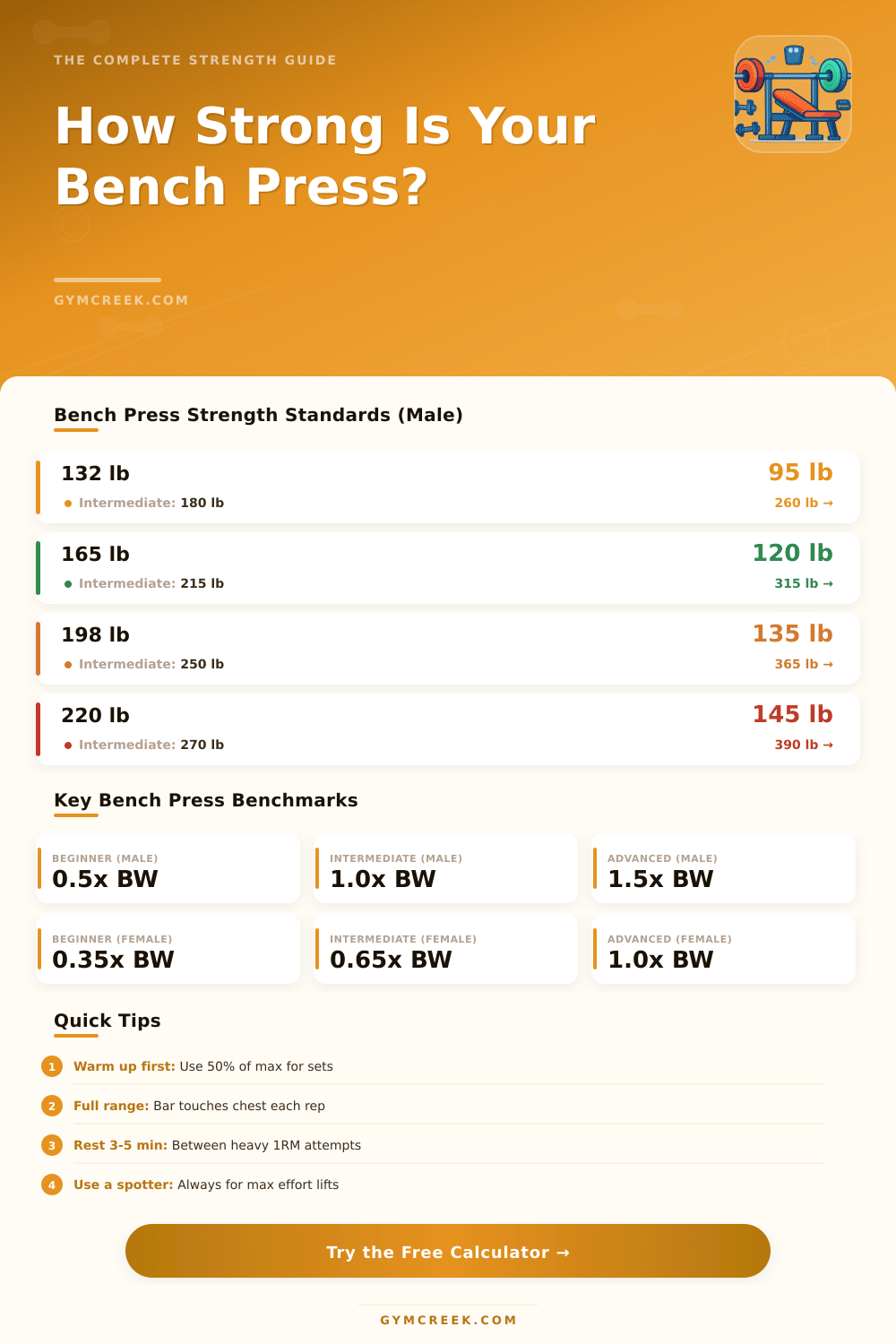
Male Standards (lb, by body weight)
| Body Wt | Beginner | Intermed. | Advanced |
|---|---|---|---|
| 132 lb | 95 | 175 | 255 |
| 148 lb | 110 | 195 | 285 |
| 165 lb | 120 | 215 | 315 |
| 181 lb | 130 | 230 | 340 |
| 198 lb | 135 | 250 | 365 |
| 220 lb | 145 | 270 | 390 |
| 242 lb | 155 | 285 | 410 |
Female Standards (lb, by body weight)
| Body Wt | Beginner | Intermed. | Advanced |
|---|---|---|---|
| 97 lb | 45 | 85 | 130 |
| 114 lb | 55 | 100 | 150 |
| 132 lb | 65 | 115 | 175 |
| 148 lb | 70 | 125 | 190 |
| 165 lb | 75 | 135 | 205 |
| 181 lb | 80 | 145 | 215 |
| 198 lb | 85 | 150 | 225 |
| Goal | % of 1RM | Rep Range | Sets | Rest Period |
|---|---|---|---|---|
| Max Strength | 90–100% | 1–3 reps | 3–5 | 3–5 min |
| Strength / Power | 80–90% | 3–5 reps | 4–6 | 2–4 min |
| Hypertrophy | 65–80% | 6–12 reps | 3–4 | 60–90 sec |
| Muscular Endurance | 50–65% | 12–20 reps | 2–3 | 30–60 sec |
| Warm-Up / Rehab | 30–50% | 15–20 reps | 2 | 60 sec |
| Level | Male Ratio (1RM / BW) | Female Ratio (1RM / BW) | Description |
|---|---|---|---|
| Untrained | 0.35–0.5x | 0.20–0.35x | Less than 3 months training |
| Beginner | 0.5–0.75x | 0.35–0.50x | 3–12 months consistent training |
| Intermediate | 0.75–1.25x | 0.50–0.75x | 1–3 years structured training |
| Advanced | 1.25–1.75x | 0.75–1.0x | 3–5 years dedicated training |
| Elite | 1.75x+ | 1.0x+ | Competitive / 5+ years |
| Formula | Equation | Best For | Accuracy |
|---|---|---|---|
| Epley | w × (1 + r/30) | General use (1–10 reps) | Very High |
| Brzycki | w × 36/(37–r) | Low rep ranges (1–6) | High |
| Lombardi | w × r^0.10 | Higher rep ranges (6–12) | Moderate |
| Mayhew | 100w / (52.2 + 41.9e^–0.055r) | Athletic populations | High |
| O'Conner | w × (1 + 0.025r) | Conservative estimate | Moderate |
When you lie on a bench and push weight upward, that is the Bench Press, one of the basic exercises in strength training. It works a lot because it is a combined move that hits several muscle groups in one action. Your chest (pectoralis major) works the most but also your front shoulders and triceps engage strongly, while your core muscles help to stabilize everything.
Getting into position is easy. Lie flat on the bench, take a bar or dumbbells and push the weight upward while your arms tighten. The hard part comes during the descent, lower it controlled until chest height, stop for a second, then push it again upward.
How to Bench Press Correctly
That controls the whole move more than one imagines. If you do the reps too quickly or let the weight bounce off your chest, you risk injuring yourself.
Here the thing with the form: it is everything. I watched lifters add weight to their bar and right away ruin the progress, because their technique fell apart. Pushing lighter weight with full control really gives better results than reckless repeating of bad moves with bigger weight.
Bad form not only feels sad, it can wreck your progress for months. Your upper back also deserves attention. Keep your shoulder blades down and back, lift your chest up too the ceiling and then push from that fixed position.
That base changes everything.
Doing the Bench Press many times weekly causes visible change. Three sessions work well, for instance one day with heavy single and double reps, another day with incline press and chest flies for some sets of five to eight reps each, and the third day as a fast session. In that third, do eight to ten sets of only one to three reps, stay around 55 to 65 percent of your maximum, and do every move fast.
Changing the rep range through different kinds also helps a lot. I saw real progress, when one spends four to six weeks chasing eight to twelve reps for muscle growth, then switches to fifteen to thirty for building endurance. Just that change can help you beat plateaus.
Trouble in different spots of the lift shows where you are the weakest. If you stop in the middle of the rise, probably your shoulders limit you. If you stay stuck at the bottom, usually that shows that your chest or back needs more work, adding dumbbell Bench Press and heavy dips can help here.
For tricep strength, exercises like JM-press and skull crushers help morethan tricep pushdowns.
Mix your angles to keep the stimulus fresh. Incline barbell work and decline dumbbells hit your upper and lower chest differently. Decline bench usually lets you do almost ten more reps than flat bench with same weight.
Inclines usually need lighter weights. Jumping between different angles, rep ranges and tools helps to beat blocks. Dumbbells work as a good alternative to the bar, though you probably lift less weight, because they are less stable.