🏃 VO2 Max Cooper Test Calculator
Estimate your aerobic fitness and VO2 max score from your 12-minute Cooper run distance
| Age Group | Poor | Fair | Good | Excellent | Superior |
|---|---|---|---|---|---|
| 20–29 | < 34 | 34–38 | 39–43 | 44–49 | ≥ 50 |
| 30–39 | < 32 | 32–36 | 37–41 | 42–47 | ≥ 48 |
| 40–49 | < 30 | 30–34 | 35–38 | 39–44 | ≥ 45 |
| 50–59 | < 27 | 27–30 | 31–35 | 36–40 | ≥ 41 |
| 60–69 | < 23 | 23–26 | 27–31 | 32–36 | ≥ 37 |
| 70+ | < 20 | 20–23 | 24–27 | 28–32 | ≥ 33 |
| Age Group | Poor | Fair | Good | Excellent | Superior |
|---|---|---|---|---|---|
| 20–29 | < 29 | 29–33 | 34–37 | 38–43 | ≥ 44 |
| 30–39 | < 27 | 27–31 | 32–35 | 36–40 | ≥ 41 |
| 40–49 | < 25 | 25–28 | 29–32 | 33–38 | ≥ 39 |
| 50–59 | < 22 | 22–25 | 26–29 | 30–34 | ≥ 35 |
| 60–69 | < 19 | 19–22 | 23–26 | 27–31 | ≥ 32 |
| 70+ | < 17 | 17–19 | 20–23 | 24–27 | ≥ 28 |
| Fitness Category | Male Distance (km) | Female Distance (km) | Male Distance (miles) | Female Distance (miles) |
|---|---|---|---|---|
| Poor | < 1.60 | < 1.30 | < 0.99 | < 0.81 |
| Fair | 1.60–1.99 | 1.30–1.69 | 0.99–1.24 | 0.81–1.05 |
| Average | 2.00–2.39 | 1.70–2.09 | 1.24–1.49 | 1.06–1.30 |
| Good | 2.40–2.79 | 2.10–2.49 | 1.49–1.73 | 1.30–1.55 |
| Excellent | 2.80–3.19 | 2.50–2.89 | 1.74–1.98 | 1.55–1.80 |
| Superior | ≥ 3.20 | ≥ 2.90 | ≥ 1.99 | ≥ 1.80 |
✅ Surface & Conditions: Use a flat, measured surface such as a 400m athletics track. Avoid testing in extreme heat, cold, or wind.
✅ Pacing Strategy: Start at a comfortable but challenging pace. Avoid sprinting in the first few minutes — aim for a consistent tempo throughout.
✅ Accurate Measurement: Use a GPS watch, phone app, or a marked track to measure distance precisely. Small errors in distance significantly affect your VO2 max estimate.
✅ Retest Consistently: Retest every 6–8 weeks under the same conditions to accurately track progress.
| Athlete / Population | Sport | VO2 Max (mL/kg/min) | Notes |
|---|---|---|---|
| Oskar Svendsen | Cycling | 97.5 | Highest recorded male |
| Joan Benoit | Marathon | 78.6 | High recorded female |
| Elite Male Distance Runner | Running | 70–85 | World-class standard |
| Elite Female Distance Runner | Running | 60–75 | World-class standard |
| Elite Male Cyclist | Cycling | 70–85 | Tour-level athlete |
| Recreational Male Runner | Running | 45–55 | Club / amateur level |
| Recreational Female Runner | Running | 38–48 | Club / amateur level |
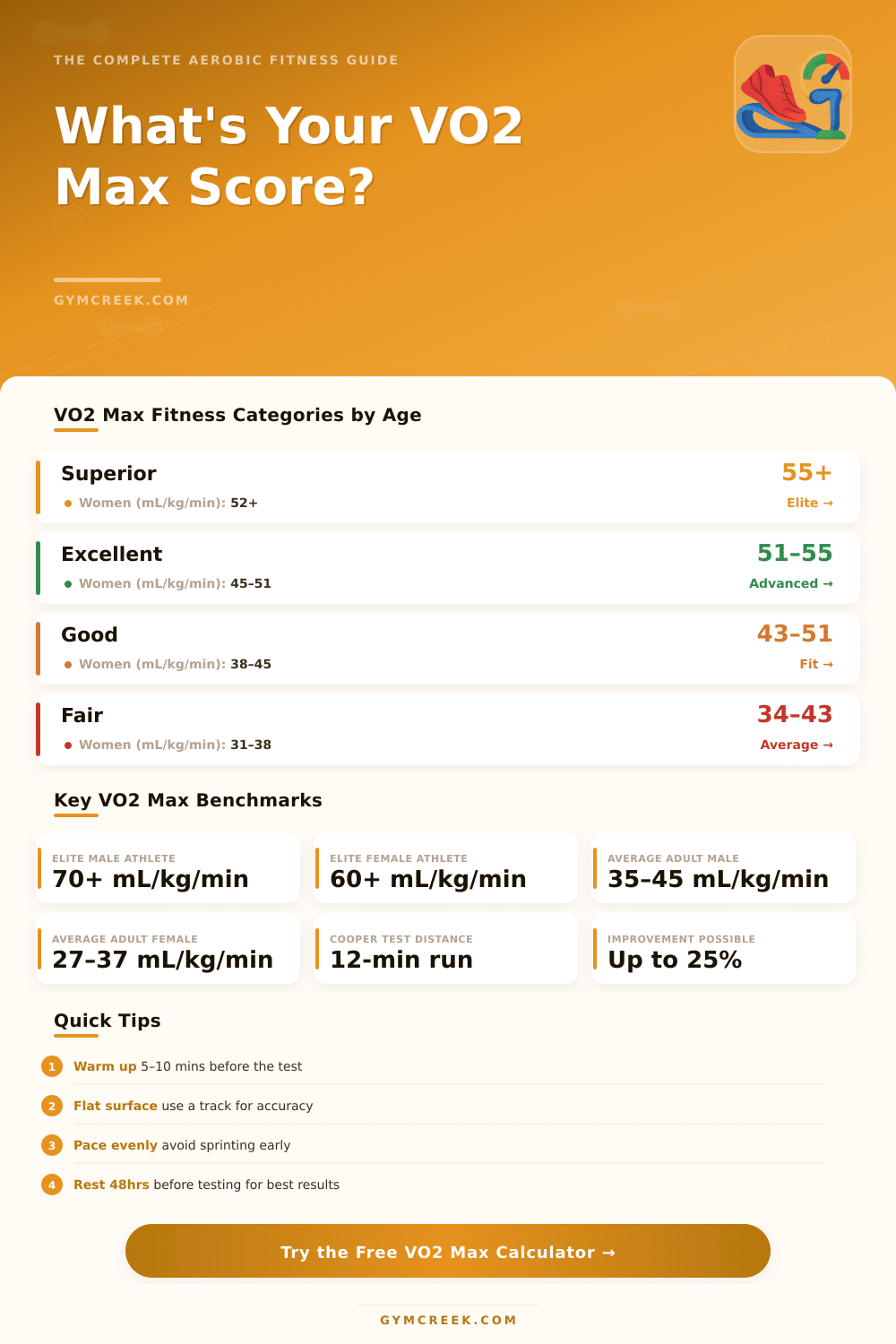
| Average Adult Male (20–39) | General | 35–45 | Healthy non-athletic |
| Average Adult Female (20–39) | General | 27–37 | Healthy non-athletic |
VO2 max is the biggest amount of oxygen that the body can absorb and use during physical activity. One can imagine it like the horsepower of a car. It measures the ability of the body to absorb oxygen in moments of effort.
The word comes from “V” for volume, “O2” for oxygen and “max” for biggest. Usually one sees it as the most reliable sign of heart fitness and aerobic ability.
What is VO2 max and why it matters
The bigger amount of oxygen that folk manage to use during movement, the less difficult the training seems and the more long one can last. High VO2 max means that the body well takes oxygen from the air and carries it to the muscles. It reveals how well the heart pumps blood to the muscles and how well those muscles take oxygen from the blood.
VO2 max is commonly discussed between athletes of endurance, for instance swimmers, cyclists, runners and skiers. It gives a fair way to measure the skill of any. The value shows itself by means of milligrams of oxygen for every kilo of body mass in one minute.
During aerobic exercise the main task of the heart system is to strengthen the flow of blood full in oxygen and nutrients.
A good lab test to measure it involves exercise in full force on a treadmill, fixed bike or rowing machine. One puts on a face mask or tube bound to a device that reads oxygen, while the folk work as hardly as possible. A test of VO2 max finds the maximum oxygen use during movement.
The Cooper test is another method, in that one runs or walks as quickly as possible four exactly 12 minutes, and the covered distance links to VO2 max.
Fitness tracking helps to also estimate VO2 max. One uses weight, distance, speed and heart rate to work out how much energy the body needs to move. Less high heart rate to reach equal levels of work gives a better result. Even so those simple calculations are not always fully precise.
When VO2 max grows, the resting heart rate tends to drop. During exercise in same intensity the normal heart rate should be lower. Genetics play a big part in VO2 max, together with body structure.
Training in high intensity with intervals is among the most useful ways to strengthen it. Typical VO2 max training is made up of intervals of one to six minutes with equal work and equal pauses. Mixing zone 2 of training with intervals some days per week also can give progress.
Too much work for VO2 max is not wise. It can lead to overtraining. That intensity is high, and fitness of VO2 max comes quickly, but is lost also quickly.
Maximum heart rate drops by 0.6 to 0.8 beats per minute each year because of aging. Before never trained older adults, that worked during nine months to a year, raised their VO2 max on average by 20 percent. Losing weight also can help improve VO2 max for all average folks, because they have more body fatthan exclusive sportsmen.
VO2 max matters for endurance activity, but speed at aerobic limit or lactate limit truly can be better measures of competitive result, because they consider more elements together.