🏋 One Rep Max Warmup Calculator
Generate precise warmup sets based on your 1RM — lift safer, heavier, and smarter
| Set | % of 1RM | Weight (lbs) | Reps | Rest | Purpose |
|---|
| Formula | Equation | Best For | Accuracy |
|---|---|---|---|
| Epley (1985) | w x (1 + r/30) | General use | ★★★★☆ |
| Brzycki (1993) | w x 36 / (37 – r) | Low reps (<10) | ★★★★★ |
| Lander (1985) | w / (1.013 – 0.0267123 x r) | Strength athletes | ★★★★☆ |
| Lombardi (1989) | w x r^0.10 | Higher rep ranges | ★★★☆☆ |
| O'Conner (1989) | w x (1 + 0.025 x r) | Conservative est. | ★★★☆☆ |
| Level | Squat (M/F x BW) | Bench (M/F x BW) | Deadlift (M/F x BW) | OHP (M/F x BW) |
|---|---|---|---|---|
| Beginner | 1.0 / 0.75 | 0.75 / 0.5 | 1.25 / 1.0 | 0.5 / 0.35 |
| Novice | 1.25 / 1.0 | 1.0 / 0.65 | 1.5 / 1.25 | 0.65 / 0.45 |
| Intermediate | 1.5 / 1.2 | 1.25 / 0.8 | 2.0 / 1.5 | 0.8 / 0.55 |
| Advanced | 2.0 / 1.5 | 1.5 / 1.0 | 2.5 / 2.0 | 1.0 / 0.7 |
| Elite | 2.5+ / 2.0+ | 2.0+ / 1.25+ | 3.0+ / 2.5+ | 1.25+ / 0.9+ |
| Reps | % of 1RM | Training Zone | Primary Adaptation |
|---|---|---|---|
| 1 | 100% | Maximal Strength | Neural efficiency |
| 2–3 | 92–95% | Strength | Max strength + CNS |
| 4–5 | 87–90% | Strength–Power | Strength + some size |
| 6–8 | 80–85% | Hypertrophy–Strength | Muscle growth + strength |
| 8–12 | 70–80% | Hypertrophy | Muscle growth (primary) |
| 12–15 | 65–70% | Muscular Endurance | Endurance + tone |
| 15–20 | 55–65% | Endurance | Metabolic conditioning |
| Set # | % of 1RM | Reps | Rest Period | Goal |
|---|---|---|---|---|
| Set 1 (Bar) | 20–30% | 10–12 | 60 sec | Movement pattern, warm tissue |
| Set 2 | 40–50% | 6–8 | 60–90 sec | Load joints, activate CNS |
| Set 3 | 60–65% | 4–5 | 90–120 sec | Speed & technique practice |
| Set 4 | 75–80% | 2–3 | 2–3 min | Specificity, feel the weight |
| Set 5 (opt.) | 88–92% | 1 | 3–5 min | Potentiation before work set |
The One Rep Max (or 1RM), as lifters call it, simply said is the biggest weight that you successfully lift for one single repetition, while you keep right form without injury. It acts as the main measure for pure strength and helps to plan your whole exercise.
DISCLOSURE: This post may contain affiliate links, meaning when you click the links and make a purchase, I receive a commission. As an Amazon Associate I earn from qualifying purchases.

Often you will hear about testing of 1RM, when dealing about the basic combined moves: deadlifts, bench press, squats. Here at those barbell exercises with many joints it truly is useful. Naturally, you could test on simple arm curls, but this does not have much sense.
How to Find Your One-Rep Max Safely
The main benefit comes when you measure the strength of your upper body, lower body or the whole body together.
But here the main point, testing of real maximum is not only lay weight on the bar and see what happens. Your body must be well rested. Many lifters prepare themselves over some days by means of lightweight, low volume work before the attempt.
One calls this time a deload, and it is important, because during the real test you push until the limit, where the from can break. Here happen the injuries. And after that?
You probably will feel exhausted during several days.
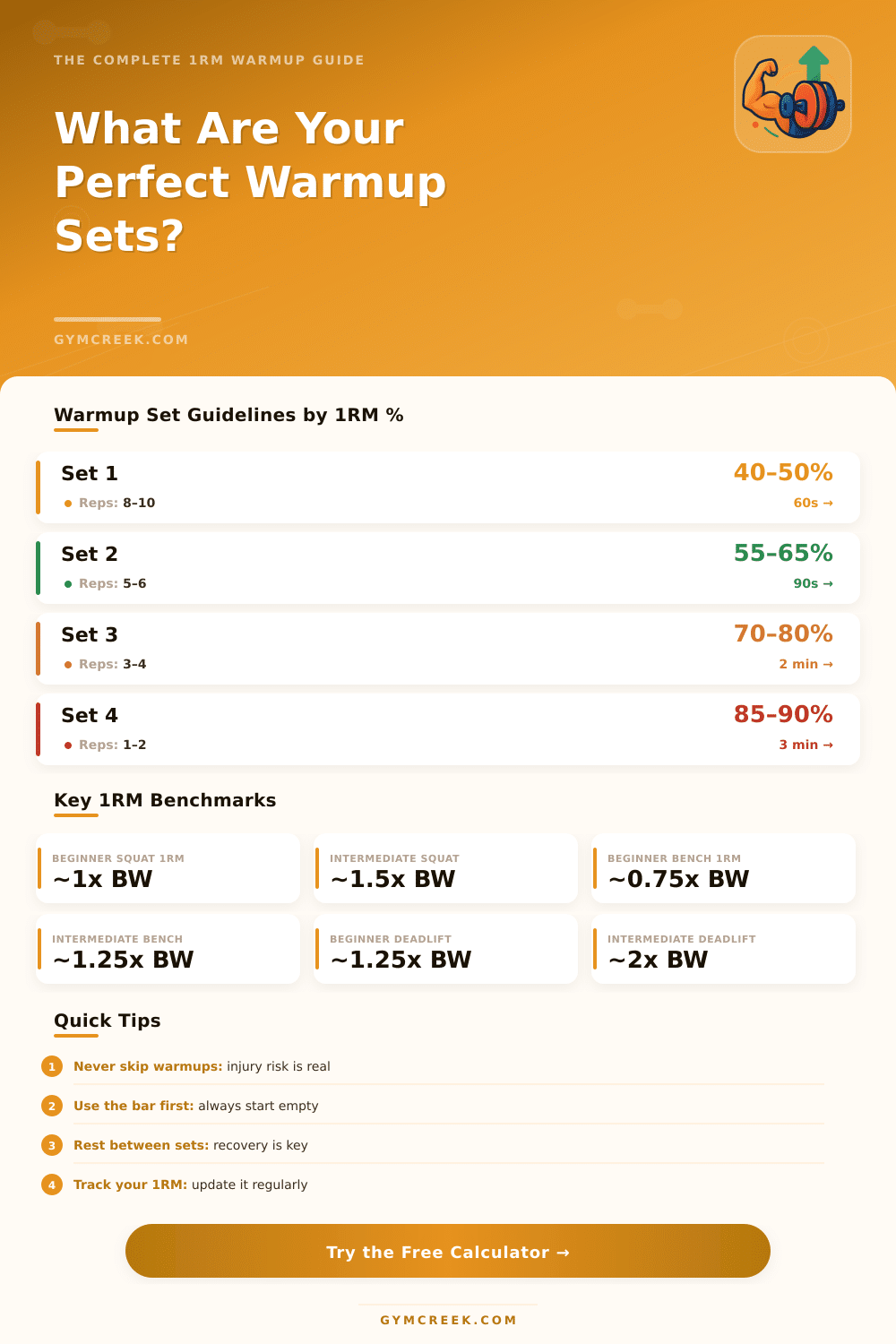
Good Warmup follows logical steps. For instance, start with five to ten repetitions with almost half of your planned maximum, later pass to three to five repetitions at about 70 percent. Later, do one or two repetitions at 85 to 90 percent.
Before the final attempt, pause two to five minutes, that time allows the energy stored in your muscles to rebuild, which matters for maximum power.
Even so not everyone needs to do the test itself. Calculators for One Rep Max exist especially for that. The idea is simple: you pick a weight, do as many repetitions as you can, and put those values in the equation.
You will get the best guess, if the wait allows you to reach between one and ten repetitions. For instance, one formula multiplies your lifted weight by the number of repetitions, later multiplies that by 0.0333 and adds the weight again.
But here what commonly surprises folks. If your training consists only of lightweight weight and big amount, then your estimated maximum from an eight repetition set probably will not be real. You need to regularly work with heavy or almost heavy loads.
The nervous system needs two to three weeks to fully rest after a real maximum test, so doing it every week does not work, those values then maybe are not real highs.
Most programs that you will follow use percentages of your 1RM. Maybe some day you must work at 70 percent, even if you never lifted that much. Here is when knowing your value becomes useful.
Regularly training with good form at lighter weights can indeed raise your maximum a lot. The numberitself is not set. Any weight that you successfully lift for that last single repetition, that is your new maximum.