🔥 Mifflin-St Jeor TDEE Calculator
Calculate your Total Daily Energy Expenditure using the gold-standard Mifflin-St Jeor formula
| Activity Level | Multiplier | Weekly Exercise | Typical Profile |
|---|---|---|---|
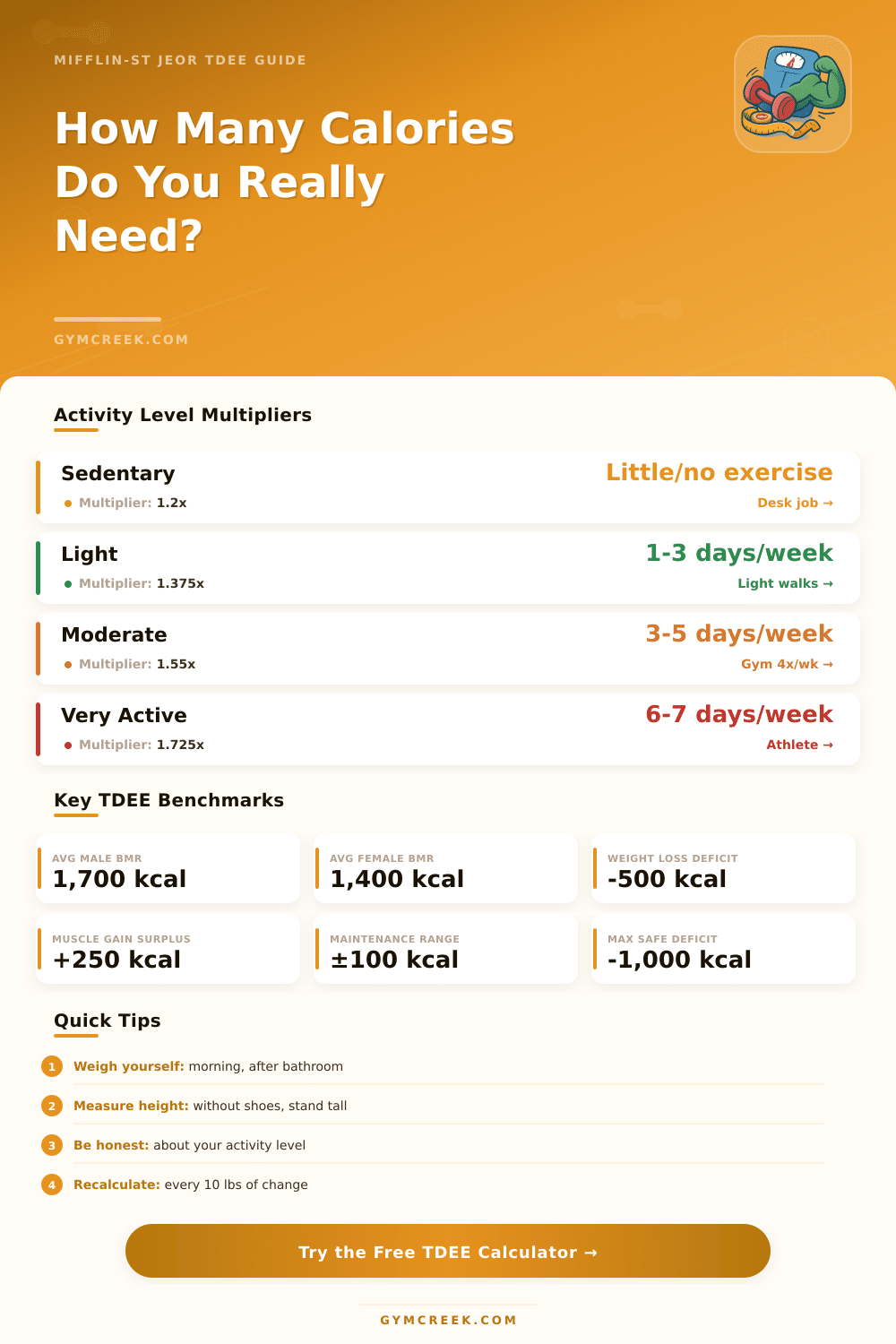
| Sedentary | 1.2× | None or minimal | Desk job, no gym |
| Lightly Active | 1.375× | 1–3 days | Light walks, yoga |
| Moderately Active | 1.55× | 3–5 days | Regular gym-goer |
| Very Active | 1.725× | 6–7 days | Athlete, hard training |
| Extra Active | 1.9× | 2x/day or physical job | Elite athlete, manual labor |
| Goal | Daily Adjustment | Weekly Change | Notes |
|---|---|---|---|
| Aggressive Loss | −750 kcal | −1.5 lb (~0.68 kg) | Requires high protein |
| Weight Loss | −500 kcal | −1 lb (~0.45 kg) | Most recommended deficit |
| Mild Loss | −250 kcal | −0.5 lb (~0.23 kg) | Sustainable, minimal muscle loss |
| Maintenance | ±0 kcal | No change | Equal intake and expenditure |
| Mild Muscle Gain | +150 kcal | +0.25 lb (~0.11 kg) | Lean bulk approach |
| Muscle Gain | +250 kcal | +0.5 lb (~0.23 kg) | Standard bulk |
| Recomposition | ±0 kcal | Body composition shift | High protein, resistance training |
| Age Group | Male BMR (avg) | Female BMR (avg) | Notes |
|---|---|---|---|
| 18–25 | 1,750–2,000 kcal | 1,450–1,650 kcal | Peak metabolic rate |
| 26–35 | 1,700–1,950 kcal | 1,400–1,600 kcal | Slight decline begins |
| 36–45 | 1,650–1,850 kcal | 1,350–1,550 kcal | Metabolism slows ~2% |
| 46–55 | 1,550–1,750 kcal | 1,300–1,500 kcal | Hormonal changes impact |
| 56–65 | 1,450–1,650 kcal | 1,250–1,420 kcal | Muscle mass declines |
| 65+ | 1,350–1,550 kcal | 1,200–1,380 kcal | Lower lean mass typical |
| Goal | Protein | Carbohydrates | Fat |
|---|---|---|---|
| Weight Loss | 35–40% | 30–35% | 25–30% |
| Maintenance | 25–30% | 40–45% | 25–30% |
| Muscle Gain | 30–35% | 40–50% | 20–25% |
| Endurance / Running | 20–25% | 50–60% | 20–25% |
| Recomposition | 35–40% | 35–40% | 20–25% |
| Keto / Low Carb | 25–30% | 5–10% | 60–70% |
• Weigh yourself in the morning after using the bathroom and before eating for the most consistent reading.
• Measure your height without shoes on a hard floor, standing straight against a wall.
• Be honest about your activity level — most people overestimate by 1–2 levels.
• Recalculate your TDEE every 10 lbs (~4.5 kg) of weight change for accurate targets.
TDEE shows the whole daily energy that the body spends. That is the amount of calories that the body burns during one day. This covers everything from basic functions of the body to exercises and daily motions.
DISCLOSURE: This post may contain affiliate links, meaning when you click the links and make a purchase, I receive a commission. As an Amazon Associate I earn from qualifying purchases.

Even so, TDEE is hard to estimate exactly because it changes daily.
What TDEE Is and How to Find It
Three main parts determine TDEE. First comes the basal metabolic rate, or BMR, that represents the energy that the body requires to simply exist at rest. It usually makes up 60 to 75 percent of TDEE.
Second is the thermal effect of food, so the energy that one uses to digest foods. Third is physical activity and exercise. Because fat does not use lot of energy to stay, the mass without fat well predicts the energy that one spends.
To estimate TDEE, start by finding the BMR. Later apply a multiply factor for activity. For sitting folks, multiply BMR by 1.2.
For a bit active, it is BMR times 1.375. For medium active, BMR times 1.55. For very active, BMR tiems 1.725.
For extremely active, BMR times 1.9. These groups have short explanations, but many folks overly estimate their activity.
Online calculators for TDEE use age, weight, height and level of activity to estimate the daily burning of calories. Even so, none of them is fully precise. They base on averages and statistics, so the results can err.
Still, using a TDEE calculator, one gets much better rating then simply guessing.
The best way to exactly determine TDEE is by using real data from life. If one tracks the eating of foods regularly, weighs himself daily in the morning and takes averages over some weeks, that gives clearer picture. Data that follows the real meals and changes of weight during a month or more, commonly turns out more reliable than any formula.
TDEE changes over time. More muscles cause bigger TDEE, so one must review the daily needs of food occasionally. If the activity drops, TDEE drops.
Steady daily habits make TDEE more predictable, while changes in the lifestyle cause it to shift.
When one knows TDEE, it serves as base for any plan. Eating foods under TDEE, one creates deficit of calories to lose weight. Eating around 500 calories above TDEE, one helps to gain muscle.
Eating exactly at TDEE, one keeps the current weight. Setting a calorie target without knowing TDEE is like gambling. Usually one cuts part of TDEE, and thecloser to the wanted weight, that slice must be smaller.