🫁 Ideal Body Weight Calculator
For Ventilator Tidal Volume & Lung-Protective Settings (ARDSnet Protocol)
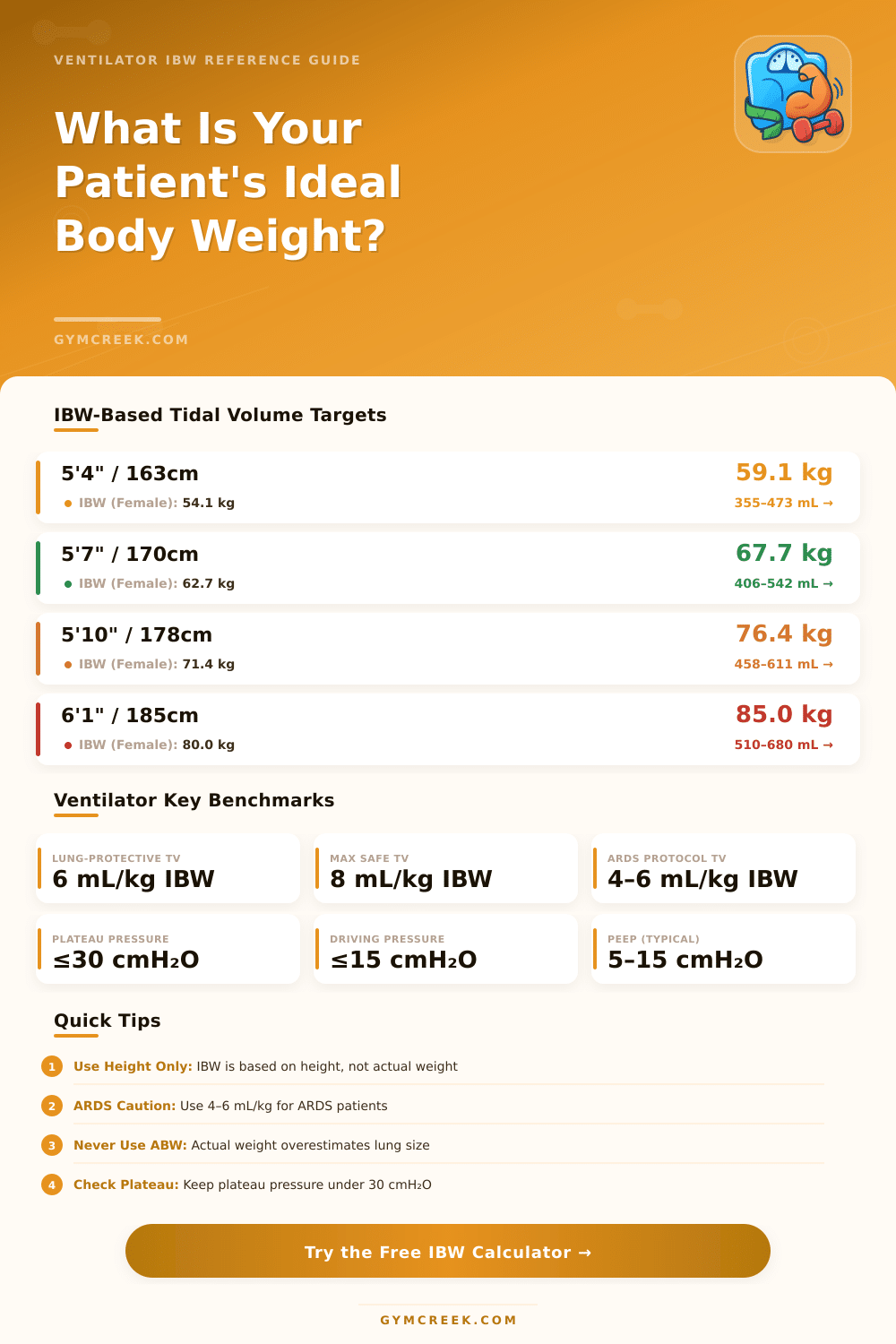
| Height | IBW Male (kg) | IBW Female (kg) | TV 6 mL/kg Male | TV 6 mL/kg Female | TV 8 mL/kg Male |
|---|---|---|---|---|---|
| 5'0" / 152 cm | 45.5 kg | 41.0 kg | 273 mL | 246 mL | 364 mL |
| 5'2" / 157 cm | 50.1 kg | 45.6 kg | 301 mL | 274 mL | 401 mL |
| 5'4" / 163 cm | 54.7 kg | 50.2 kg | 328 mL | 301 mL | 438 mL |
| 5'6" / 168 cm | 59.3 kg | 54.8 kg | 356 mL | 329 mL | 474 mL |
| 5'8" / 173 cm | 63.9 kg | 59.4 kg | 383 mL | 356 mL | 511 mL |
| 5'10" / 178 cm | 68.5 kg | 64.0 kg | 411 mL | 384 mL | 548 mL |
| 6'0" / 183 cm | 73.1 kg | 68.6 kg | 439 mL | 412 mL | 585 mL |
| 6'2" / 188 cm | 77.7 kg | 73.2 kg | 466 mL | 439 mL | 622 mL |
| 6'4" / 193 cm | 82.2 kg | 77.7 kg | 493 mL | 466 mL | 658 mL |
| Indication | TV Target (mL/kg IBW) | Rationale | Plateau Pressure Goal |
|---|---|---|---|
| ARDS (Moderate–Severe) | 4–6 mL/kg | ARDSnet ARMA Trial | ≤30 cmH₂O |
| ARDS (Mild) | 6 mL/kg | Lung-protective ventilation | ≤30 cmH₂O |
| Standard Ventilation | 6–8 mL/kg | General ICU practice | ≤30 cmH₂O |
| COPD / Air Trapping | 5–7 mL/kg | Permissive hypercapnia | ≤30 cmH₂O |
| Post-Op (No Lung Dz) | 7–9 mL/kg | Routine surgical recovery | ≤30 cmH₂O |
| Neuromuscular Disease | 8–10 mL/kg | Prevent atelectasis | ≤30 cmH₂O |
| Asthma (Severe) | 6–8 mL/kg | Low RR, allow exhalation | ≤30 cmH₂O |
| Formula | Male (5'7" / 170 cm) | Female (5'7" / 170 cm) | Primary Use |
|---|---|---|---|
| Devine (1974) | 67.6 kg | 63.1 kg | Ventilator TV (ARDSnet) |
| Robinson (1983) | 68.0 kg | 62.3 kg | Drug dosing |
| Miller (1983) | 64.5 kg | 59.0 kg | Drug dosing |
| Hamwi (1964) | 70.3 kg | 60.8 kg | Nutrition / dietetics |
| BMI-based (BMI=22) | 67.3 kg | 67.3 kg | General population |
The physical pitch presents a broad range, and the “ideal” amount for any folk depends on his height, age, gender and physical fitness; simply said, it is the mass that usually comes with low risk of death. That notion is not fresh; one built it on more than hundred years of studies about how physical traits bind to general health. The tables of height and weight from Metropolitan Life Insurance that published in the starts of the 1940s, became the mainstream base for estimate this outside the laboratory.
DISCLOSURE: This post may contain affiliate links, meaning when you click the links and make a purchase, I receive a commission. As an Amazon Associate I earn from qualifying purchases.

For genuinely estimate the ideal physical mass, the formula of Devine from 1974 probably stay the most heavily used method. For men one starts at 50 kilos as base, later add each 2.3 kilos for every inch above five feet. Like this, if folk surpasses five feet by ten inches, one would estimate around 73 kilos for him, so around 161 pounds.
How to Find a Healthy Body Weight
One can think about that also otherwise: one takes 110 pounds and add each 5 pounds for every inch above five feet.
But here the key spot. Although the formula of Devine lack strong scientific base, one uses it everywhere when maybe. It helps for dose medicines, set Ventilator devices, estimate nutritious needs and control renal skills.
In addition, it gives fast and simple mode estimate basic risks at patients.
Actually, never lack formulas for that. Each from them gives a bit different results. The formula of Robinson from 1983 would give 164.9 pounds for same folk, while the one of Miller from that same period reach around 161.2 pounds.
Devine could point 171.1, and Hamwi, who dates from 1964… Raise it to 177.2. So we have quite a wide range according to what metohd one chooses.
The index of physical mass commonly feeds as extra mode estimate all causes. BMI simply considers the proportion between mass and height. Even so here it fails: it does not mind in muscular amount, bone density or general physical structure.
That forms a remarkable absence. For estimate the real wanted pitch of some, it does not suffice to simply read from table of height and mass; one must consider, how far from that mass are made up of bones, muscles against fat.
The actual truth is, that no formula answers four all at once. Those calculations do not consider genetics, already existing diseases or personal varieties. Every folk is different built.
The physical type plays big role, thin folks naturally stay slim, heavy ones tend to more round form, and middle ones bear more muscles naturally. Every kind requires his own method for think the mass.
The percentage of physical fat genuinely deserve your mainstream attention. There is no magic amount that counts for all only according to height. Most serious is observe the whole physical structure instead of obsess about the figure on the weight.
The ideal physical mass can serve as good starting spot, but it formsonly chip of the whole.