🏋 TDEE Calculator for Bodybuilding
Calculate your Total Daily Energy Expenditure to bulk, cut, or recomp — with bodybuilding-specific macro splits.
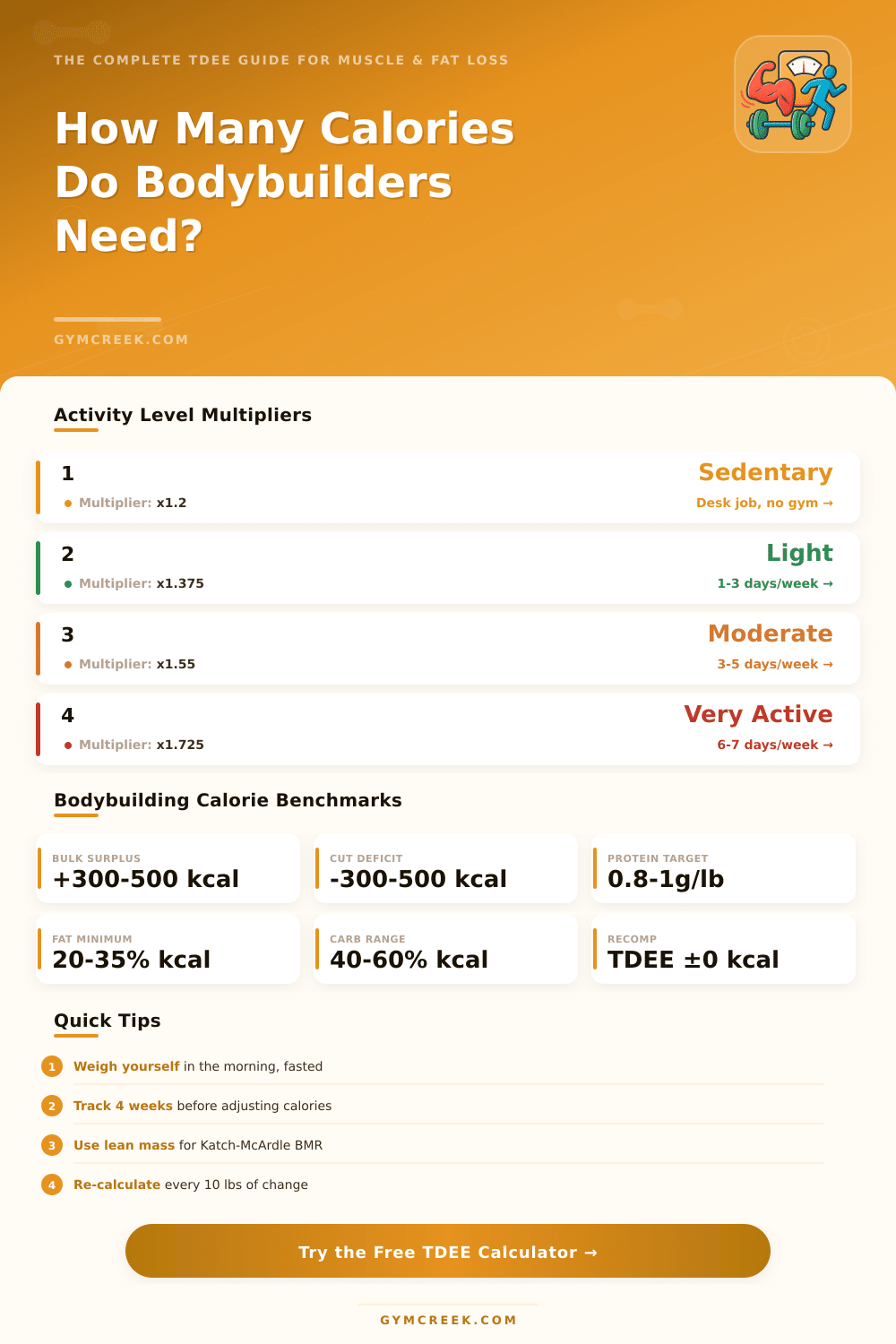
| Activity Level | Multiplier | Training Frequency | Typical Bodybuilder Profile |
|---|---|---|---|
| Sedentary | 1.2 | No structured exercise | Complete beginner, recovering from injury |
| Lightly Active | 1.375 | 1–3 days/week | Part-time lifter, mostly sedentary job |
| Moderately Active | 1.55 | 3–5 days/week | Intermediate bodybuilder, gym 4x/week |
| Very Active | 1.725 | Hard training 6–7 days | Advanced lifter, high-volume programs |
| Extremely Active | 1.9 | 2x/day or physical job | Competitive bodybuilder in prep phase |
| Goal | Calorie Adjustment | Expected Weekly Change | Best For |
|---|---|---|---|
| Lean Bulk | +300 kcal/day | +0.25–0.5 lbs lean mass | Minimizing fat gain while building muscle |
| Aggressive Bulk | +500 kcal/day | +0.5–1 lb/week | Beginners, underweight lifters |
| Maintenance / Recomp | 0 kcal | Gradual recomposition | Intermediate lifters at healthy body fat |
| Moderate Cut | -300 kcal/day | -0.5 lb/week fat loss | Preserving muscle during off-season cut |
| Aggressive Cut | -500 kcal/day | -1 lb/week fat loss | Pre-contest or rapid fat loss phases |
| Contest Prep | -700 kcal/day | -1.2–1.5 lbs/week | Competitive bodybuilders, short timeline |
| Category | Males | Females | Bodybuilding Context |
|---|---|---|---|
| Essential Fat | 2–5% | 10–13% | Contest stage level, not sustainable long-term |
| Athletic | 6–13% | 14–20% | Competitive bodybuilder off-season |
| Fitness | 14–17% | 21–24% | Lean bulk starting point |
| Average | 18–24% | 25–31% | Typical gym-goer, cut phase recommended |
| Obese | 25%+ | 32%+ | Prioritise fat loss before bulking |
| Goal | Protein | Carbs | Fat | Protein Target (per lb BW) |
|---|---|---|---|---|
| Lean Bulk | 30% | 50% | 20% | 0.8–1.0g/lb |
| Aggressive Bulk | 25% | 55% | 20% | 0.7–0.9g/lb |
| Maintenance / Recomp | 35% | 40% | 25% | 1.0–1.1g/lb |
| Moderate Cut | 40% | 35% | 25% | 1.0–1.2g/lb |
| Aggressive Cut | 45% | 30% | 25% | 1.2–1.4g/lb |
| Contest Prep | 50% | 25% | 25% | 1.4–1.6g/lb |
| Age Group | Avg Male BMR | Avg Female BMR | Notes |
|---|---|---|---|
| 15–20 | 1,800–2,100 kcal | 1,450–1,700 kcal | Peak growth hormone, efficient metabolism |
| 21–30 | 1,700–2,000 kcal | 1,400–1,650 kcal | Prime muscle-building years |
| 31–40 | 1,600–1,900 kcal | 1,300–1,550 kcal | Slight metabolic slowdown begins |
| 41–50 | 1,500–1,800 kcal | 1,250–1,500 kcal | Prioritise protein intake to preserve mass |
| 51+ | 1,400–1,650 kcal | 1,150–1,400 kcal | Resistance training essential to offset decline |
Bodybuilding requires a level of precision in various aspect of the bodybuilding process. One of the most valuable aspects of bodybuilding is understanding how many calories your body burn each day. This information, known as your TDEE (Total Daily Energy Expenditure), is needed to determine how many calorie you should consume during bulking or cutting phases. Without this information, it is impossible to ensure that your diet support your bodybuilding goals.
Calculating the number of calories that a bodybuilding athlete should consume involves the use of complex spreadsheet. However, moddern technology make it possible to calculate your calorie needs using a TDEE calculator bodybuilding. These calculators take into account the demands of your training regimen and your bodybuilding goals to determine the number of calories that you need to consume each day.

TDEE Calculator Bodybuilding for Accurate Results
What Is TDEE and Why Does It Matter for Bodybuilders?
TDEE stands for Total Daily Energy Expenditure. TDEE calculations determine the amount of calories that an individual burn daily. This is not only derived from the calories that the body burns to perform essential functions, but also includes the calories burned during exercise. By understanding your TDEE, you can determine the calories that you need to consume daily to gain or lose weight. Consuming calories at a rate significantly higher than your TDEE will result in weight gain. Conversely, consuming fewer calories then your TDEE will lead to weight loss.
TDEE calculations start with your Basal Metabolic Rate (BMR). Your BMR is the number of calories that your body burns daily at rest to perform essential bodily function. The TDEE calculation also takes into account the number of calories that you burn during physical activity. Bodybuilders typically perform intense physical activities, so they multiply their BMR by a higher number than other individual. For example, bodybuilders typically fall into the “very active” category as they perform intense weight training for six or more days a week.
Due to the nature of bodybuilding, individuals typically cycle through various phase. During bulking phases, bodybuilders consume 300 calories more than their TDEE to enable their bodies to gain muscle. During cut phases, bodybuilders consume 700 to 1000 calories less than their TDEE to lose fat while trying to retain as much muscle as possible. If these numbers are not correctly calculated for an individual, their bodybuilding efforts can lead to excessive muscle loss or fat gain.
TDEE is influenced by various factors. The age of an individual, the sex of the individual, and their body composition all play a significant role in determining the TDEE of a bodybuilder. A 25-year-old man with a lean body composition will have a significantly different TDEE than a 45-year-old woman with a higher body fat percentage and muscle masses. The TDEE needs to be calculated according to these parameters to provide the best recommendation for bodybuilding success.
Many bodybuilders track TDEE, their body weight, body measurements, and the progress that they make in photography to track their success. They also adjust the calories that they consume according to these result to ensure that they are achieving the best possible outcome from their bodybuilding efforts. Knowing these parameters at the beginning of a bodybuilding cycle enables an individual to track their success and determine whether their TDEE calculation is accurate.
An individual’s TDEE can change over time. The body composition changes as bodybuilders lose body fat or gain muscle mass. In such instances, recalibrating the TDEE calculation is essential. For bodybuilders who are losing body fat, their TDEE will drop. You can account for this by using a TDEE calculator every four weeks or after each ten-pound change in body weight. For bodybuilders who are gaining muscle mass, their TDEE will increase. This will affect the number of calories that they consume daily.
For bodybuilding competitions, protein intake is crucial. While carbohydrates and fats provide the energy for bodybuilding competitions, protein provides the essential components needed to grow and repair muscle tissue. When bodybuilders are performing cutting phases to lose body fat, they typically consume 1.2 to 1.6 grams of protein per pound of body weight. These values are already accounted for in the best TDEE calculators for bodybuilding athlete.
Understanding how calories impact bodybuilding can help avoid some common mistake. Many bodybuilding beginners consume excessive calories to encourage muscle growth. However, the body can only produce a certain amount of muscle growth per month. Beyond that level, any calories consumed will be gained as body fat.
Conversely, bodybuilders who attempt to lose a significant amount of body fat can greatly affect their training performance. When bodybuilders cut calories too drastic, it affects their training and recovery phases from excessive fatigue to muscle injuries. The best approach is to cycle between consuming calories above and below your TDEE to gain or lose weight. This approach allows bodybuilders to maintain their strength and muscle mass in the gym.
The activity level of bodybuilders can vary. Powerlifters perform intense training three times per week. In contrast, bodybuilders compete in high-intensity workouts six days per week. Furthermore, the activity that an individual performs outside of bodybuilding can significantly impact the number of calories that they burn daily.

The body fat percentage that an individual has can also be used in TDEE calculations. The most accurate calculations use lean body mass rather than total body weight. For instance, a 200-pound man with a body fat percentage of 10% will have a higher TDEE than a 200-pound man with 25% body fat. This is why bodybuilders lose body fat to have a lower body fat percentage for competitions.
The best way to evaluate whether your TDEE calculation is accurate is to track your progress. Gaining more than 0.5 pounds of weight per week during a bulking phase indicates that an individual is consuming too many calories. Losing more than 1 pound of body weight per week during a cut phase can indicate that an individual is losing muscle as well as body fat. Tracking body weight and body fat percentage will allow bodybuilders to determine whether their TDEE calculation is accurate.
Knowing your TDEE can have a significant impact on the mindset and psychology of an individual. Knowing your TDEE can remove the difficulties of knowing if you are consuming enough calories or if you have consumed too many calories. With this knowledge, bodybuilders can focus on their training to achieve their bodybuilding goals.
Modern TDEE calculators include pre-programmed goals and macronutrient recommendations to assist bodybuilders in their training and bodybuilding goals based on decades of research in the field of sports nutrition. Whether an individual is a teenager or a masters athlete over the age of 50, these calculators offer recommendations for bodybuilders of all ages and experience levels.
TDEE calculators offer estimates of the number of calories that an individual needs daily. However, there is a margin of error with these estimates. Individual differences in metabolism can drastically impact the number of calories that are burned daily. Other variables such as body fat percentage, lean body mass, age, and sex influence TDEE. Furthermore, the menstrual cycle of female athletes can have a significant impact on the calories that they burn daily. However, these calculators offer a good start to determining how many calories a bodybuilder need daily.
Overall, understanding how many calories your body burns daily is the first step in any bodybuilding regime. Knowing your TDEE will ensure that you build muscle effectively during bulking phases and reveal the muscle that you trained during your cutting phases. Understanding these parameters allows an individual to maintain a healthy metabolism over time. Whether competing in bodybuilding competitions or desiring to look and feel the most in your life, knowledge of TDEE will separate those who achieve their bodybuilding goals from those who do not. Furthermore, the consistent tracking of body composition and the periodic recalibration of the TDEE will be the true keys to long-term success in the bodybuilding field.