🏋 Strength Workout Calorie Calculator
Estimate calories burned during weight training & strength workouts based on your body & session details
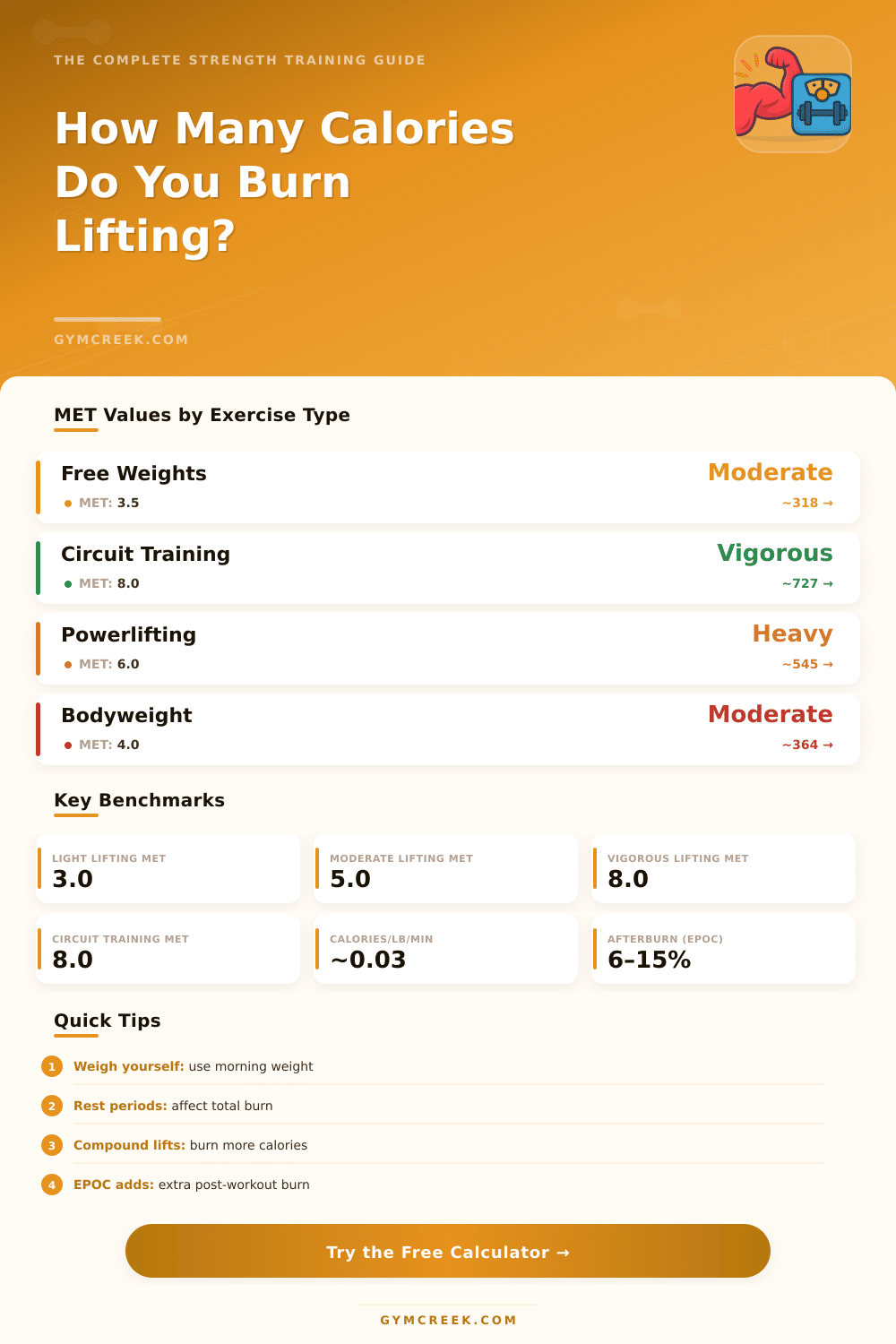
| Exercise Type | Intensity | MET Value | Cal/hr (180 lb) |
|---|---|---|---|
| General Weight Training | Moderate | 3.5 | 318 |
| Free Weights | Light | 3.0 | 273 |
| Free Weights | Moderate | 5.0 | 455 |
| Free Weights | Vigorous | 6.0 | 545 |
| Powerlifting / Heavy Compound | Vigorous | 6.0 | 545 |
| Circuit Training | Vigorous | 8.0 | 727 |
| Bodyweight Exercises | Moderate | 4.0 | 364 |
| CrossFit / Functional | Vigorous | 8.5 | 773 |
| Hypertrophy / Bodybuilding | Moderate | 4.5 | 409 |
| Kettlebell Training | Vigorous | 8.2 | 745 |
| Goal | Rep Range | Sets | Rest Period |
|---|---|---|---|
| Max Strength | 1–5 reps | 3–6 | 3–5 min |
| Hypertrophy (Muscle Growth) | 6–12 reps | 3–5 | 60–90 sec |
| Muscular Endurance | 12–20 reps | 2–4 | 30–60 sec |
| Power | 1–5 reps (explosive) | 3–6 | 2–4 min |
| Circuit / Fat Loss | 10–20 reps | 3–5 | 15–45 sec |
| General Fitness | 8–15 reps | 2–4 | 60–120 sec |
| Training Style | EPOC Duration | Extra Cal Burn | Total Boost |
|---|---|---|---|
| Light Weight Training | 30–60 min | 15–30 cal | ~5% |
| Moderate Strength | 1–3 hours | 30–60 cal | ~8% |
| Heavy Compound Lifts | 3–6 hours | 50–100 cal | ~10% |
| Circuit Training / HIIT | 6–24 hours | 75–150 cal | ~15% |
| High-Volume Bodybuilding | 2–5 hours | 40–80 cal | ~9% |
| CrossFit / Functional | 6–24 hours | 80–160 cal | ~14% |
| Body Weight | 30 Minutes | 45 Minutes | 60 Minutes |
|---|---|---|---|
| 130 lb (59 kg) | ~100 cal | ~150 cal | ~200 cal |
| 155 lb (70 kg) | ~120 cal | ~180 cal | ~240 cal |
| 180 lb (82 kg) | ~140 cal | ~210 cal | ~280 cal |
| 205 lb (93 kg) | ~160 cal | ~240 cal | ~320 cal |
| 230 lb (104 kg) | ~180 cal | ~270 cal | ~360 cal |
| 255 lb (116 kg) | ~200 cal | ~300 cal | ~400 cal |
Weigh yourself: Use your morning weight before eating for the most consistent measurement.
Rest periods matter: Shorter rests = higher continuous heart rate = more calories burned overall.
Compound lifts burn more: Squats, deadlifts, and bench press engage more muscle groups than isolation exercises.
Track your sets: More sets = more total work performed = higher calorie expenditure.
Strength training offer one of the most effective ways to build muscle, boost metabolism, and improve overall health. There is various factors that influence the number of calories that are burned during weight lifting. Using a strength workout calorie calculator allow individuals to track the number of calories burned during there strength training routine.
Many individuals dont consider strength training as a workout that burns a significant numbers of calories. However, the demands placed upon the body during weight lifting do create a burn in the number of calories that are expended. Various factor influence the number of calories that are burned during a strength training routine, including body weight, the intensity of the workout, the number of rests performed between sets, and the level of fitness of the individual performing the routine.

How a Strength Workout Calorie Calculator Works
The science behind strength workout calorie calculators rely upon the MET (Metabolic Equivalent of Task) values for various workouts. MET values is used to calculate the energy expended by an individual during a routine. The MET value for strength training typically ranges from 3.0 for lower-intensity efforts to 8.5 or more for intense efforts such such as CrossFit workouts. The calorie calculator factors these MET values in according to an individual’s characteristics and their workout specifics.
One of the factors used by a strength workout calorie calculator is the weight of the individual. Individuals of a greater weight will expend more calories during their routine as they are moving more mass during their lifts. An individual that weighs 200 lbs. Will expend more calories during a workout than an individual that weighs 130 lbs… Hence, weight is a factor in almost all legitimate calorie calculation formulas.

The intensity with which an individual performs their lift burns more calories. Individuals that lift heavy weights will burn more calories than those that lift with light weights. Furthermore, the afterburn effect created by lifting heavy weights will continue to burn additional calories even after the workout beyond the calories that were burned during the performance of the exercise. This afterburn effect can burn an additional 5% to 15% of the calories calculated for the strength training routine.
The number of rests between sets will impact the number of calories burned. An individual that perform rests of 30 to 60 seconds between sets will burn more calories during their session than an individual that takes longer rests between sets. While longer rests between heavy lifting sets allows for the individual to build more strength, the number of calories burned during the set will be less.
The fitness level of the individual will factor into the calculation of the calories burned during a strength training routine. An individual that is beginning strength training will burn more calories during their sessions than an individual that is more advanced in their training. This is due to the body of the beginner expending more effort to perform the same exercises as the experienced strength trainee.
For those seeking to lose fat from their bodies, strength training is the most beneficial form of exercise. While an individual may burn more calories during a 45-minute run than during a strength training session of comparable length, the muscle that is gained from strength training will increase the resting rate at which an individual burns calories. Each pound of muscle gained will burn 6-10 additional calories per day at rest. This impact over time can have a major impact upon the number of calories that are burned daily by an individual.
The afterburn effect represents one of the hidden benefits of weight lifting. After performing strength training and lifting heavy weights, an individual will continue to burn calories after their session. The body will continue to burn these calories as a result of the exertion of the body’s muscles during the session, as well as as a result of the creation of EPOC. Studies show that an individual can continue to burn calories from these resistance exercises for up to 24-48 hours. This makes weight lifting an excellent form of exercise for individuals that have limited time to commit to fitness routines each day.
The nutrition that an individual consumes in relation to their strength training routine will also have an impact upon the number of calories that are burned. Consuming the proper amount of protein and carbohydrates before and after a lifting routine will allow the body to train harder and recover from the strenuous exercise.

Tracking the number of calories burned during an individual’s strength training routine with a strength workout calorie calculator allows them to better understand their body and their efforts during their workouts. These numbers can help to reveal whether an individual is lifting heavy enough during their sessions. Many individuals discover that the “moderate” weights that they lift fall into the lighter category of weights lifted, which explains their lack of progress in building muscle strength. The use of a strength workout calorie calculator allows for the removal of guesswork from an individual’s fitness routine.
Routines that focus upon lifting heavy weights and taking long rests between sets will burn fewer calories than routines that incorporate bodybuilding or circuit training routines. However, the focus upon lifting heavy weights will create muscle damage within the body, which helps to increase the gains in strength of the individual’s muscles over time.
Women are often worried about the impact that strength training can have upon their bodies to make them appear bulky. However, it will take years of dedication to strength training for the body composition of a woman to change in such a manner. For women in particular, strength training can help improve their body composition, improve their strength in daily activities, and improve their metabolism to aid in fat loss.
The age of an individual can impact the number of calories that are burned during a strength training routine. While younger individuals may naturaly have higher rates of metabolism than those of an older age, older individuals can burn as many or more calories as a younger individual through the strength training routines that they perform. Individuals of an advanced age may even find additional benefit in strength training as muscle loss is a natural part of aging beyond the age of 40. Those that lift weights regularly will maintain higher metabolisms than their peers of the same age that do not lift weights.
The form in which an individual performs their routine has an impact upon the number of calories that are burned. Performing the exercises with proper form and range of motion will burn more calories than if an individual performs the same exercises with less than proper form or with limited range of motion.

There are various goals that can be incorporated into an individual’s weight lifting routine. Strength training allows an individual to build muscle, develop strength in their muscles, improve their cardiovascular health, and incorporate various elements into their routine to ensure that they achieve their desired results. However, the use of a strength workout calorie calculator can help quantify one of these goals. Additionally, the goals that an individual sets for themselves will always remain the foundation of a successful fitness routine.
Regardless of the goals that an individual sets for themselves in relation to their fitness and strength training routines, understanding how many calories are burned during these sessions will allow an individual to optimize their routine to achieve their goals for their health and fitness. Whether an individual is dedicated to improving their health as an athlete or an individual that simply wishes to feel good in their bodies and have strength in their muscles, understanding the caloric demands upon their bodies of these routines allows for optimization of their lifts and recovery periods. You should of used a calculator to see the results.