🏋 TDEE Calculator for Bodybuilding
Calculate your Total Daily Energy Expenditure to bulk, cut, or recomp — with bodybuilding-specific macro splits.
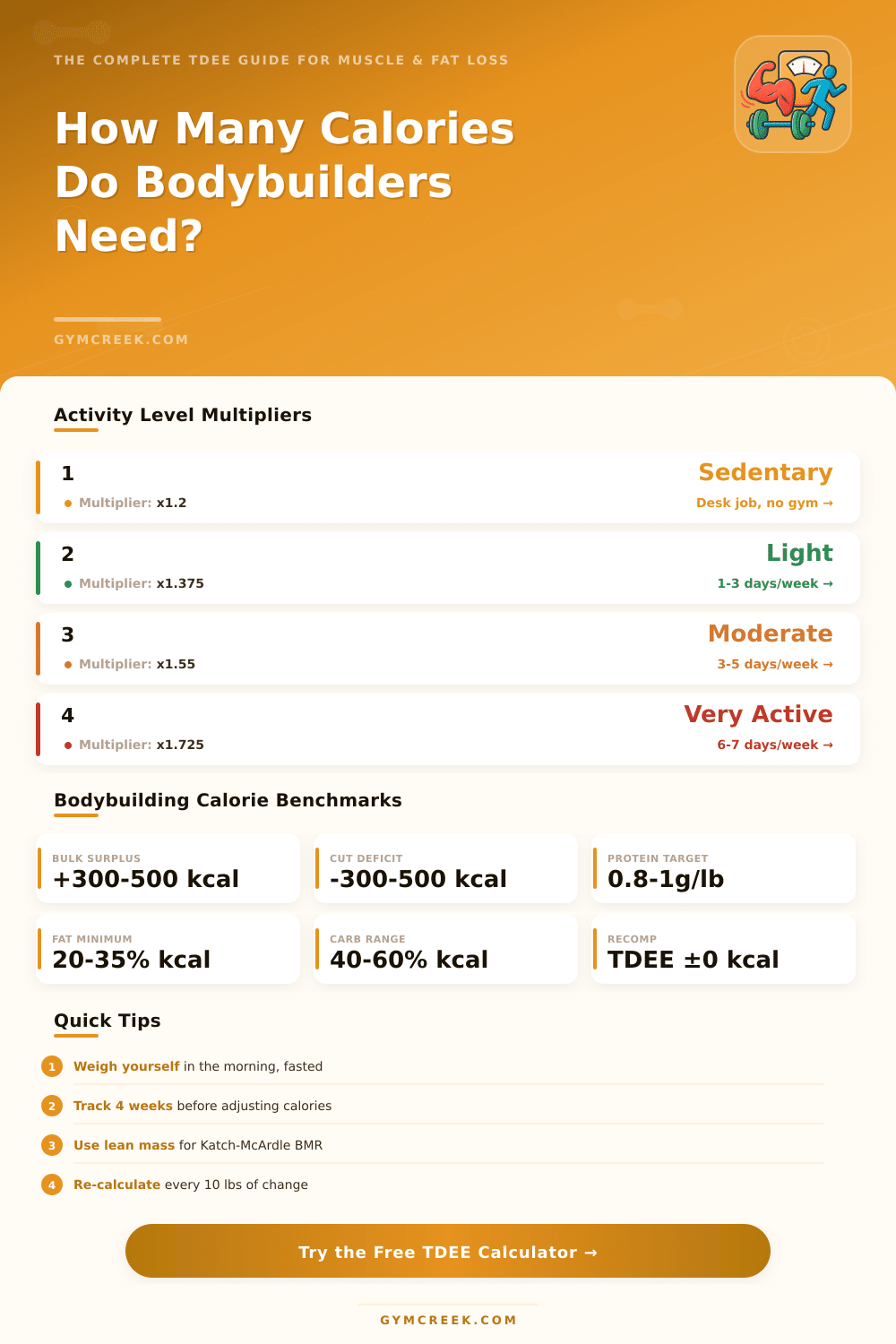
| Activity Level | Multiplier | Training Frequency | Typical Bodybuilder Profile |
|---|---|---|---|
| Sedentary | 1.2 | No structured exercise | Complete beginner, recovering from injury |
| Lightly Active | 1.375 | 1–3 days/week | Part-time lifter, mostly sedentary job |
| Moderately Active | 1.55 | 3–5 days/week | Intermediate bodybuilder, gym 4x/week |
| Very Active | 1.725 | Hard training 6–7 days | Advanced lifter, high-volume programs |
| Extremely Active | 1.9 | 2x/day or physical job | Competitive bodybuilder in prep phase |
| Goal | Calorie Adjustment | Expected Weekly Change | Best For |
|---|---|---|---|
| Lean Bulk | +300 kcal/day | +0.25–0.5 lbs lean mass | Minimizing fat gain while building muscle |
| Aggressive Bulk | +500 kcal/day | +0.5–1 lb/week | Beginners, underweight lifters |
| Maintenance / Recomp | 0 kcal | Gradual recomposition | Intermediate lifters at healthy body fat |
| Moderate Cut | -300 kcal/day | -0.5 lb/week fat loss | Preserving muscle during off-season cut |
| Aggressive Cut | -500 kcal/day | -1 lb/week fat loss | Pre-contest or rapid fat loss phases |
| Contest Prep | -700 kcal/day | -1.2–1.5 lbs/week | Competitive bodybuilders, short timeline |
| Category | Males | Females | Bodybuilding Context |
|---|---|---|---|
| Essential Fat | 2–5% | 10–13% | Contest stage level, not sustainable long-term |
| Athletic | 6–13% | 14–20% | Competitive bodybuilder off-season |
| Fitness | 14–17% | 21–24% | Lean bulk starting point |
| Average | 18–24% | 25–31% | Typical gym-goer, cut phase recommended |
| Obese | 25%+ | 32%+ | Prioritise fat loss before bulking |
| Goal | Protein | Carbs | Fat | Protein Target (per lb BW) |
|---|---|---|---|---|
| Lean Bulk | 30% | 50% | 20% | 0.8–1.0g/lb |
| Aggressive Bulk | 25% | 55% | 20% | 0.7–0.9g/lb |
| Maintenance / Recomp | 35% | 40% | 25% | 1.0–1.1g/lb |
| Moderate Cut | 40% | 35% | 25% | 1.0–1.2g/lb |
| Aggressive Cut | 45% | 30% | 25% | 1.2–1.4g/lb |
| Contest Prep | 50% | 25% | 25% | 1.4–1.6g/lb |
| Age Group | Avg Male BMR | Avg Female BMR | Notes |
|---|---|---|---|
| 15–20 | 1,800–2,100 kcal | 1,450–1,700 kcal | Peak growth hormone, efficient metabolism |
| 21–30 | 1,700–2,000 kcal | 1,400–1,650 kcal | Prime muscle-building years |
| 31–40 | 1,600–1,900 kcal | 1,300–1,550 kcal | Slight metabolic slowdown begins |
| 41–50 | 1,500–1,800 kcal | 1,250–1,500 kcal | Prioritise protein intake to preserve mass |
| 51+ | 1,400–1,650 kcal | 1,150–1,400 kcal | Resistance training essential to offset decline |
Your Total Daily Energy Use, short for TDEE, shows the whole amount of calories that you burn in one day to back your body functions, including exercise. Think of it as your BMR (the energy that you spend simply sitting through the day) plus the extra calories that you burn through training and daily movement. If you care about bodybuilding or sporting activity, this number really matters when you set your nutrition.
DISCLOSURE: This post may contain affiliate links, meaning when you click the links and make a purchase, I receive a commission. As an Amazon Associate I earn from qualifying purchases.

Here the spot: food works as the fuel that powers everything. Whether you want more tough lifts or want to grow muscle, everything depends on what and how much you eat. Your nutrition backs directly your training.
TDEE: Your Daily Calories and How to Use Them
To know how to get muscles you not only need to know what foods help, but also how much of them you really need, and here TDEE becomes your guide.
To count TDEE, the formula looks at several things: your age, gender, body weight, height and your daily activity. The BMR part stays the base, because it points the calories that you burn in full rest. Later TDEE gorws according to rating of the extra calories that your movement and training use daily.
Say that your BMR is 1559; after adding for exercise, it could reach around 2553 for your TDEE.
The simplest way to guess TDEE? Multiply your body weight by a calorie number. Problem is that those ratings stay only rough, even in the best case.
Every person’s daily motion is different. Unless you are a professional bodybuilder, your muscle mass itself will not alter TDEE a lot, compared too usage of your whole body weight as base.
Your TDEE adjusts when your lifestyle adjusts. Set daily routine keeps it stable, but sudden changes (as new job), different training plan or anything (can quickly raise it). The real value comes only from real follow-up.
Note your foods honestly, measure your weight each morning, and gather data for some weeks. That strips the real level that you live, and helps to count whether to eat more or less.
To lose weight, you must eat less than you burn. Aim for 80 to 90 percent of your TDEE, to create a gap that is safe and lasting. 20 percent cut is the usual advice, so if your TDEE is 2553, that lays you at around 2042 calories a day.
Many calculators also share the macros, like carbs, fat and protein, based on whether you bulk or cut.
To get muscle, adding around 500 calories above your TDEE commonly is the best. Research studies show that muscle gain tops out at about 0.75 pounds per week in perfect conditions. That extra 500 calories help to build muscle well, while at least growing less extra fat.
Recall that when your weight and activity adjust over time, your TDEE also moves, sorecounting it is a key part of the plan.