Army PFT Calculator
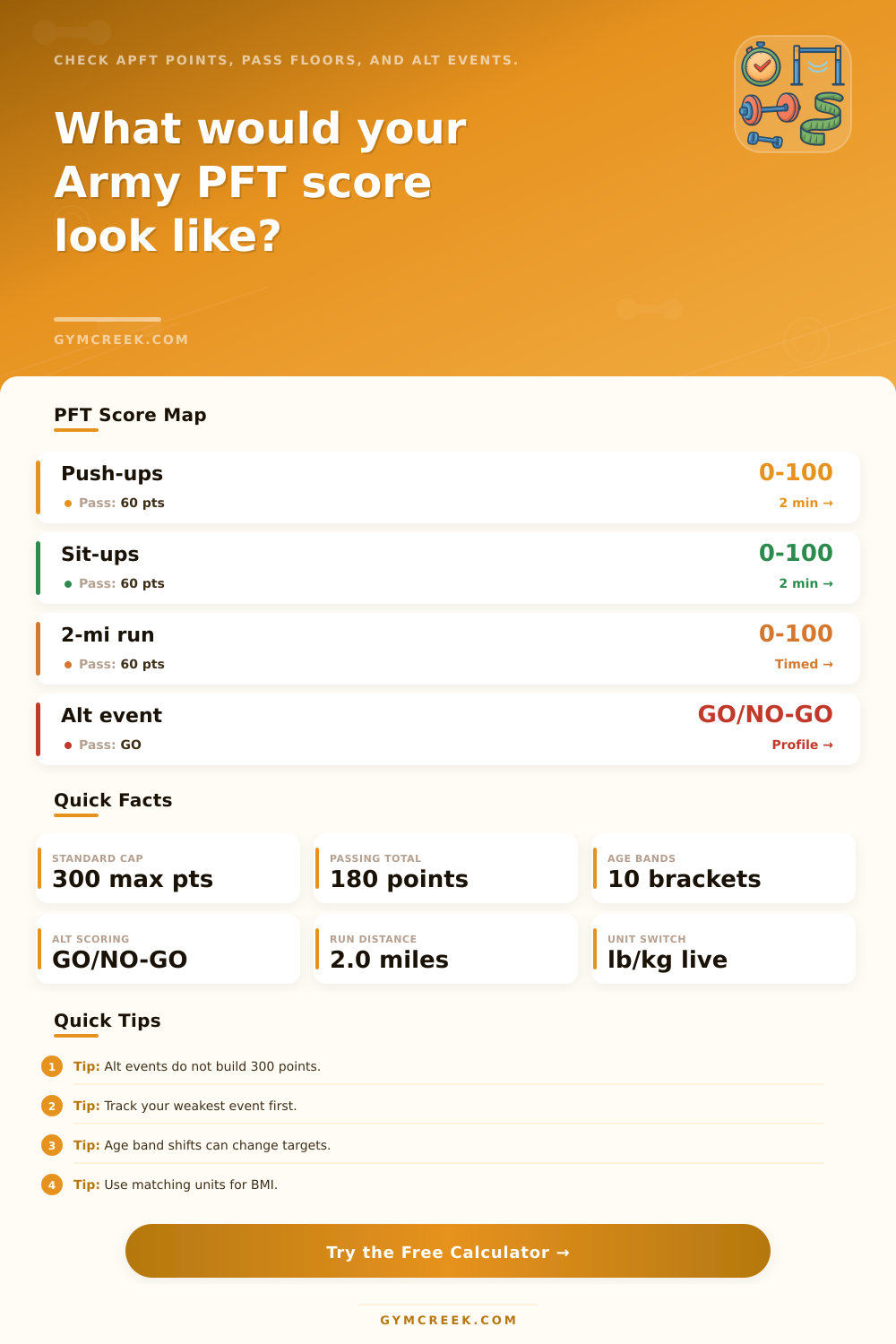
Estimate a legacy Army PFT or APFT-style result with age-and-gender scoring bands for push-ups, sit-ups, and the 2-mile run, plus alternate aerobic pass logic for profile cases.
📌Preset Soldier Profiles
These nine presets span entry, school, recheck, and permanent-profile scenarios so you can compare standard scoring against alternate aerobic pass rules.
⚙PFT Inputs
Army PFT readiness snapshot
Enter your event data to estimate points, pass status, and alternate-event context.
📊Metrics Grid
📑Reference Tables
| Event | Scoring | Pass line | Why it matters |
|---|---|---|---|
| Push-ups | 0 to 100 | 60 points | Upper-body endurance floor |
| Sit-ups | 0 to 100 | 60 points | Core endurance floor |
| 2-mile run | 0 to 100 | 60 points | Only standard aerobic points |
| Alt aerobic | GO or NO-GO | Meet table time | Profile-based record path |
| Age band | M push 60 | F push 60 | Sit-up 60 |
|---|---|---|---|
| 17-21 | 42 | 19 | 53 |
| 27-31 | 39 | 17 | 45 |
| 42-46 | 30 | 12 | 38 |
| 57-61 | 18 | 8 | 27 |
| Alt event | 17-21 M/F | 37-41 M/F | 62+ M/F |
|---|---|---|---|
| 800-yd swim | 20:00 / 21:00 | 22:00 / 23:00 | 25:00 / 26:00 |
| 6.2-mi bike | 24:00 / 25:00 | 26:00 / 27:00 | 32:00 / 34:00 |
| 2.5-mi walk | 34:00 / 37:00 | 36:00 / 39:00 | 38:30 / 41:30 |
| Scoring read | GO only | GO only | GO only |
| Total | Read | Meaning | Use case |
|---|---|---|---|
| 300 | Perfect | All three events maxed | Legacy benchmark |
| 270+ | Strong | Comfortable packet range | School prep |
| 180-269 | Passing | Meets 60 per event | Diagnostic or packet |
| Under 180 | Below line | At least one weak event | Targeted training |
💡Tips
The Army Physical Fitness Test (PFT) are used to measure the physical fitness level of soldier through three separate events. The three events for the PFT are push-ups, sit-ups, and a two-mile run. Each soldier must compete in each of these event to recieve a passing score on the test.
Push-ups test a soldier’s upper-body endurance, sit-ups tests a soldier’s physical strength and stability, and the two-mile run tests a soldier’s cardiovascular endurance. To earn a passing score for the PFT, each soldier must earn at least 60 point for each event, which ensure that the soldier earns at least 180 points for all three events for a passing grade on the test. The score that the soldier earns on each of the events for the PFT change according to the age of the soldier taking the test.
Army PFT: Push-ups, Sit-ups and Two-Mile Run
For example, a soldier between the ages of 17 and 21 must perform more repetitions for each event then a soldier between the ages of 42 and 46. Therefore, a soldier whose age is 20 years of age will have different requirement for push-ups and sit-ups than a soldier whose age is 45 years of age. Additionally, women have there own scoring scale for each of the PFT events, which have different requirements for each event.
Some soldiers may not be able to compete in the PFT due to their medical profile for that soldier. A medical profile is given to a soldier if that soldier is injury and cannot perform certain physical activities. For soldiers with a medical profile, the two-mile run event can be replaced with activities like swimming or cycling.
These alternative events dont provide points for the soldier’s score, but the soldier must compete in them within a specific time to earn a passing score for their physical fitness test. For soldiers with a medical profile, soldiers must still earn at least 60 point in the push-up and sit-up events. Soldiers must focus on performing each event proper for the PFT.
For push-ups, the soldier’s chest should reach the ground and their elbows should be at a 90 degree angle to the soldier’s body. If a soldier does not complete the push-ups with the proper form, the soldier will not earn any points for those push-ups. For sit-ups, the soldier should place their hand behind their head and touch their elbows to their knee.
If the soldier does not perform the sit-ups with the proper form, the soldier will not earn any points for those sit-ups. For the two-mile run, the soldier should not start too fast for the run. If the soldier starts too fast, they may not have enough energy to run the two-mile distance at a required speed.
Soldiers can improve their score on the test by focus on their weakest event. For example, if a soldier earns 70 points for their push-up event but only 45 points for their sit-up event, the soldier should of focus on improving their sit-up score to earn at least 60 points. Improving one event will result in an improved total score for the soldier.
Additionally, soldiers should be aware of external factor that may impact the soldiers score on the physical fitness test. These factors include heat, altitude, and lack of sleep for the soldier. Preparing for these factors and understanding the way in which the PFT may impact a soldier’s physical performance is an important part of preparing to take the test.