💧 Sweat Rate Calculator
Measure your fluid loss during exercise & get personalized hydration data
| Body Weight Lost | Dehydration Level | Performance Impact | Recommended Action |
|---|---|---|---|
| < 1% | Minimal | None significant | Maintain normal intake |
| 1% – 2% | Mild | ~10% aerobic decline | Increase fluid intake |
| 2% – 3% | Moderate | Reduced endurance | Rehydrate promptly |
| 3% – 4% | Significant | Strength & cognition drop | Rehydrate immediately |
| > 5% | Severe | Heat illness risk | Medical attention possible |
| Sweat Rate | Per Hour (L) | Per Hour (fl oz) | Replace Per Hour |
|---|---|---|---|
| Very Low | 0.3 L | ~10 fl oz | ~8 fl oz |
| Low | 0.5 L | ~17 fl oz | ~14 fl oz |
| Moderate | 0.8 L | ~27 fl oz | ~22 fl oz |
| High | 1.2 L | ~41 fl oz | ~33 fl oz |
| Very High | 1.8 L | ~61 fl oz | ~49 fl oz |
| Extreme | 2.5+ L | ~85+ fl oz | ~68 fl oz |
| Weight Lost (lbs) | Weight Lost (kg) | Fluid Lost (fl oz) | Fluid Lost (L) |
|---|---|---|---|
| 0.5 lbs | 0.23 kg | 7.7 fl oz | 0.23 L |
| 1.0 lb | 0.45 kg | 15.3 fl oz | 0.45 L |
| 1.5 lbs | 0.68 kg | 23.0 fl oz | 0.68 L |
| 2.0 lbs | 0.91 kg | 30.7 fl oz | 0.91 L |
| 3.0 lbs | 1.36 kg | 46.0 fl oz | 1.36 L |
| 4.0 lbs | 1.81 kg | 61.4 fl oz | 1.81 L |
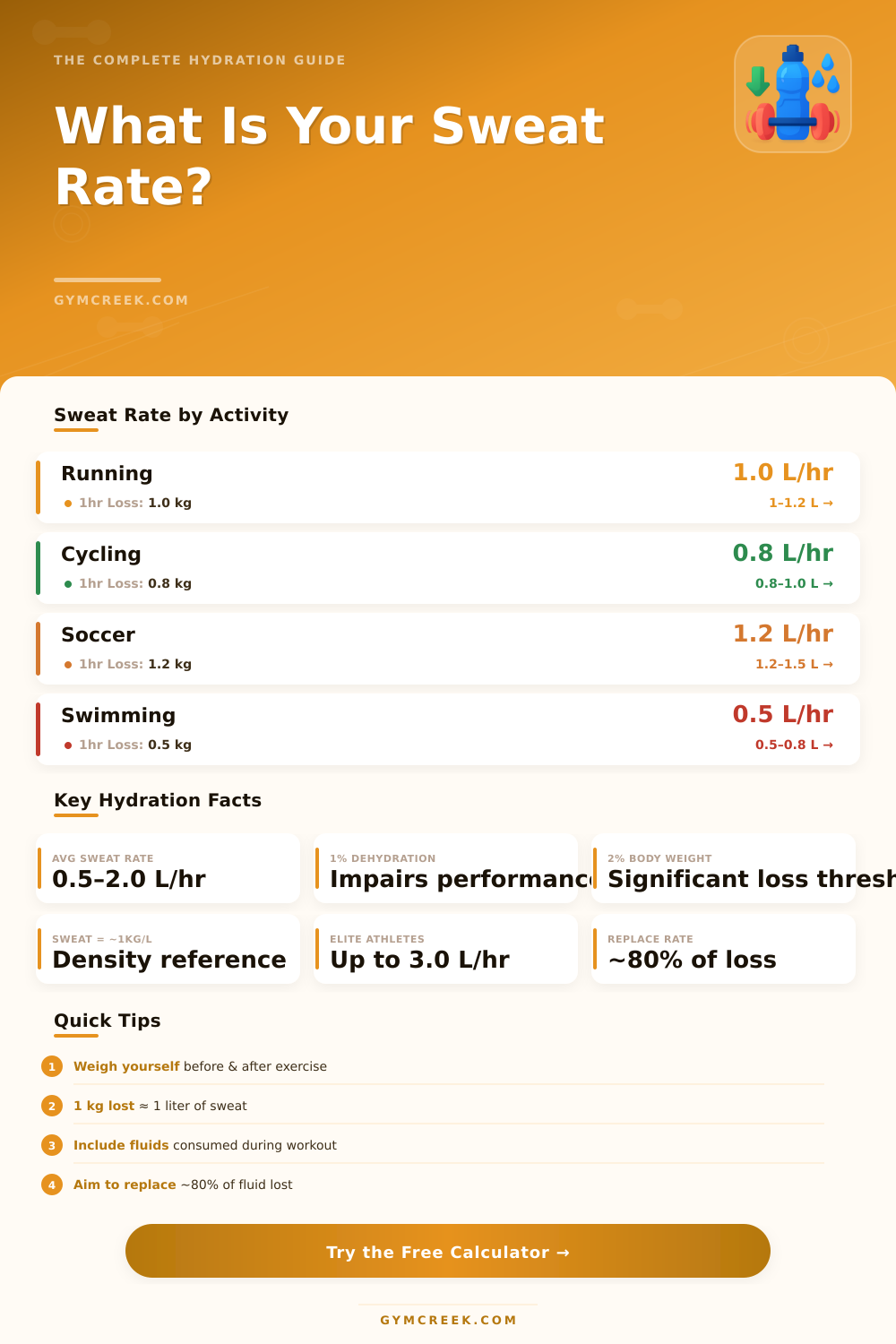
| Activity (1 hr) | Avg Sweat Loss | Fluid to Replace (80%) | Electrolyte Need |
|---|---|---|---|
| Easy Jog | 0.6–0.9 L | 480–720 mL | Low |
| Tempo Run | 1.0–1.4 L | 800 mL–1.1 L | Moderate |
| Road Cycling | 0.7–1.1 L | 560–880 mL | Low–Mod |
| HIIT Session | 1.0–1.6 L | 800 mL–1.3 L | Moderate |
| Soccer Match | 1.0–2.0 L | 800 mL–1.6 L | High |
| Weightlifting | 0.4–0.7 L | 320–560 mL | Low |
| Hot Yoga | 1.5–2.5 L | 1.2–2.0 L | High |
Sweat rate are a measurement of the amount of fluid that an individual lose through the process of sweating during exercise. Sweat is one of the bodys mechanism for preventing the body from becoming more hot through exercise. As the body sweat, the body loses fluid and electrolytes.
If an individual lose too much fluid through sweating, dehydration can occur. Dehydration can lead to a decrease in an individual’s endurance and aerobic capacity. As a result, it is important for individual to measure there sweat rate in order to develop an effective hydration strategy that enable them to maintain their physical performance.
How to Measure Your Sweat Rate
To measure an individual’s sweat rate, the individual should weigh themself without clothes before beginning to exercise. Prior to weighing themselves, the individual should not consume any food or water for at least one hour. Afterwards, the individual should exercise for a specific length of time (such as one hour).
Following exercise, the individual should weigh themselfs again. Subtract the post-exercise weight from the pre-exercise weight to calculate the total weight loss of the individual. If the individual consume fluids during exercise, add that amount of fluid to the total weight loss.
Divide the total weight loss by the length of time (in hours) that the individual exercised. The result of this equation will be the individuals sweat rate (in liters or ounce per hour). An individual’s sweat rate can vary with a variety of factors.
Factors that can impact an individual’s sweat rate include the environment in which they exercise, the intensity of the exercise, and the type of activity perform. For instance, hot and humid environments will lead to increased sweating by the body. Additionally, individuals that perform high-intensity exercises will typically sweat more than individuals performing low-intensity exercise.
Similarly, individuals that perform activities like running in the sun will typically lose more fluid than individuals who exercise in activities like swimming in a pool. Consequently, an individual’s sweat rate can vary with these different factors, so it is important for individuals to measure their rate under a variety of condition. While it is important to replace the fluids an individual loses through exercise, it isnt necessary for an individual to replace 100% of the fluids that they lose through exercise.
Instead, most exercise expert recommend that individuals drink approximately 80% of the amount of fluid that they lose. If an individual drink excessive amount of plain water, they may dilute the sodium content of their blood. This condition is known as hyponatremia, and can lead to bloating and confusion.
If an individual that naturaly lose alot of salt through there sweat, they should consume electrolytes as well as water to replace the electrolytes that they naturaly lose. Dehydration is the condition of an individual loses a certain percentage of their body weight through the fluid that they lose in their sweat. If an individual lose less than 1% of their body weight through dehydration, they will not experience negative effect from dehydration.
However, if an individual lose between 1-2% of their body weight, they may begin to feel increases in their heart rate, along with decreases in their mental clarity. However, if an individual lose more than 2% of their body weight, their physical endurance and strength will begin to decrease significantly. Individuals can avoid these effects by using individual’s sweat rate as a means of determining how much fluid they should of consume prior to, during, and after their exercise period.
An individual can improve their hydration strategy by utilizing their sweat rate to guide them in the amount of fluid that they should consume during different phase of their exercise routine. Before exercise, individuals should consume fluids to ensure that their bodies are properly hydrate. During exercise, they should take sips of fluid rather than drinking large amount of fluid.
After exercise, individuals should use their sweat rate to determine the amount of fluid that they need to consume to recover from their exercise routine. Thus, by measuring their sweat rate, individuals can develop a strategy for hydration that is based off their own bodies rather than guesswork.