🚶 Stride Length Calculator
Calculate your stride length, steps per mile & distance from height or measured walk
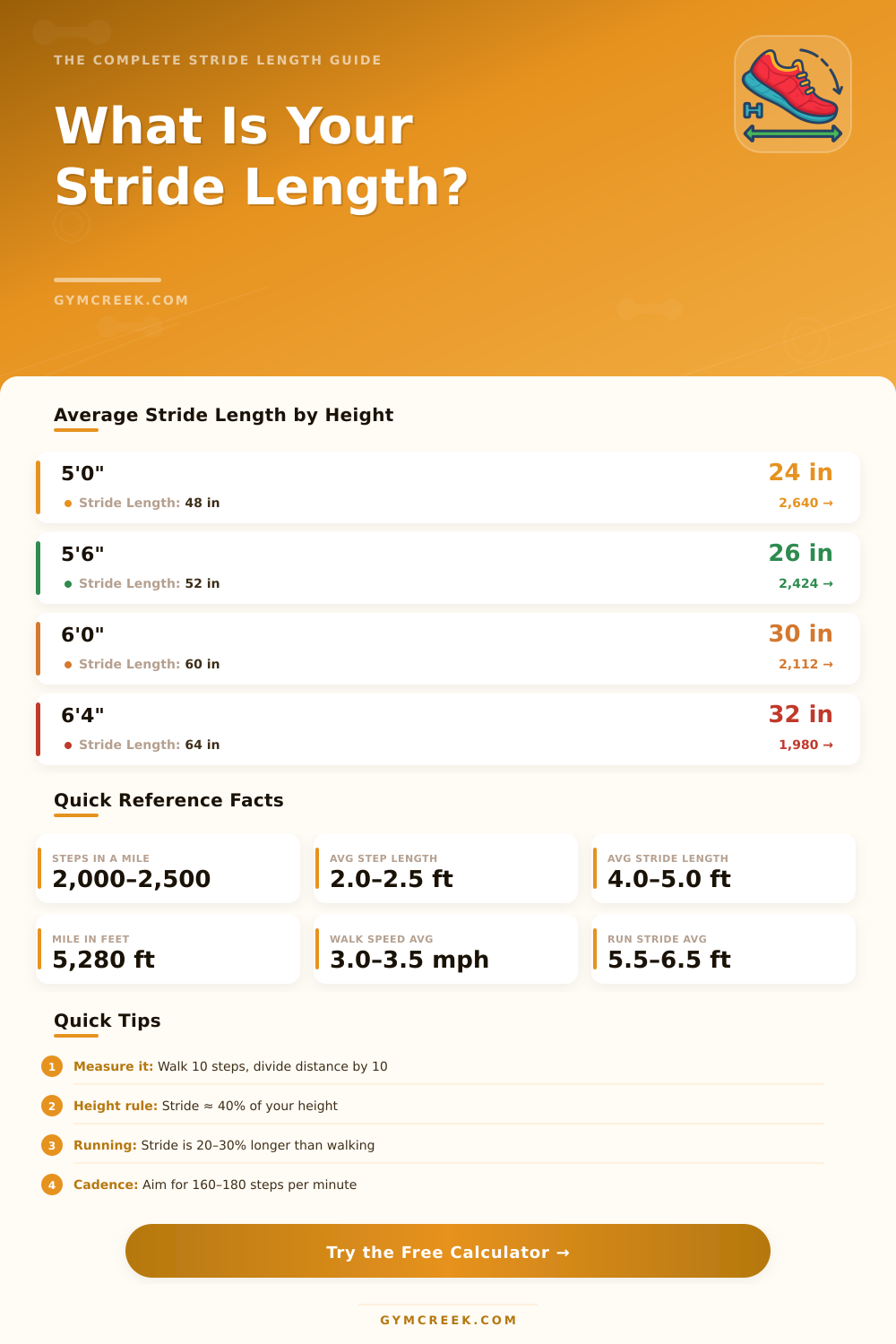
| Height | Step Length (in) | Steps/Mile Walking | Steps/Mile Running | Stride Length (ft) |
|---|---|---|---|---|
| 4'10" (147 cm) | 22.5 in | 2,816 | 2,025 | 3.75 ft |
| 5'0" (152 cm) | 24.0 in | 2,640 | 1,900 | 4.0 ft |
| 5'2" (157 cm) | 25.0 in | 2,534 | 1,823 | 4.17 ft |
| 5'4" (163 cm) | 26.0 in | 2,436 | 1,753 | 4.33 ft |
| 5'6" (168 cm) | 27.0 in | 2,344 | 1,687 | 4.5 ft |
| 5'8" (173 cm) | 28.0 in | 2,262 | 1,628 | 4.67 ft |
| 5'10" (178 cm) | 29.0 in | 2,184 | 1,572 | 4.83 ft |
| 6'0" (183 cm) | 30.0 in | 2,112 | 1,521 | 5.0 ft |
| 6'2" (188 cm) | 31.5 in | 2,012 | 1,448 | 5.25 ft |
| 6'4" (193 cm) | 33.0 in | 1,920 | 1,382 | 5.5 ft |
| Steps | Distance (26 in step) | Distance (30 in step) | Distance (km) | Time (3 mph) |
|---|---|---|---|---|
| 1,000 | 0.41 miles | 0.47 miles | 0.66–0.76 km | ~8 min |
| 2,000 | 0.83 miles | 0.95 miles | 1.33–1.52 km | ~17 min |
| 2,500 | 1.03 miles | 1.19 miles | 1.66–1.9 km | ~21 min |
| 5,000 | 2.07 miles | 2.37 miles | 3.33–3.81 km | ~41 min |
| 8,000 | 3.31 miles | 3.79 miles | 5.33–6.1 km | ~66 min |
| 10,000 | 4.14 miles | 4.73 miles | 6.67–7.62 km | ~83 min |
| 12,000 | 4.97 miles | 5.68 miles | 7.99–9.14 km | ~99 min |
| 15,000 | 6.21 miles | 7.10 miles | 10.0–11.4 km | ~124 min |
| Race / Distance | Miles | Steps (avg walk) | Steps (avg run) | Metric |
|---|---|---|---|---|
| 1 Mile | 1.0 mi | ~2,200 | ~1,600 | 1.6 km |
| 5K | 3.1 mi | ~6,820 | ~4,956 | 5 km |
| 10K | 6.2 mi | ~13,640 | ~9,912 | 10 km |
| 10 Miles | 10.0 mi | ~22,000 | ~16,000 | 16.1 km |
| Half Marathon | 13.1 mi | ~28,820 | ~20,960 | 21.1 km |
| Full Marathon | 26.2 mi | ~57,640 | ~41,920 | 42.2 km |
| Activity | Cadence (steps/min) | Typical Speed | Step Length (avg) | Stride Length (avg) |
|---|---|---|---|---|
| Slow Walk | 80–100 | 2.0–2.5 mph | 20–24 in | 40–48 in |
| Normal Walk | 100–120 | 2.5–3.5 mph | 24–28 in | 48–56 in |
| Brisk Walk | 120–140 | 3.5–4.5 mph | 28–32 in | 56–64 in |
| Power Walk | 130–150 | 4.0–5.0 mph | 30–34 in | 60–68 in |
| Easy Jog | 150–165 | 5.0–6.5 mph | 36–42 in | 72–84 in |
| Running | 165–180 | 6.5–9.0 mph | 42–52 in | 84–104 in |
| Fast Running | 180–200 | 9.0–12 mph | 50–62 in | 100–124 in |
Step length are the measurement of the distance that a person cover during a single step. Step length is a necessary measurement for translating the number of steps that a person take into the distance that they have traveled. While fitness trackers and smartwatches will count the number of steps that a person takes, they does not measure the distance.
This is because the device dont know the length of the steps of the individual using the device. A step can be described as the movement of one foot forward, but a stride is the movement of one foot to the next foot. A stride is approximately twice the length of the step distance.
What Is Step Length and How to Measure It
Thus, an individual must understand the difference between these two distance to calculate the distance that they have traveled. Individuals that are tall have longer step lengths than individuals that is short in stature. Therefore, an individual that is tall will travel more distance with few steps compared to an individual that is short in stature.
The type of activity that an individual perform will alter the length of the steps that they take. For instance, an individual that walks will have shorter steps than an individual that runs because they are not traveling as far with each movement of the leg. However, an individual that is hiking on uneven terrain will have shorter steps than an individual that is walking on even terrain.
Additionally, the number of steps that an individual take in a specific period of time, also known as cadence, will impact the distance that they have traveled. Cadence is expressed in the number of steps that a person takes in a minute. Cadence and step length are both important variable in determining the walking speed of an individual.
A variety of methods can determine an accurate step length. One method is to use a tape measure to physically measure the distance that an individual takes ten natural step. Once you have measured the total distance for ten steps, you can divide the distance by ten to find the true step length of the individual.
Another method of measuring step length is to time the distance that an individual travel, such as one mile, and dividing the total number of steps by the distance traveled. Using these measurement methods is more accurate than using formulas based off an individual’s height because these methods accounts for an individual’s specific physical quirks and the way in which they walk. Another way of estimating an individual’s step length is through their height.
According to biomechanics research, an individual’s step length is approximately 41 percent of their total height when measured in inches. For instance, if an individual is 70 inches in height, they can calculate their step length by multiplying 70 by 0.41. This method of calculating step length is less precise than directly measuring an individual’s step length because this method do not account for an individual’s specific leg length and fitness levels.
By knowing an individual’s step length, there are various fitness goal that can be planned according to that measurement. For instance, if an individual desires to walk specific distance, such as a 5K or marathon distance, they can use their calculated step length to determine how many step they must take to cover that distance. On average, an individual takes between 2,000 and 2,500 steps to travel one mile when walking.
However, this number can decrease if the individual is running at a steady pace, as running cover more distance per step than walking. Furthermore, an individual’s cadence can also be used to estimate their traveling speed. If an individual takes 120 steps per minute, they will travel at a speed that is dependent upon the length of their step.
If the individual takes shorter steps, they will travel at a slower rate compared to an individual that takes longer steps of the same rate of cadence. However, there are some common error that may occur when attempting to calculate an individual’s distance traveled. One of the most common error is to confuse step length and stride length.
Using stride length instead of step length will double the individual’s estimated distance traveled. Additionally, ignoring cadence is another mistake that may be made. However, ignoring cadence is a mistake because cadence can impact the distance traveled over specific lengths of time.
Furthermore, assuming that an individual’s step length will be the same as others without considering leg length and fitness levels is another error. Step length dont apply to everyone. To avoid these errors, individuals can measure their step length periodically to account for any changes in their fitness or stepping form.
Finally, individuals can use GPS tracking to cross-check the accuracy of the steps and distance traveled by the individual.