Steps to Calories Burned Calculator
Estimate how many calories your steps likely burned by blending stride-based distance, walking or run-walk pace, grade, terrain, body weight, and daily step-goal context in one view.
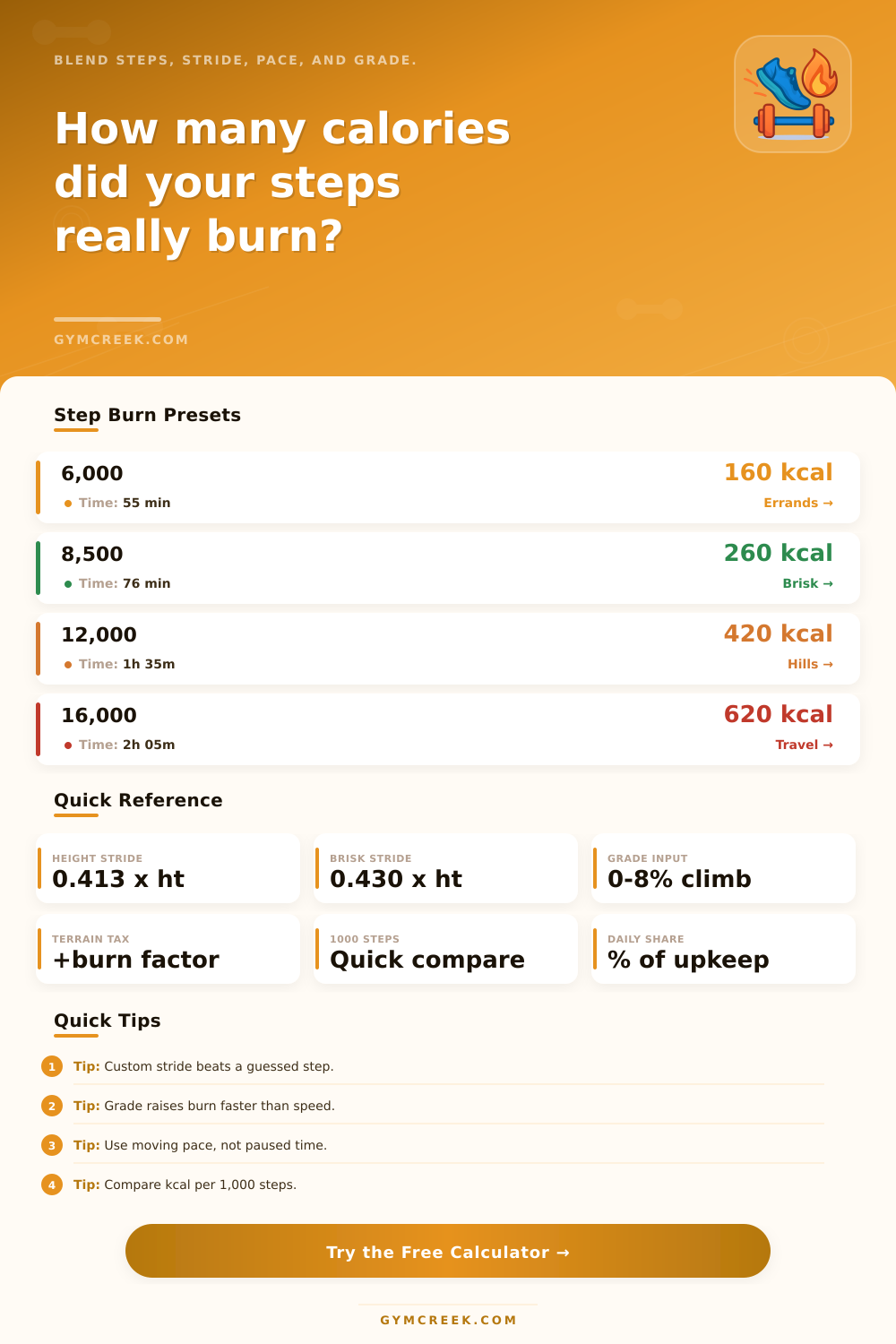
📌Preset Step Days
These nine presets cover realistic step-heavy days so you can compare office movement, brisk walking, travel mileage, and higher-burn run-walk sessions without rebuilding the form from scratch.
⚙Step Burn Inputs
Steps to calories snapshot
Enter your step count, pace, and stride details to estimate calorie burn.
📊Step Metrics
📑Reference Tables
| Body wt | Flat | 3% grade | Sand |
|---|---|---|---|
| 125 lb | 29 kcal | 38 kcal | 35 kcal |
| 155 lb | 36 kcal | 47 kcal | 43 kcal |
| 185 lb | 43 kcal | 56 kcal | 51 kcal |
| 215 lb | 50 kcal | 65 kcal | 60 kcal |
| Steps | Miles* | Calories* | Read |
|---|---|---|---|
| 4,000 | 1.8-2.0 | 100-170 | Light day |
| 8,000 | 3.5-4.0 | 220-340 | Active day |
| 12,000 | 5.2-6.0 | 340-520 | Big walk |
| 16,000 | 7.0-8.0 | 480-720 | Travel or hike |
| Pace | Min/mi | ACSM MET | Read |
|---|---|---|---|
| 2.5 mph | 24:00 | 2.8 | Easy stroll |
| 3.0 mph | 20:00 | 3.5 | Steady walk |
| 3.8 mph | 15:47 | 4.7 | Brisk walk |
| 5.0 mph | 12:00 | 8.0 | Run-walk edge |
| Output | Formula | Inputs | Purpose |
|---|---|---|---|
| Stride | 0.413 to 0.445 x ht | Height or custom step | Distance estimate |
| Calories | ACSM walk or run | Pace, grade, weight | Primary burn model |
| Goal burn | Burn x goal ratio | Steps and daily goal | Project full-day total |
| Upkeep share | Mifflin x activity | Sex, age, ht, wt | Daily context |
💡Practical Tips
Steps can calculates the total movement that a person makes, but the measurement of the calories that the body burns from performing those steps are not as accurate. Steps only measure the number of times that a person move their legs, but the number of calories that the body burns is related to many different factor altogether. One of the main factors that impact the number of calories that the body burns as a person takes a certain number of steps is the distance that the person walks.
Not all individual have the same stride lengths, for instance. An individual that is tall will take a longer stride than an individual that is short, which means that the tall individual will travel further with the same number of steps as the short individual. An individual can calculate their stride length by multiplying their height by 0.4, but measuring their stride length while they walk can provide more accuratly result.
Steps Do Not Accurately Measure Calories Burned
The distance that an individual travels has an impact on the number of steps that they must take to cover that distance; the more steps that an individual takes, the more energy that their body must expend to cover that distance. Another factor that impact the number of calories that are burned during a certain number of steps is the pace at which the individual walks. Individuals that walk at slow rates, such as 2.5 miles per hour, will burn fewer calories than individuals that walk at a faster and more briskly rate, such as 3.8 miles per hour.
Additionally, rates of over 5 miles per hour will cause the body to utilize energy in different way; it must use more glycogen stores of energy to fuel those faster strides. The third main factor in the number of calories that the body burns as it walks a certain number of steps is the incline and the terrain where the individual perform their walking. An incline is any slope or hill that the walker climbs.
If any incline is used, the demands for oxygen of the body will increase. For instance, if the individual climbs a hill with a 3% incline, their demands for oxygen can increase 50% or more compared to when they are walking on flat terrain. Terrain includes the type of surface upon which an individual walks; pavement is more efficient than sand or trails, for instance.
Thus, calories will be burned at a higher rate if an individual is walking on sand or on a trail compared to pavement. The fourth main factor is the bodys weight of the individual. The heavier the individual, the more calories will be burned as compared to an individual of a lower body weight.
For instance, an individual that weighs 155 pounds will burn 36 calories during 1,000 steps, while an individual that weighs 215 pounds may burn 50 calories during those same 1,000 steps. Other factors, such as the age or gender of the individual will impact the calories that the body burns throughout the day. Many individuals makes mistakes when attempting to calculate the calories that the body burns from walking a certain number of steps.
Individuals may only consider the total number of steps that they walked. For example, an individual might think that walking 10,000 steps will always burn the same amount of calories, but this isnt true. If an individual takes more steps per minute (cadence), they will burn more calories.
Additionally, total walking time does not necessarily equal movement time; walking for 30 minutes with 5-minute breaks will take an individual longer to walk 10,000 steps, but they will have burned fewer calories than if they walked for 30 minutes without taking any break. In order to accuratly calculate the number of calories that the body burns during a specific period, an individual should consider each of these different factors. For example, by calculating the number of calories that are burned per 1,000 steps, an individual may find that they burn more calories when they walk at a faster pace on an incline than when they walk slowly on flat terrain for the same amount of steps.
Finally, while steps are used to encourage individuals to incorporate more movement into their lives, they should of also provide time for the body to rest and recover to avoid overtaxing their joint.