CSS Swim Calculator
Estimate critical swim speed from 200 and 400 tests, then project training splits, benchmark times, and pool-lap targets.
Each preset loads a real swim test profile, updates units, and recalculates CSS right away.
CSS swim profile
Enter your 200 and 400 tests and the calculator will project CSS pace, split targets, and benchmark times.
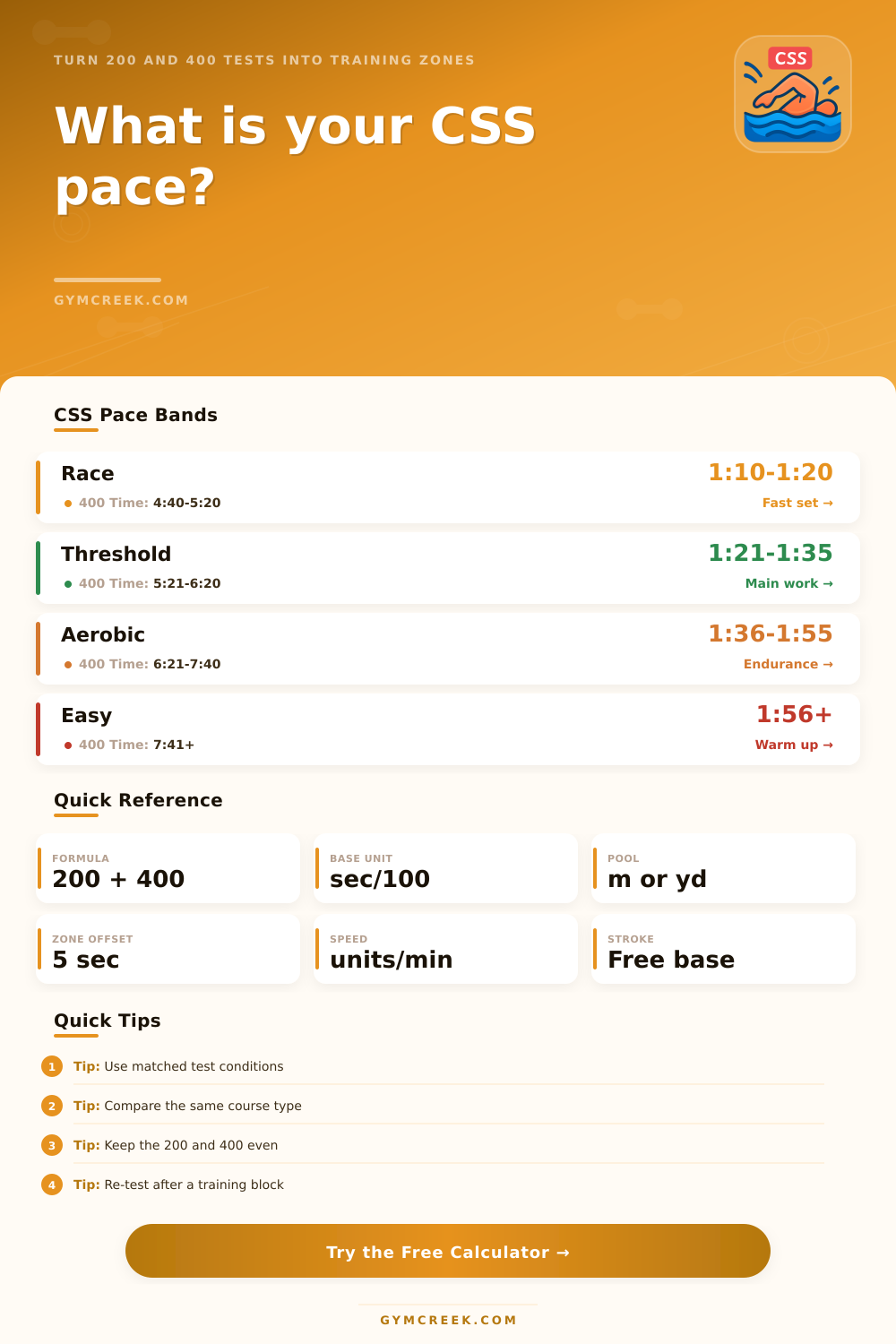
| Band | CSS/100 | 400 time | Use |
|---|---|---|---|
| Race | 1:10-1:20 | 4:40-5:20 | Fast set |
| Threshold | 1:21-1:35 | 5:21-6:20 | Main work |
| Aerobic | 1:36-1:55 | 6:21-7:40 | Endurance |
| Easy | 1:56+ | 7:41+ | Warm up |
| Zone | Pace | 100 repeat | Purpose |
|---|---|---|---|
| Fast | -5 to -2 | Hard | Speed |
| CSS | 0 to +2 | Steady | Main set |
| Easy | +3 to +6 | Loose | Recovery |
| Open | +7+ | Long | Aerobic |
| Stroke | Factor | Bias | Note |
|---|---|---|---|
| Freestyle | 1.00x | Base | Best CSS test |
| Backstroke | 1.04x | Slow | Turn cost |
| Butterfly | 1.08x | Hard | Short reps |
| Breaststroke | 1.12x | Hardest | Most drag |
| Formula | Inputs | Output | Use |
|---|---|---|---|
| CSS pace | 200, 400 | Sec / 100 | Main split |
| Target time | CSS, dist | Total time | Benchmark |
| Lap split | CSS, pool | Per length | Pool pacing |
| Zone range | CSS, offset | Hard/easy | Training guide |
Use this CSS swim calculator to turn 200 and 400 test swims into critical swim speed, benchmark splits, and practical training zones for the next workout block.
Critical swim speed are a measurement of the rate at which a person can swim, and critical swim speed is the rate at which a person can swim for a long period of time without becoming too fatigued. Rather than being an abstract measurement of a swimmer’s capability, critical swim speed is a helpful tool in that it allow for a swimmer to use their test times to map out their training for the pool. A swimmer can use critical swim speed to plan their training for the pool.
Critical swim speed can be calculated by swimming two different distances. A swimmer is to swim a 200-meter distance and an 400-meter distance. After completing each of these distance, the time for each distance is recorded.
How to Find Your Critical Swim Speed
To calculate the critical swim speed for that swimmer, the coach subtracts the time for the 400-meter distance from the time for the 200-meter distance. The result of that subtraction is to be divided by two. This number will be the swimmer’s threshold pace in seconds per 100 meters.
The 200-meter distance is used to test the swimmer’s anaerobic ability, and the 400-meter distance test the swimmer’s aerobic ability. Many swimmers find this measurement helpful to understand there physical capability. With the calculation of critical swim speed, training zones can be established for that swimmer.
During main sets, the swimmer should swim at their critical swim speed. During interval training, however, the swimmer should swim more fast than their critical swim speed. During periods of recovery, such as between intervals, a swimmer should be swimming slower than their critical swim speed.
Many swim coaches establish these training lane by adding or subtracting five second per 100 meters from the swimmer’s critical swim speed. Freestyle swimming is often used as the baseline for measuring a swimmer’s critical swim speed, since freestyle swimming allow a swimmer to move through the water with less resistance than the other swimming strokes. Thus, strokes like butterfly, backstroke, and breaststroke may require different critical swim speed from the same swimmer due to the differences in resistance and strength in each stroke.
The distance of the pool in which a swimmer trains can affect their critical swim speed. In a 25-meter pool, which is common in many community pools, a swimmer will turn more frequent. Frequent turning allows a swimmer to maintain their pace for longer period of time.
In a 50-meter long course pool, which is common in swimming competitions, there will be fewer turns. Thus, a swimmer will have to maintain their critical swim speed for longer distance. For open water swimming, a swimmer may have to adjust for the movement of the water cause by waves or sighting targets.
Yet, the critical swim speed equation is unaffected. With the times calculated for each 200- and 400-meter distance, as well as the distance of the pool in which a swimmer trains, splits for distances like 100 meters, 1500 meters, or individual lap can be projected. In testing a swimmer’s critical swim speed, however, there are certain mistake that should be avoided.
For instance, if a swimmer tests their 200-meter distance with high intensity yet their 400-meter distance with low intensity, the resulting critical swim speed will be inaccurate. Additionally, both distances must be swam by fresh leg to ensure accuracy, and each distance must utilize the same swimming stroke. Furthermore, the swimmer should re-perform the critical swim speed test every four to six weeks to ensure that the swimmer can track their development in relation to their physical fitness.
A swimmer should account for stroke bias when comparing critical swim speed between strokes. For example, a swimmer will typically find that their critical swim speed for butterfly or breaststroke is slower then their critical swim speed for freestyle swimming. A swimmer’s critical swim speed can help to define different performance level.
For instance, a critical swim speed of under 1:20 per 100 meters will indicate the swimmer’s ability to race to the finish line. A critical swim speed between 1:21 and 1:35 will indicate the swimmer’s threshold pace. A critical swim speed between 1:36 and 1:55 will indicate their aerobic endurance.
Any critical swim speed slower than 1:36 will typically be used for warm-ups and recovery periods. Additionally, by calculating a swimmer’s critical swim speed, their time for a 1500-meter swim can be projected. Target splits can also be established for efforts like 200-meter swimming repeats.
Finally, all critical swim speed test should be logged in a notebook to monitor the physical condition of the swimmer.