Weightlifting Volume Calculator
Measure session tonnage, weekly working sets, and pattern-adjusted load for barbell and accessory blocks.
💪 Preset Training Blocks
🔧 Training Inputs
Weekly training volume snapshot
Current numbers compare the selected lift pattern, set count, and goal band.
📊 Fitness Metrics Grid
📖 Reference Tables
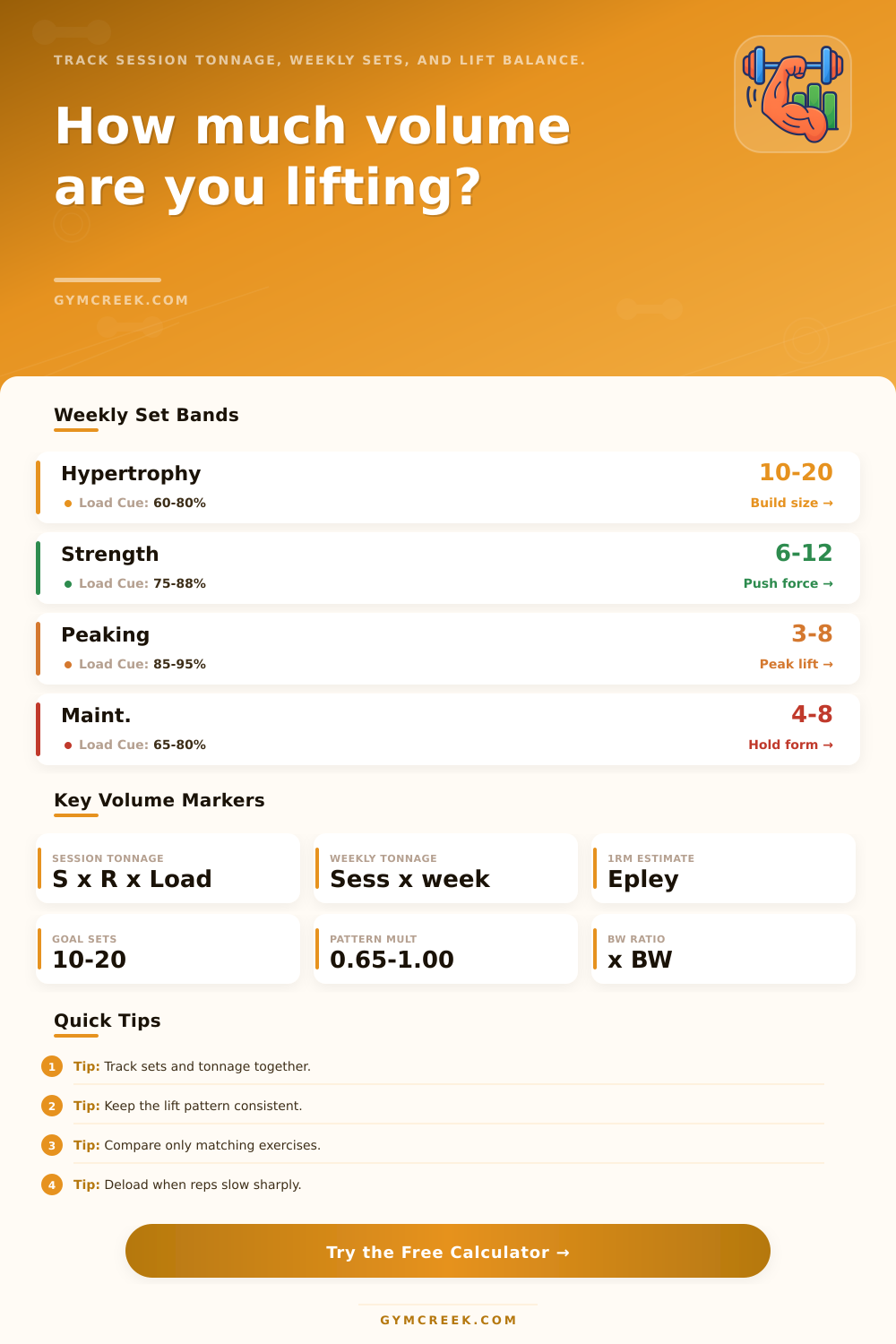
Goal bands and load cues
Use the goal selector to compare your current volume against common training targets for the same lift.
| Goal | Weekly sets | Load cue | Interpretation |
|---|---|---|---|
| Hypertrophy | 10-20 | 60-80% | Best for size and work capacity. |
| Strength | 6-12 | 75-88% | Balances load, volume, and recovery. |
| Peaking | 3-8 | 85-95% | Low volume with higher intensity. |
| Maintenance | 4-8 | 65-80% | Hold strength with less fatigue. |
Lift pattern multipliers
Different movements tolerate different weekly tonnage. The multiplier helps compare lifts without pretending all reps cost the same.
| Pattern | Multiplier | Examples | Volume cue |
|---|---|---|---|
| Barbell compound | 1.00x | Squat, bench, deadlift | Use as the base reference. |
| Secondary compound | 0.85x | Front squat, close-grip | Useful for variations and support lifts. |
| Isolation or accessory | 0.65x | Curls, extensions, raises | Track carefully, but compare separately. |
| Olympic derivative | 0.75x | Pulls, high pulls, power clean | High speed work usually needs less tonnage. |
Rep zones and intensity ranges
Reps help interpret whether your block is chasing pure tonnage, strength output, or heavier peak work.
| Reps | Intensity | Best use | Volume effect |
|---|---|---|---|
| 1-3 | 85-95% | Peaks, singles, doubles | Low reps, low fatigue, high intensity. |
| 4-6 | 75-88% | Strength blocks | Strong mix of load and work. |
| 7-10 | 60-80% | Hypertrophy blocks | Classic tonnage-building range. |
| 11-15 | 45-70% | Accessories | Very high rep volume with lower load. |
Formula reference
These formulas are the backbone of the calculator. They keep the output clear, repeatable, and comparable across blocks.
| Metric | Formula | Output | Why it matters |
|---|---|---|---|
| Session tonnage | Load x reps x sets x exercises | Work done in one session | Shows the immediate volume demand. |
| Weekly tonnage | Session x weekly sessions | Training load for the week | Useful for block-to-block comparison. |
| Estimated 1RM | Load x (1 + reps/30) | One-rep max estimate | Anchors intensity and goal bands. |
| Bodyweight ratio | Weekly tonnage / bodyweight | Volume relative to size | Helps compare lifters of different sizes. |
💡 Practical Tips
Compare tonnage only when the lift pattern stays the same.
Weekly sets tell you if the block is drifting too high or too low.
Weightlifting volume simply said is how much work you do during training session or weekly For exercise you count it multiplying the weight by the sets and repetitions. For instance, 100 pounds on bench press for 3 sets of 10 repetitions gives 3000 of total volume for that exercise. In weightlifting volume commonly is just the sets and repetitions numbered.
Volume training is high work and attention to every repetition during session. Volume distinctly helps muscle growth and endurance. It ranks among the best ways to progress and reach hypertrophy.
What Is Weightlifting Volume and How It Helps Muscles
Fans of volume method say that it forces strong muscle adaptation.
In bodybuilding people discuss the best training method to grow muscle and strength. First you thought that heavy weights alone suffice for growth. Later scientists show that high-intensity volume training work well for muscle mass.
Bigger volume help to get weight. Even so there are ways grow size by heavy weights and few repetitions. Strength you best get lifting heavy.
Intensity and volume depend on each other. If intensity grows, the possible volume declines. A lifter will not do his one-rep record for several sets or repetitions.
For maximum force you want high intensities. For size choose high volume. Anyhow sets must reach failure for progress.
Low volume, as 5 sets weekly, well operate for force, but a bit more sets come with bigger volume. The more difficult sets, the more volume. Simple beginner programs have only around 25 sets weekly, so it is low volume.
Too big volume breaks or even stops progress. It can fatigue heart and CNS before muscle fails. Lower body twice weekly with 3-4 sets each group are good base.
In quality training rest time between sets gets shorter, but total volume stays same. Volume usage well understood help to set training for the intended result, what matters for strong athletes.