Skeletal Muscle Mass Calculator
Estimate skeletal muscle mass from tape measurements, body size, age, sex, and ethnicity. Blend an anthropometric model with a fast body-mass estimate.
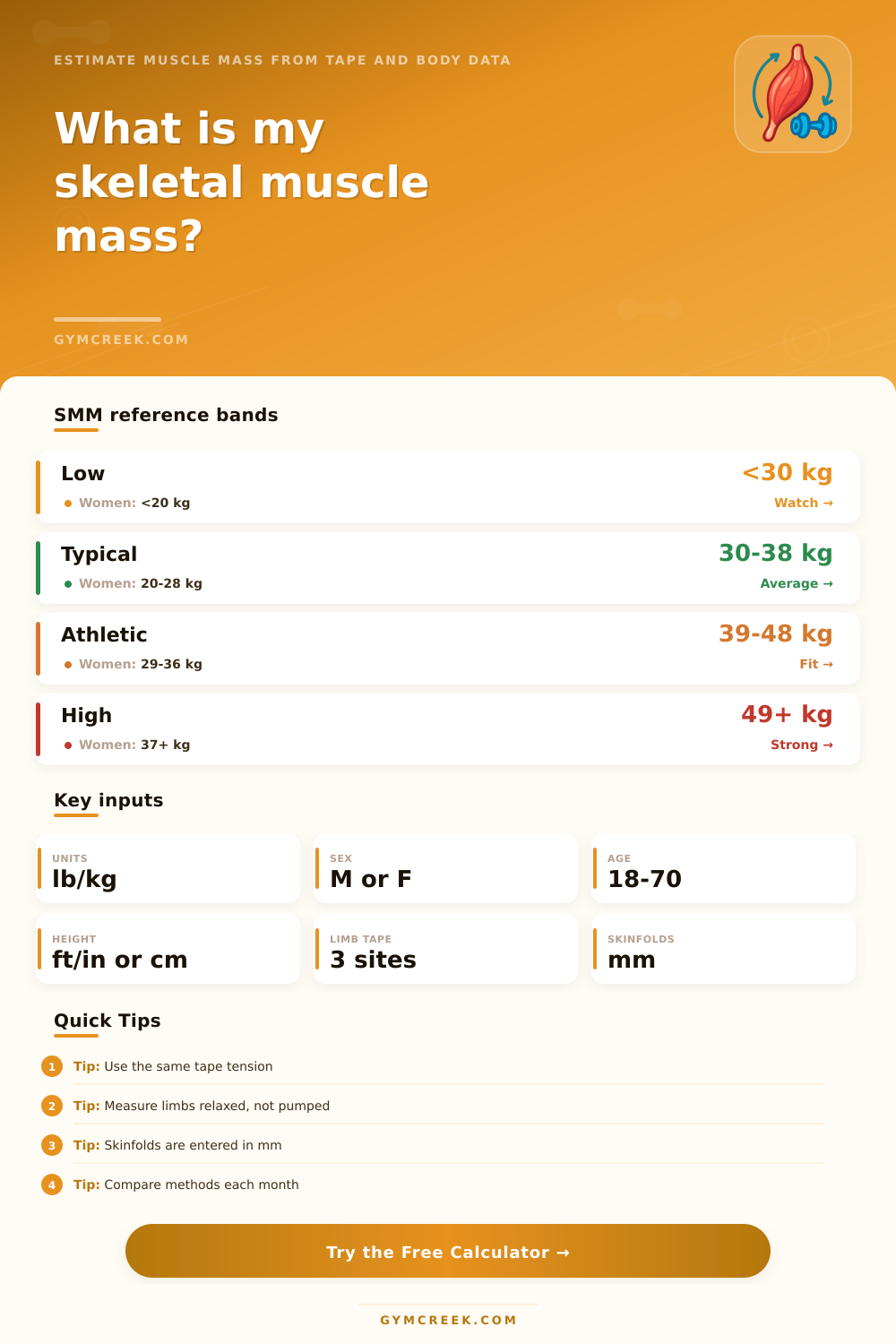
| Band | Men SMI | Women SMI | Interpretation |
|---|---|---|---|
| Low | <8.0 | <6.5 | Worth checking. |
| Typical | 8.0-9.4 | 6.5-7.4 | Normal range. |
| Athletic | 9.5-10.6 | 7.5-8.4 | Strong base. |
| High | 10.7+ | 8.5+ | Very muscular. |
| Site | How to take it | Why it matters | Common error |
|---|---|---|---|
| Arm | Midpoint, relaxed | Upper-limb muscle | Flexing the arm |
| Thigh | Largest or mid | Biggest muscle site | Moving tape angle |
| Calf | Widest point | Lower-limb size | Measuring seated |
| Skinfold | Pinch in mm | Corrects girth | Reading in cm |
| Method | Inputs | Output | Best use |
|---|---|---|---|
| Lee anthropometric | Tape, age, sex | SMM kg | Best with all sites |
| Body-mass shortcut | Weight, height | SMM kg | Fast screening |
| Blended estimate | Both models | Stable SMM | Regular tracking |
| Context layer | Body fat % | Lean share | More context |
| Convert | Factor | Applies to | Note |
|---|---|---|---|
| lb to kg | 0.4536 | Body weight | Imperial input |
| in to cm | 2.54 | Height, tape | Metric output |
| mm to cm | 0.10 | Skinfolds | For correction |
| cm to m | 0.01 | Height | Index formula |
| Days | Profile | Use case | Trend clue |
|---|---|---|---|
| 0-1 | Low volume | Recovery phase | Hold steady |
| 2-3 | Base work | Beginner build | Slow gains |
| 4-5 | Serious train | Strength focus | Nice trend |
| 6+ | High load | Advanced phase | Watch recovery |
Skeletal muscles form 30% to 40% of total body mass. They bind to bones and mean many kinds of movements and tasks. You control freely when they work.
In the body exist three kinds of muscular tissue: skeletal, cardiac and smooth. Tendons tie them to bones and together they report all movements of the body
How Skeletal Muscles Work and Grow
Skeletal muscle binds bones to each other. During training almost all intended muscles belong to that type. For instance biceps, triceps, pectorals, quadriceps and alike.
Seen muscles are skeletal, also called voluntary or striated. They grow bigger, stronger or expand endurance, when you raise weights. The musclse that can be seen are skeletal.
Muscular contraction causes almost every move in the body. Joints, bones and skeletal muscles together execute actions as walking. Those muscles help to keep position, back internal organs and control body heat.
The muscular system preserves most carbohydrates as glycogen, what matters for energy during training.
Hypertrophy of muscle happen by means of increase of skeletal muscle because of expansion of its fibers. Mechanical tension comes from force during lifting. Sufficient overload damage the muscle slightly, what launches processes for growth.
CrossFit stimulate hypertrophy, so expansion of skeletal muscle and more force.
The best mode to get muscle are resistance training by means of free weights, machines or calisthenics with progressive overload. Compound exercises as bench press, squats, deadlifts and military presses best accumulate. Run, cycling and yoga no a lot expand muscle.
Type 2 fast fibers are intended by bodybuilders for explosive energy during lifting. For force, use few repetitions with heavy weights.
Rhabdomyolysis because of exercise is breakdown of skeletal muscle after too hard work, something to observe. Myostatin is protein from skeletal muscles, that circulates and affect muscular evolution according to studies. Muscle cells do not regenerate ontheir own, what means recall about real training.