🏋 Strength Standards Calculator
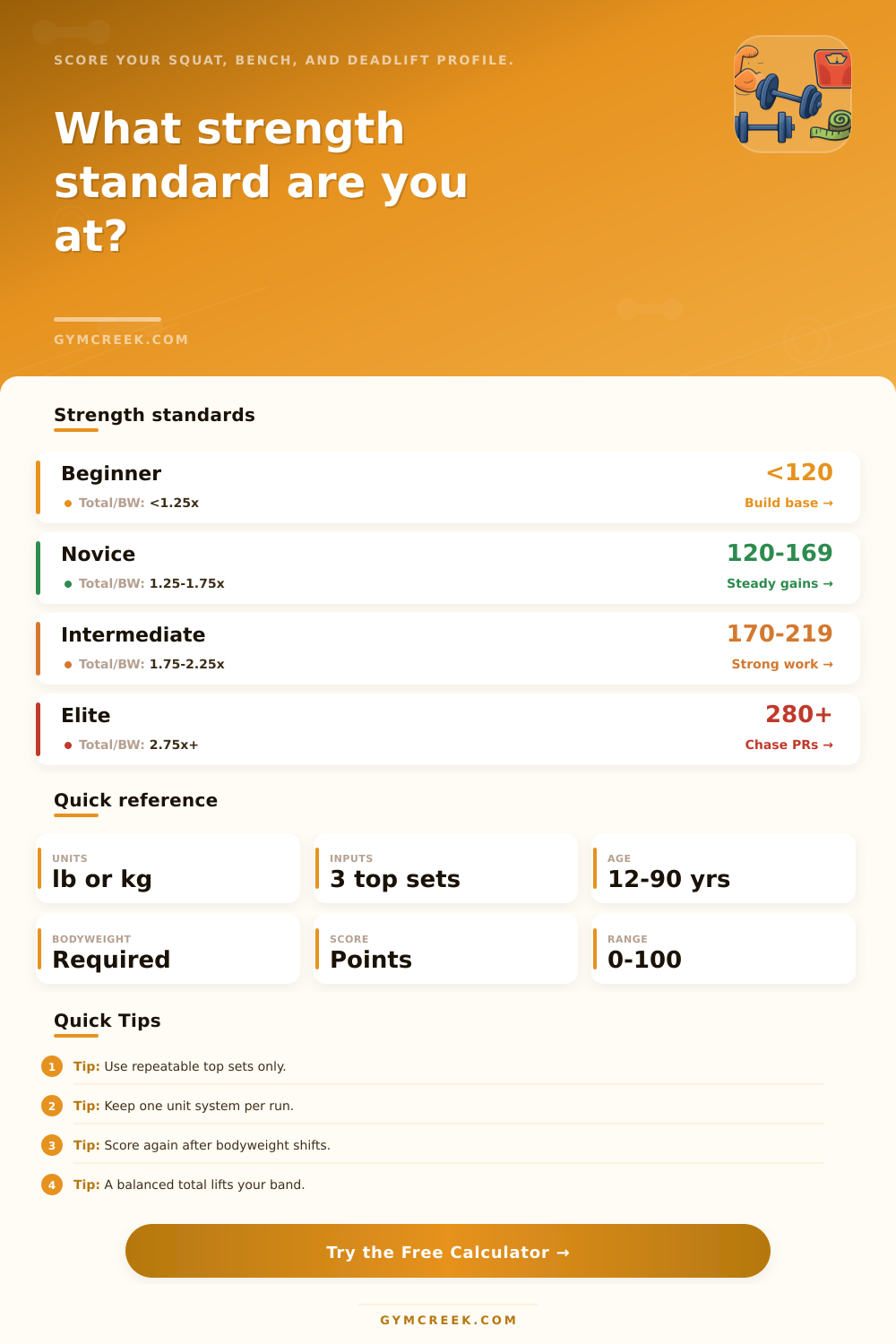
Score your squat, bench, and deadlift profile with bodyweight, age, and balance so you can see your current strength standards fast.
💪 Strength Profiles
Presets load realistic top sets and athlete details, giving you a fast starting point for score, band, and balance checks.
📝 Athlete Profile
🏋 Top-Set Lifts
💪 Squat top set
💥 Bench top set
🔥 Deadlift top set
Use repeatable top sets, not missed attempts. Each lift becomes an estimated 1RM before the strength score is built.
📈 Strength Breakdown
📊 Strength Metrics Grid
📑 Reference Tables
| Band | Score | Total/BW | Note |
|---|---|---|---|
| Beginner | <120 | <1.25x | Build base |
| Novice | 120-169 | 1.25-1.75x | Steady gains |
| Intermediate | 170-219 | 1.75-2.25x | Strong work |
| Elite | 280+ | 2.75x+ | Chase PRs |
| Lift | Novice | Advanced | Note |
|---|---|---|---|
| Squat | 1.25x | 2.0x+ | Lower-body base |
| Bench | 0.75x | 1.25x+ | Press strength |
| Deadlift | 1.5x | 2.75x+ | Big pull driver |
| Total | 1.75x | 2.5x+ | Meet ready |
| Phase | Factor | Total bias | Use |
|---|---|---|---|
| Base | 0.96 | -4% | Skill build |
| Build | 0.99 | -1% | Growing work |
| Peak | 1.02 | +2% | Sharp test |
| Test | 1.04 | +4% | Heavy day |
| Metric | Formula | Use case | Notes |
|---|---|---|---|
| 1RM | Blend E + B | Top set | Stable max |
| Total | S + B + D | Meet total | Core score |
| Strength | Ratio x 100 | Relative score | BMI and age bias |
| Balance | 100 - gap | Lift spread | Closer = better |
💬 Calculator Tips
⚠ Disclaimer
Strength standards are descriptions of how groups perform in specific exercises. They come from thousands or millions of lifters’ one-rep maxes relative to bodyweight and gender. To estimate whole-body strength, look at numbers for squat, bench press and deadlift.
Similar standards count for bodybuilding moves, for instance barbell curl or leg press
What Are Strength Standards?
Strength standards tables point one-rep maxes according to bodyweight. They have values for gym exercises as bench press, squat and deadlift. Tools as Symmetric Strength give analyses for lifters, based on research and data from strength competitions.
Other tools let you compare your maximum lifts with those of other lifters, and even compete with freinds.
In standards you share training levels in categories for lifters. You who did not train the exercises, but can do them correctly, belong to the bottom group. Later come those that train regularly for some months, a couple of years, several years, and finally the athletes in strength sports.
Such tables base on definitions from books as “Practical Programming” and “Starting Strength“, together with standards for powerlifting and weightlifting.
In fitness worlds circulate some famous standards. Popular target is one-plate overhead press, two-plate bench, three-plate squat, and so on. Bodyweight-based rule offers squat in twice bodyweight, bench in 1.5 times bodyweight and deadlift in 2.5 times bodyweight.
About pull-ups you commonly want ten reps with own bodyweight.
Strength standards give an absolute strength number in pounds, and a relative one. The relative variant considers bodyweight. Also templates help to estimate one-rep maxes from submaximal lifts, adapting to bodyweight and sex.
Recall that strength standards are only general ideas from research, lifts and personal experience. Factors as limb length play a role. Folks with long arms struggle in bench press, even if they weigh the same as those with short arms.
Strength and size only correspond, they do not depend on each other. Constant calorie deficit can change everything.
For older lifters are adjustments. The McCulloch coefficient for someone sixty is 1.34, and a reasonable change would be around 75 percent of young lifter numbers. It cannot be universal, because all of us differ a lot, factors as bodyweight, age and sex must always be takeninto account.