🏋 Sumo Deadlift 1 Rep Max Calculator
Estimate a sumo top set, then compare projected 1RM, opener, training max, and bodyweight ratio in one view.
💪 Sumo Presets
Presets load clean top sets, not warmups. Use them as a meet-readiness starting point, then refine with your own training history.
📝 Sumo Deadlift Inputs
🏋 Top-Set Sumo Deadlift
💪 Technique check
💥 Secondary check
🔥 Sumo top set
Enter your best repeatable sumo top set. The calculator turns it into a projected 1RM, opener, and training max.
📈 Breakdown
📊 Fitness Metrics Grid
📑 Reference Tables
| Reps | Load % | Use it for | Best cue |
|---|---|---|---|
| 1 | 100% | True single | Meet max |
| 3 | 93% | Top triple | Peak work |
| 5 | 86% | Heavy set | Strength base |
| 8 | 79% | Back-off set | Fatigue check |
| Band | Men | Women | Meaning |
|---|---|---|---|
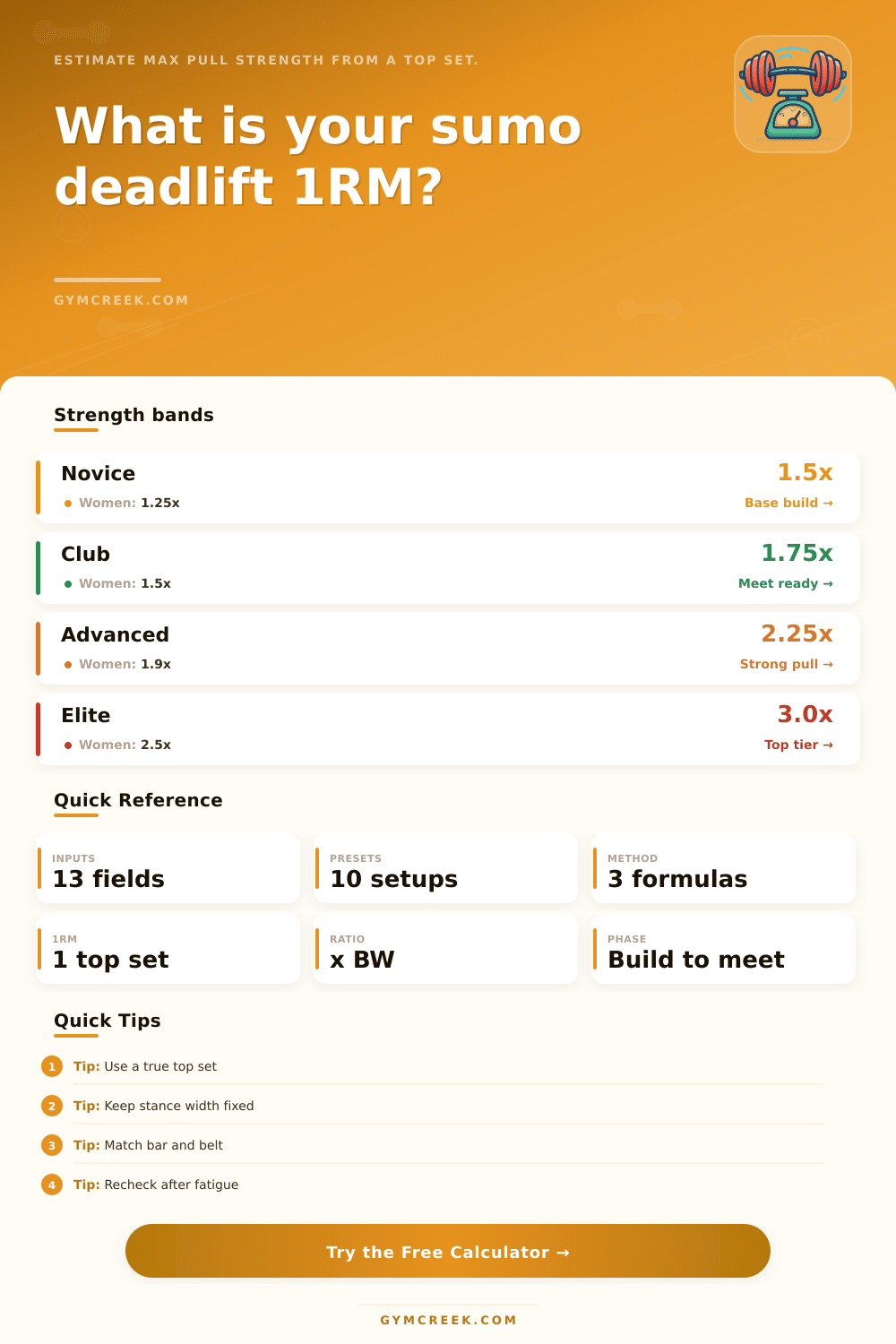
| Novice | 1.25-1.75x | 1.0-1.5x | First total |
| Club | 1.75-2.25x | 1.5-2.0x | Regular meet |
| State | 2.25-2.75x | 2.0-2.4x | Strong build |
| National | 2.75x+ | 2.4x+ | PR chase |
| Attempt | % of 1RM | Purpose | Risk level |
|---|---|---|---|
| Opener | 88-92% | Secure lift | Low |
| Second | 95-98% | Build total | Moderate |
| Third | 100-103% | PR attempt | High |
| Reserve | 104-105% | Elite day | Very high |
| Metric | Formula | Use case | Notes |
|---|---|---|---|
| Epley | W x (1 + R/30) | Top set | Fast estimate |
| Brzycki | 36/(37-R) | Blend | Conservative |
| Opener | 0.86-0.92x | Test day | Safe start |
| Ratio | x BW | Relative | Compare pulls |
💬 Deadlift Notes
⚠ Disclaimer
DISCLOSURE: This post may contain affiliate links, meaning when you click the links and make a purchase, I receive a commission. As an Amazon Associate I earn from qualifying purchases.

The sumo deadlift is a kind of barbell deadlift that powerlifters commonly use. During performance of sumo deadlift, the lifter takes a wide stance and grabs the bar between the legs. The feet stand as a sumo wrestler, with toes under the bar and pointing outside.
Sumo-style deadlift uses a wide stance and narrow hold
Sumo Deadlift: What It Is and Why Use It
This exercise works the hips, glutes and lower back. Wide stance reduces the tension on lower back and strengthens the work of the posterior chain. Compared with conventional deadlift, sumo puts much more stress on hips, gluts and hamstrings.
Also the quadriceps engage more in sumo deadlift. Quadriceps, glutes and adductors work more, while hamstrings and back work less.
Both styles, conventional and sumo; work mostly the same muscles. None is really better based on impact on muscles. From a bodybuilding view, sumo deadlift has stronger activation of glute medius, which reduces fatigue of lower back.
Depending on training focus, it is useful. It deserves more attention because of its versatility and helps build muscles. For folks with long legs it is the best barbell deadlift choice.
Physical build matters a lot for choosing a stance. Those with long arms, long legs and short torso usually do better with conventional. Folks with long trunks and short limbs profit more from sumo.
Also the angle of the hip socket affects. Try both and see which allows you to raise a heavier bar.
Good setup and execution of sumo deadlift can simplify every attempt. It requires hundreds of reps, practice, analysis and correction to get it right. New sumo pullers restart every rep with fast sets to hammer in the technique.
Sumo deadlift is technically much more difficult than it seems. Switching to sumo can be a challenge at first, but it solves stability problems that some lifters have with conventional pulling.
Some lifters can raise 8 to 10 percent more weight with sumo. If sumo allows more weight, then it is the right choice for contest. Sumo can feel a bit easier, but it does not cheat.
No form of deadlift is a cheat. Sumo deadlift is a completely valid deadlift. It trains hip-hinge move and is unique to build full-body strength with rawpower.