Deadlift Bar Weight Calculator
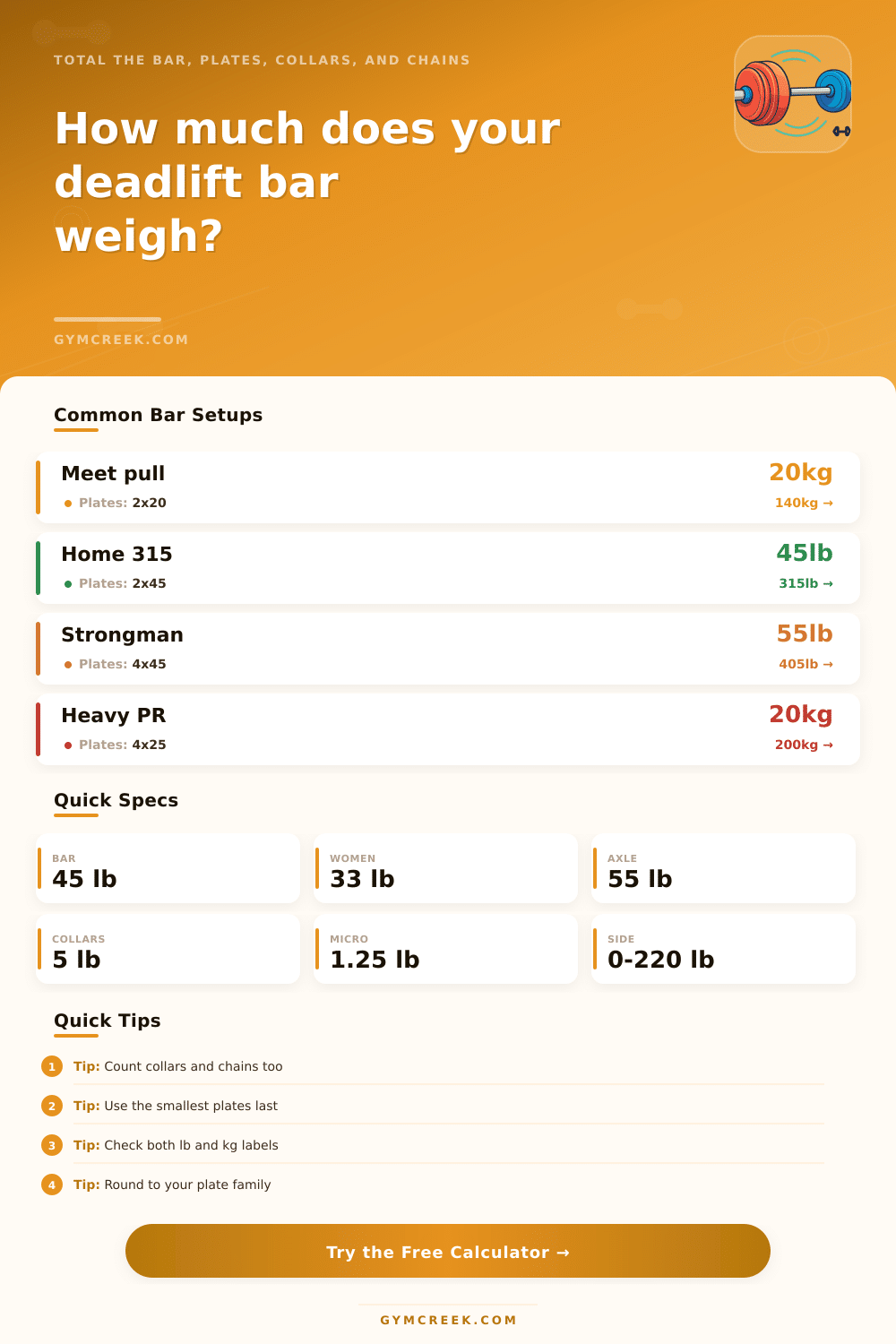
Build the full deadlift setup in pounds or kilograms, count collars and accessories, and see the exact per-side plate stack before you pull.
| Bar type | Imperial | Metric | Notes |
|---|---|---|---|
| Competition deadlift bar | 45 lb | 20 kg | Most common meet pull bar |
| Power bar | 45 lb | 20 kg | Stiffer shaft, still weighs the same |
| Women's bar | 33 lb | 15 kg | Shorter and lighter sleeve setup |
| Axle or stiff bar | 55 lb | 25 kg | Strongman style and thicker grip |
| Family | Common sizes | Smallest step | Best use |
|---|---|---|---|
| Iron plates | 45/35/25/10 | 1.25 | Simple home or club setup |
| Bumper plates | 45/25/10/5 | 1.25 | Safer for repeated drops |
| Home gym mix | 45/25/10/5 | 0.5 | Fine tuning and odd pairs |
| Strongman discs | 100/75/45/25 | 5 | Large jumps for heavy pulls |
| Ratio | Feel | Level | Meaning |
|---|---|---|---|
| 0.75 x BW | Light | Technique | Easy speed work or warm-up pull |
| 1.00 x BW | Solid | Base | Common first strength milestone |
| 1.50 x BW | Strong | Intermediate | Often a meaningful training target |
| 2.00 x BW | Heavy | Advanced | Big single for many lifters |
| Total | Bar | Each side | Typical use |
|---|---|---|---|
| 135 lb | 45 lb | 45 lb | Light or first plate day |
| 225 lb | 45 lb | 90 lb | Classic two-plate pull |
| 315 lb | 45 lb | 135 lb | Three plates per side |
| 405 lb | 45 lb | 180 lb | Four plates per side |
A deadlift bar is made specially for deadlifting. These bars have lower diameter, bigger distance between the sleeves and more rough knurling. Standard power bar measures between 28.5 mm and 29 mm, but deadlift bar has only 27 mm.
DISCLOSURE: This post may contain affiliate links, meaning when you click the links and make a purchase, I receive a commission. As an Amazon Associate I earn from qualifying purchases.

This does not seem a lot but the slimmer diameter through the whole length of power bar give enough difference in surface area.
What Is a Deadlift Bar
Standard Olympic barbell is a bit more than 7 feet, while deadlift bar is near 7.5 feet with around 90 inches. It weighs same as some standard Olympic barbell, namely 20 kg or around 45 pounds. Squat bar even so is heavier at 25 kg.
Deadlift bars are slimmer, so they are easier to grip and more bendy, what helps to raise them from the soil. Slimmer bar bends more, what allows the lifter to stand up before the whole weight rises from the flloor. The 27 mm diameter compared to 29 mm does a big difference.
It is lot more easy to use without straps and lot more easy to break the floor.
The Texas Deadlift Bar is special competitive barbell, created to help to pull bigger weight. Made in Texas by Buddy Capps, this bar is the favorite for powerlifters, that want more whip, excellent grip and maximum output. It is 90 inches with 56 inches between sleeves, weighs 20 kg, has 27 mm diameter and capacity of 1500 pounds.
The Rogue Ohio Deadlift Bar is made in United States, right for deadlifts, with 27 mm diameter pole, 20 kg weight and 15.5 inch loadable sleeves.
Deadlift bar is a simple bar. It is used only for deadlifting. With it you can reach bigger numbers.
You saw around 5 % increase in your maximum. Other pulled 402 pounds in contest with deadlift bar, but some months later only 396 with rigid bar. Even so another bar will not change a lot, unless the grip was the main limit.
The trap bar is other good choice that you should know. It moves the hold of the body to the sides, what is much more natural way to raise heavy load from the floor. Deadlifts with trap bar put the body more in squat position than with straight bar and stress more the quads.
The hex bar lot more help for right and safe technique. It can feel safer and less hard for the posterior chain. For big force trap bars serve well, but they limit the carry over to traditional deadlifts.
Heavy duty deadlift bars are made from prime steel for durability during heavy deadlifts. Some have 165 000 PSI tensile strength and match IPF standards. Quality gear with neutral grips, knurled handles and heavy duty construction helps safely build strength.