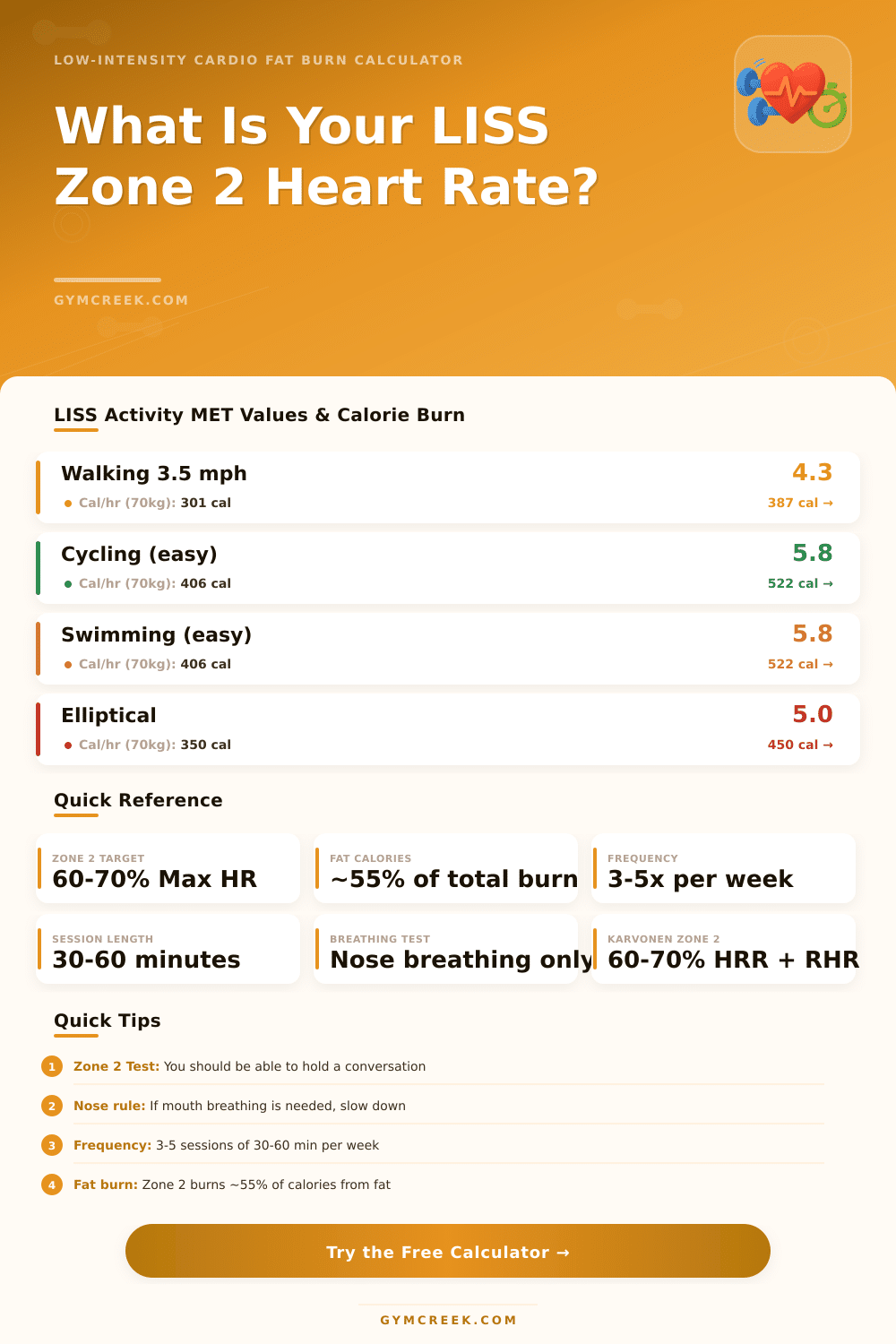
🚶 LISS Heart Rate Zone Calculator
Calculate your Zone 2 LISS heart rate range and estimate calories and fat burned per session for walking, cycling, swimming, elliptical, and rowing.
| Zone | % Max HR | Description | LISS Phase | Benefit |
|---|---|---|---|---|
| Zone 1 | 50–60% | Active Recovery | Warm-up / Cool-down | Gentle cardio, recovery |
| Zone 2 | 60–70% | Aerobic Base | LISS main target | Fat burn, aerobic base |
| Zone 3 | 70–80% | Aerobic Power | Too intense for LISS | Cardio efficiency |
| Zone 4 | 80–90% | Lactate Threshold | HIIT territory | Race pace, LT |
| Zone 5 | 90–100% | VO2 Max | Sprint / intervals only | Speed, VO2 max |
| Activity | MET | 60 kg (132 lb) | 75 kg (165 lb) | 90 kg (198 lb) |
|---|---|---|---|---|
| Walking 3.5 mph | 4.3 | 258 cal/hr | 323 cal/hr | 387 cal/hr |
| Cycling (easy) | 5.8 | 348 cal/hr | 435 cal/hr | 522 cal/hr |
| Swimming (easy) | 5.8 | 348 cal/hr | 435 cal/hr | 522 cal/hr |
| Elliptical | 5.0 | 300 cal/hr | 375 cal/hr | 450 cal/hr |
| Rowing (easy) | 4.8 | 288 cal/hr | 360 cal/hr | 432 cal/hr |
LISS stands for low-intensity steady cardio. That is a kind of training, in that the main goal is to keep a stable rhythm during more time. Sessions normally last from 30 to 60 minutes.
The key is to stay in a low to mid-intensity level during the whole period, without too much pressure.
What is LISS cardio?
The intended Heart Rate Zone for LISS usually falls between 50 and 70 percent of the maximum heart rate. Some recommended guidelines narrow that range to 50 to 65 percent. Anyhow, the point is to stay in an area that feels controlled and stable.
One considers that range also as zone 2 of training.
To estimate the maximum heart rate, subtract your age from 220. Like this, a 20-year-old person would have a maximum of around 200 beats per minute. For a 35-year-old, it would be about 185.
And a 55-year-old would reach 165. After that, multiply that number by 0.50 and 0.65 to find the LISS range. For the 55-year-old example, the goal would fall roughly between 83 and 107 beats per minute.
In practice, heart rate during LISS commonly stays somewhere between 120 and 150 beats, depending on the person. 125 bpm works well for LISS. Some aim for 120 to 140 bpm.
For instance on a rowing machine, the rhythm can reach 135 in the first five minutes and later stay stable around 145 to 147 for the rest of the session. When the heart rate becomes too high, one can correct the intensity, for instance lowering the incline on a treadmill, to bring it down.
In that slow LISS zone of 130 to 150 bpm the heart learns to pump more blood in one beat. One calls that ventricular growth. HIIT does not give blood time too collect quite a lot in the left ventricle for the same impact.
LISS helps to also lower the resting heart rate over time. When the resting rhythm is 60 bpm, adding LISS weekly is great for heart health. It is useful also for recovery, because recovery depends on aerobic process.
Options for LISS activities are hiking, brisk walking, easy running, cycling, swimming at a slow pace, rowing or use of a stair machine. It does not matter what one chooses, if the heart rate stays in the intended range. LISS cardio burns the biggest share of energy from fat compared with harder work.
In addition, LISSimproves the physical skill to carry oxygen, which unloads the heart in everyday tasks.