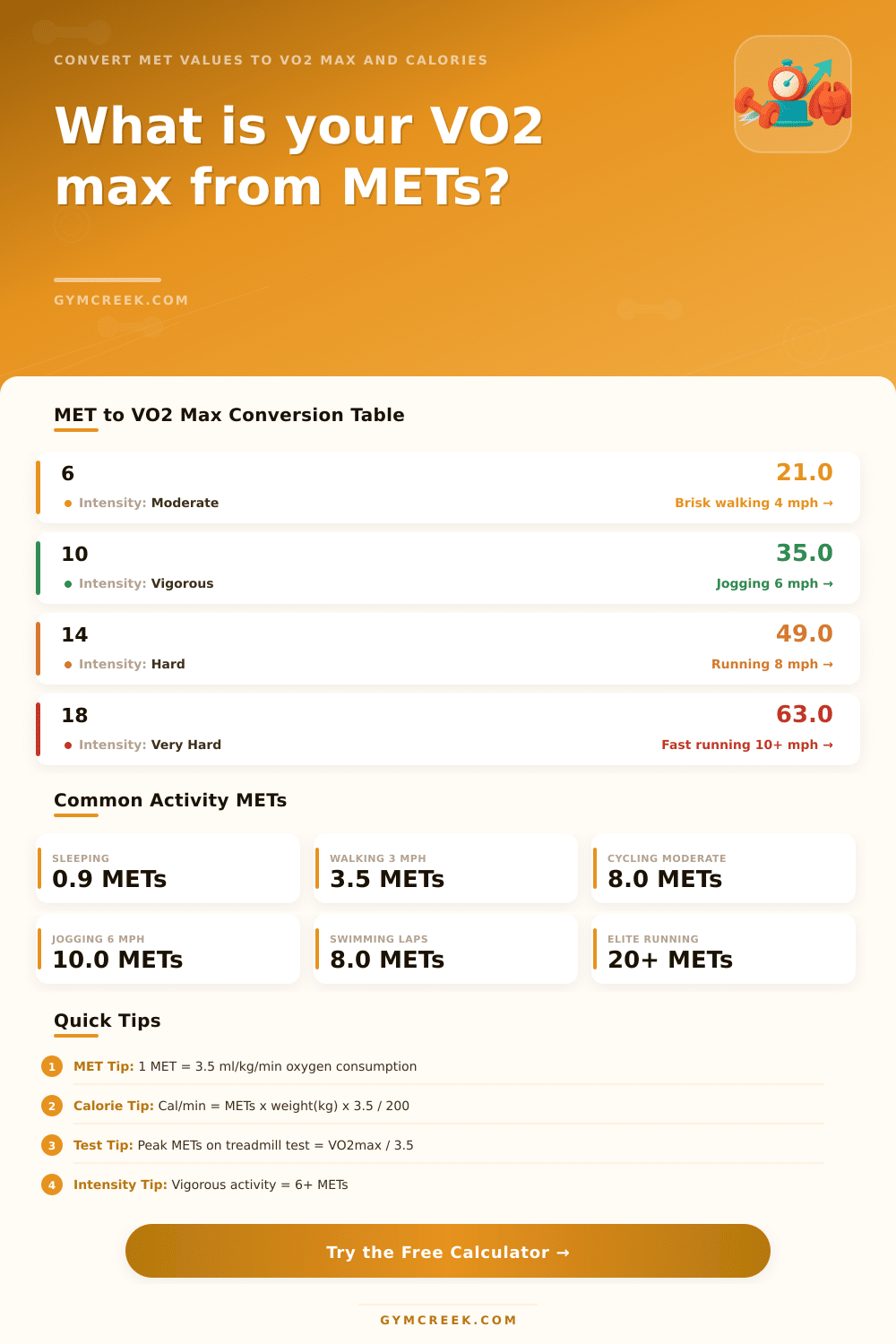
💪 METs to VO2 Max Calculator
Convert MET values to VO2 max, estimate calories per minute, and calculate treadmill VO2 using the ACSM equation.
| Activity | METs | VO2 (ml/kg/min) | Intensity |
|---|---|---|---|
| Sleeping | 0.9 | 3.2 | Rest |
| Sitting / desk work | 1.5 | 5.3 | Sedentary |
| Walking 2.5 mph | 3.0 | 10.5 | Light |
| Walking 3.5 mph | 3.5 | 12.3 | Light |
| Cycling easy (<10 mph) | 4.0 | 14.0 | Moderate |
| Brisk walk 4 mph | 5.0 | 17.5 | Moderate |
| Cycling moderate (10–12 mph) | 8.0 | 28.0 | Vigorous |
| Swimming laps (moderate) | 8.0 | 28.0 | Vigorous |
| Jogging 5.5 mph | 9.0 | 31.5 | Vigorous |
| Running 6 mph | 10.0 | 35.0 | Hard |
| Running 7 mph | 11.5 | 40.3 | Hard |
| Running 8 mph | 13.5 | 47.3 | Very Hard |
| Running 10 mph | 16.0 | 56.0 | Very Hard |
| Elite racing pace | 20.0+ | 70.0+ | Maximal |
| Peak METs | VO2 Max (ml/kg/min) | Fitness Category (Male) | Fitness Category (Female) |
|---|---|---|---|
| 6 | 21.0 | Poor | Fair |
| 8 | 28.0 | Fair | Good |
| 10 | 35.0 | Average | Excellent |
| 12 | 42.0 | Good | Superior |
| 14 | 49.0 | Excellent | Elite |
| 16 | 56.0 | Superior | Elite |
| 18 | 63.0 | Elite | World Class |
| 20 | 70.0 | World Class | World Class |
| 22 | 77.0 | World Class | World Class |
| 25 | 87.5 | World Class | World Class |
Understanding your cardiovascular fitness is one of the most valuable insights that can be gained from analyzing your health. Two of the most common measurements of fitness include METs and VO2 max. These two measurements is used to quantify the efficiency of the cardiovascular system in utilizing oxygen during physical activity. The METs to VO2 max calculator makes it easy to convert one to the other, regardless of your fitness or health status.
Whether you are performing a stress test, purchasing a wearable fitness device, or simply trying to understand what your MET measurements mean for your health, being able to perform the conversion between METs and VO2 max is a valuable tool in understanding your fitness in relation to your heart, lung, and muscles.

Mets To Vo2 Max Calculator
One MET represents the amount of oxygen that the body consumes at rest. This measurement is standardized at 3.5 milliliters of oxygen per kilogram of body weight per minute. METs can be used to represent any level of physical activity. For instance, walking may register at around 3 METs while running at a challenging rate may register at 12 METs or more.

VO2 max is another measurement of the efficiency of the cardiovascular system. Instead of measuring METs at rest, VO2 max is a measurement of the maximum volume of oxygen that an individual can utilize in the body during periods of intense exercise. The higher the VO2 max of an individual, the more greater the capacity of that individual of utilizing oxygen during periods of exertion. VO2 max is often expressed in units of ml/kg/min. Individuals with high VO2 max levels has lower risks of developing conditions like heart disease, diabetes, and even cancer.
You can relate the two measurements to one another in that you can convert METs to VO2 max by multiplying the two values by a factor of 3.5. Thus, an individual who has reached a level of 10 METs during an exercise test will have a VO2 max of 35 ml/kg/min. This relationship between METs and VO2 max allows for individuals to understand their fitness level in any setting or with any equipment.
Many individuals are first made aware of the concept of METs during a stress test or through devices that assess their fitness. Doctors often use the peak MET levels achieved during a stress test to indicate the longevity of an individual. Individuals with higher MET levels have been proven to have better health outcomes. For individuals who are able to reach 10 METs or more, health outcomes are consider to be excellent.
Both of these indicators can differ according to age or gender. The VO2 max and MET levels of a 25-year-old male will differ from that of a 60-year-old female. Charts that classify these levels provide individuals with a general understanding of their classifications, average, good, or elite. As shown in the chart above, different classifications exist based on various measurements of METs and VO2 max.
Both of these indicators allow for individuals to understand their health in relation to exercise. For instance, if an individual understands their VO2 max, they can adjust their training to focus on improve that specific measurement. Many training plans incorporate percentages of an individual’s VO2 max to allow for the individual to perform at the necessary levels for that specific type of activity. Additionally, knowing the number of METs that certain activities require allows for individuals to perform activities of appropriate level to their fitness.
Another of the uses of METs is to calculate the number of calories that are burned during exercise. METs are a direct calculation of the energy that the body expends during exercise. Thus, calculating METs is one of the best methods for understanding how many calories are burned during exercise. Higher MET values lead to the burning of more calorie during those activities.
Both of these measurements have scientific backing for their calculations. METs are calculated at 3.5 ml/kg/min for one MET. However, there are a few research projects that indicate that this value may slightly differ from individual to individual, especially those with higher levels of fitness. However, the general use of this calculation for MET to VO2 max conversion is proven to be reliable for all individuals.
Both of these measurements are made possible through the use of technology. Fitness devices are able to calculate VO2 max and METs for the individual without the individual having to perform any exercise. However, the measurements that is published by these devices are estimated measurements. For the most accurate measurement of VO2 max or METs, an individual can perform the test in an exercise lab. Alternatively, the METs to VO2 max calculator above will produce an excellent estimation of an individual’s VO2 max if the METs are calculated during a maximal exercise test.
To improve an individual’s MET capacity and VO2 max levels, there are a variety of exercises that can be performed. Aerobic exercise is one of the best methods of increasing these levels over time. Whether an individual chooses to run, cycle, swim, or walk, incorporating aerobic exercise into the individuals routine will lead to an increase in these measurements over time.

Both of these measurements are a direct measure of the functionality of the individuals body. They are a measurement of health that goes beyond physical attributes to assess the lifelong health of the individual. By gaining an understanding of the relationship between METs and VO2 max, individuals gain a more complete understanding of there health.
Individuals of any age or athletic status can benefit from gaining an understanding of each of these measurements. Whether an individual is working to improve their health as an athlete, a cardiac patient, or an older adult, knowing the relationship between METs and VO2 max allows individuals of all statuses to take greater control of their health outcomes. You should of used this information to stay fit.