🏃 Treadmill Running Pace Calculator
Convert treadmill speed to running pace, estimate finish times, and find your flat-equivalent effort.
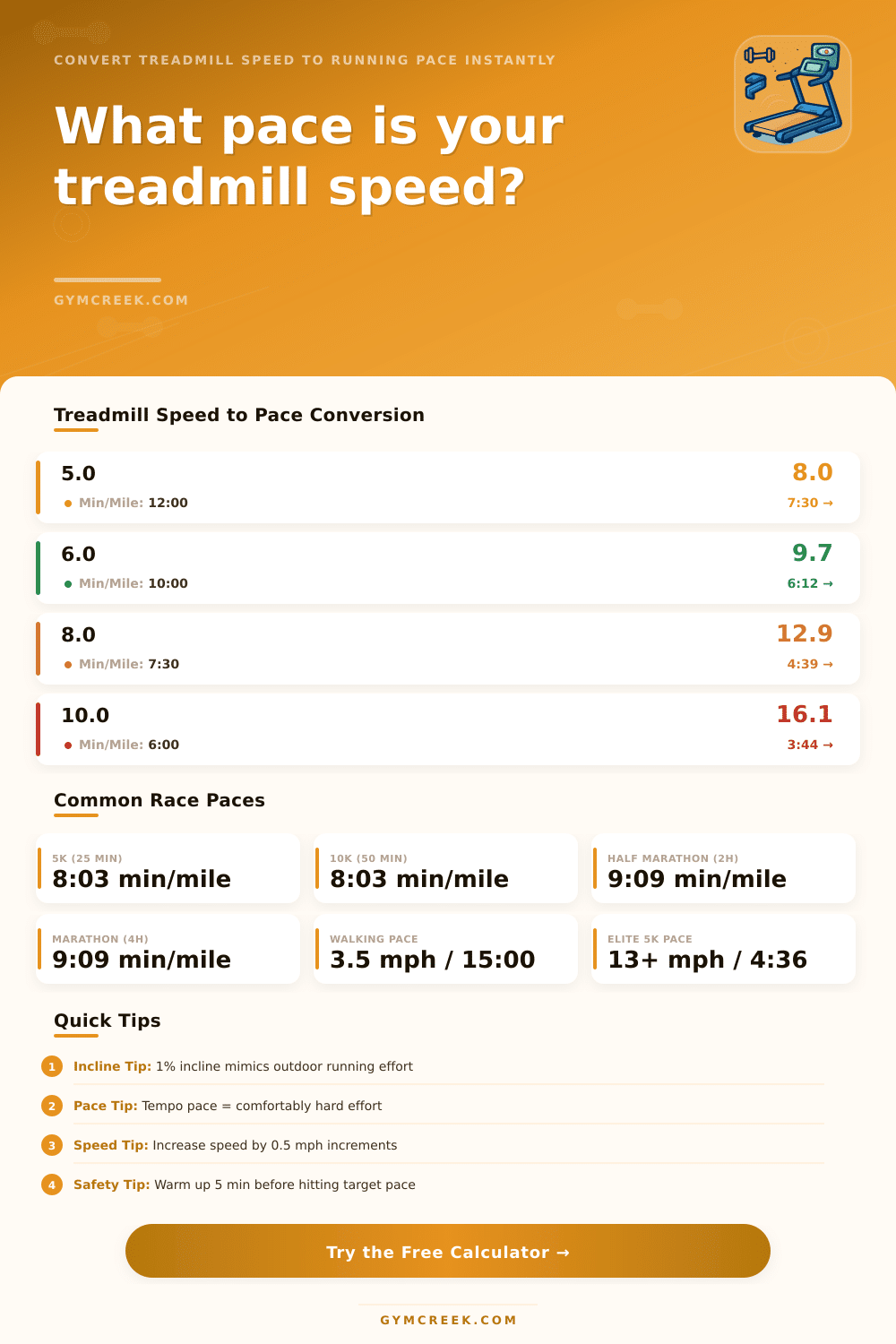
| Speed (mph) | Speed (km/h) | Pace (min/mile) | Pace (min/km) |
|---|---|---|---|
| 4.0 | 6.4 | 15:00 | 9:22 |
| 4.5 | 7.2 | 13:20 | 8:17 |
| 5.0 | 8.0 | 12:00 | 7:27 |
| 5.5 | 8.9 | 10:55 | 6:47 |
| 6.0 | 9.7 | 10:00 | 6:13 |
| 6.5 | 10.5 | 9:14 | 5:44 |
| 7.0 | 11.3 | 8:34 | 5:19 |
| 7.5 | 12.1 | 8:00 | 4:58 |
| 8.0 | 12.9 | 7:30 | 4:39 |
| 9.0 | 14.5 | 6:40 | 4:08 |
| 10.0 | 16.1 | 6:00 | 3:44 |
| 12.0 | 19.3 | 5:00 | 3:06 |
| 14.0 | 22.5 | 4:17 | 2:40 |
| Race / Goal | Finish Time | Pace (min/mile) | Treadmill Speed |
|---|---|---|---|
| 5K | 20:00 | 6:26 | 9.3 mph |
| 5K | 25:00 | 8:03 | 7.5 mph |
| 10K | 45:00 | 7:15 | 8.3 mph |
| 10K | 55:00 | 8:51 | 6.8 mph |
| Half Marathon | 1:45:00 | 8:01 | 7.5 mph |
| Half Marathon | 2:00:00 | 9:09 | 6.6 mph |
| Marathon | 3:30:00 | 8:01 | 7.5 mph |
| Marathon | 4:00:00 | 9:09 | 6.6 mph |
pace simply shows how many time you need to go across a set distance, no mysteries here. The calculation is basic: share the time by the distance. Assume that you ran 5 kilometers in 30 minutes.
This equals 6 minutes each kilometer. Convert that to hour, and you find around 10 kilometers per hour. That forms the basic idea, as many runners plan their training and their routes, whether they intend to improve their pace.
How to Work Out Your Running Pace and Train Better
You do not need a fancy GPS device to estimate your pace. Something simple as a watch is enough. Simply measure your time for a distance that you know, and do the math.
Calculators for pace are very handy… They give you the pace, time or distance, if you enter two of those values. They work for everything, whether you prepare for 5k, 10k, half marathon or whole marathon.
There is no magic number that defines “good” pace. It depends on your fitness, age, sex, weight and how prepared you are overall. Pace that seems easy one week, could change entirely the next.
Age also matters, the pace usually drops with the years. Someone in their twenties can run at 8:30 each mile without much sweat, while beginners commonly are close to 15 minutes each mile, and everything that is normal while you build your base.
Easy running happens in that pleasant place, where you can talk without problem. The most runners reach this area between 59 and 74 percent of their VO2max, or about 65 to 79 percent of the maximum pulse. Even so, it ranges from day too day based on the feeling of your body, the weather or the type of ground.
At 5-minute rhythm you enter the hard zone. At 10 minutes? It stays more in steady work.
The 80/20 rule is popular in the running world for good reason. Around 80 percent of your runs should be easy and comfortable, while the other 20 percent go to harder sessions of pace. It is the steady balanced training that truly moves you forward over months and years.
Add around 500 metres to your long run each week; it builds the fitness step by step, without breaking you.
Start more slowly than your instinct suggests is truly good tactics. The mind wants to move fast, but all that leads to hitting a wall halfway through. Runs with pauses after hard efforts help to cut the tiredness and build threshold.
It is worth saying also that tracking the volume in minutes instead of miles is useful; a fast runner does more distance in 60 minutes than a slow one, so the comparison becomes fairer.
Note this: amateur runners end around 14 percent more slowly when they controlthemselves, compared to when the pace is set from outside. This shows how tricky self-judgment can be without good planning. Calculators for pace settle that problem well, showing expected final times and splits based on your targets, which helps to keep everything under control.