🏃 Relative VO2 Max Calculator
Estimate your aerobic fitness capacity in ml/kg/min — and see where you rank for your age & gender
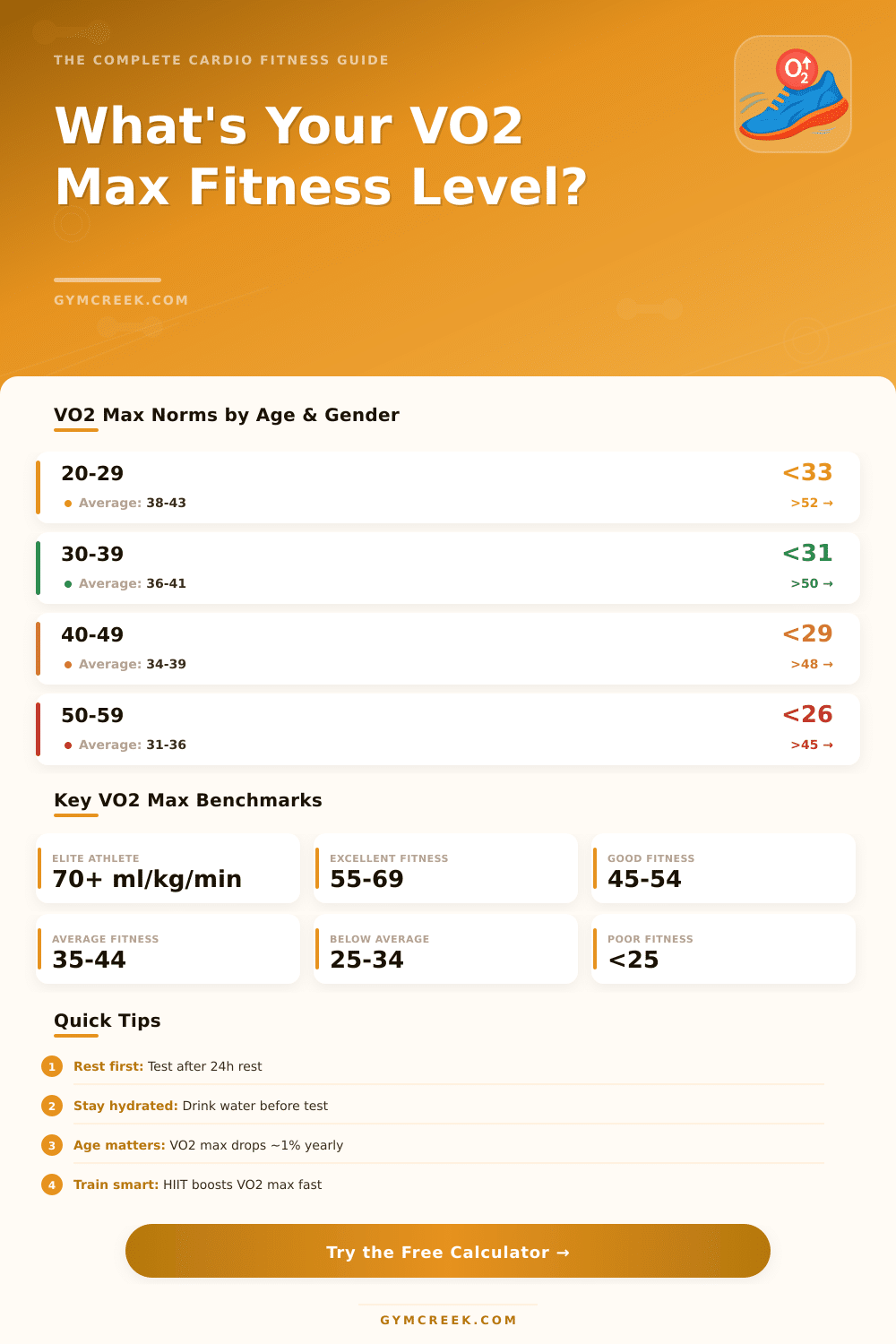
| Age Group | Very Poor | Poor | Fair | Good | Excellent | Superior |
|---|---|---|---|---|---|---|
| 20–29 | <33.0 | 33.0–36.4 | 36.5–41.8 | 41.9–46.7 | 46.8–52.4 | ≥52.5 |
| 30–39 | <31.5 | 31.5–35.4 | 35.5–40.9 | 41.0–44.9 | 45.0–49.4 | ≥49.5 |
| 40–49 | <30.2 | 30.2–33.5 | 33.6–38.9 | 39.0–43.7 | 43.8–48.0 | ≥48.1 |
| 50–59 | <26.1 | 26.1–30.9 | 31.0–35.7 | 35.8–40.9 | 41.0–45.3 | ≥45.4 |
| 60–69 | <20.5 | 20.5–26.0 | 26.1–32.2 | 32.3–36.4 | 36.5–44.2 | ≥44.3 |
| Age Group | Very Poor | Poor | Fair | Good | Excellent | Superior |
|---|---|---|---|---|---|---|
| 20–29 | <28.0 | 28.0–31.4 | 31.5–35.6 | 35.7–40.0 | 40.1–46.4 | ≥46.5 |
| 30–39 | <27.0 | 27.0–30.4 | 30.5–33.7 | 33.8–37.6 | 37.7–42.9 | ≥43.0 |
| 40–49 | <25.1 | 25.1–28.9 | 29.0–32.2 | 32.3–36.8 | 36.9–41.0 | ≥41.1 |
| 50–59 | <21.0 | 21.0–24.4 | 24.5–28.9 | 29.0–32.8 | 32.9–37.0 | ≥37.1 |
| 60–69 | <17.5 | 17.5–20.1 | 20.2–24.4 | 24.5–30.2 | 30.3–31.4 | ≥31.5 |
| Zone | Name | % Max HR | % VO2 Max | Benefit |
|---|---|---|---|---|
| Zone 1 | Recovery | 50–60% | 28–42% | Active recovery, fat burn |
| Zone 2 | Aerobic Base | 60–70% | 42–60% | Endurance, mitochondria |
| Zone 3 | Tempo | 70–80% | 60–75% | Lactate threshold |
| Zone 4 | Threshold | 80–90% | 75–90% | VO2 max improvement |
| Zone 5 | Maximal | 90–100% | 90–100% | Peak power, speed |
(Marathon WR)
(Highest Recorded)
Endurance Athlete
Adult
Per Year After 25
Improvement
Cardiac Risk
VO2 Max Gains
| Method | Formula Used | Equipment | Accuracy | Best For |
|---|---|---|---|---|
| Cooper 12-Min Run | Cooper (1968) | Track/GPS | ★★★★ | Active adults |
| Resting HR Method | Uth-Sorensen (2004) | HR monitor | ★★★ | General population |
| Non-Exercise Model | Jackson et al. (1990) | None | ★★★ | Sedentary individuals |
| Sub-max Bike Test | Astrand-Ryhming | Cycle ergometer | ★★★★ | Clinical/lab setting |
| Lab Direct Test | Measured O₂ uptake | Metabolic cart | ★★★★★ | Elite athletes |
VO2 Max is commonly talked about in sporting settings, but what does it mean and why is it important? Relative VO2 Max shows the most oxygen that your body can use during hard exercise when it must support your physical weight. Experts measure it in milliliters of oxygen used for every kilogram of your weight, or simply ml/kg/min for short.
That differs from absolute VO2 Max, which simply shows the total oxygen use of your body during the same hard activity. In liters per minute. The main difference is that absolute VO2 Max does not depend on age, weight height or gender at all.
What Is Relative VO2 Max and Why It Matters
It stays the same for all.
So, why do we need relative VO2 Max as a separate measure? Because only raw numbers make fair comparison almost impossible between folks of different body types. Think about a 90-kilogram person with absolute VO2 Max of 4.0 liters per minute compared to someone weighing only 57 kilos.
On paper, the heavier folk would seem the stronger athlete, but reality commonly porves otherwise. When you adjust the score by physical mass, everything falls in right proportion. This way absolute values adjust to relative, so that we can compare fairly.
Relative VO2 Max truly opens sight to the ability to last long efforts. It allows lining folks of various sizes on the same base. When your smart watch shows your VO2 Max, it means the relative version.
Physical mass plays a big role hear. Because relative VO2 Max divides oxygen use by your weight, reducing fat naturally raises the score. The fewer extra fat you carry, the higher your relative VO2 Max becomes, while you stay in a healthy limit.
Training and weight control form a strong circle, because both show general health. A runner at a lighter weight commonly reaches higher relative VO2 Max, even if the actual oxygen use stays almost unchanged.
The values change a lot based on the group observed. Average men usually reach around 35 to 40 ml/kg/min, while average women fall between 26 and 30 ml/kg/min. It can drop to 27 ml/kg/min for folks out of shape or ill.
One cyclist once reached 97 ml/kg/min, a truly rare figure. Absolute VO2 Max for a young casual man is typically around 3.5 liters per minute, while a similar woman stays close to 2 liters per minute.
Folks with the highest relative VO2 Max scores commonly are slim and not too muscular. VO2 Max predicts lifespan well. Those with great levels have death risk almost five times reduced.
That is worth noting. Training at the right level, doing steady cardio or intervals, can raise your VO2 Max overtime. What once was seen as the top sport standard is now only one part ofthe athletic puzzle.