🏃 Running Pace to Watts Calculator
Estimate your running power output in watts based on pace, weight, and terrain
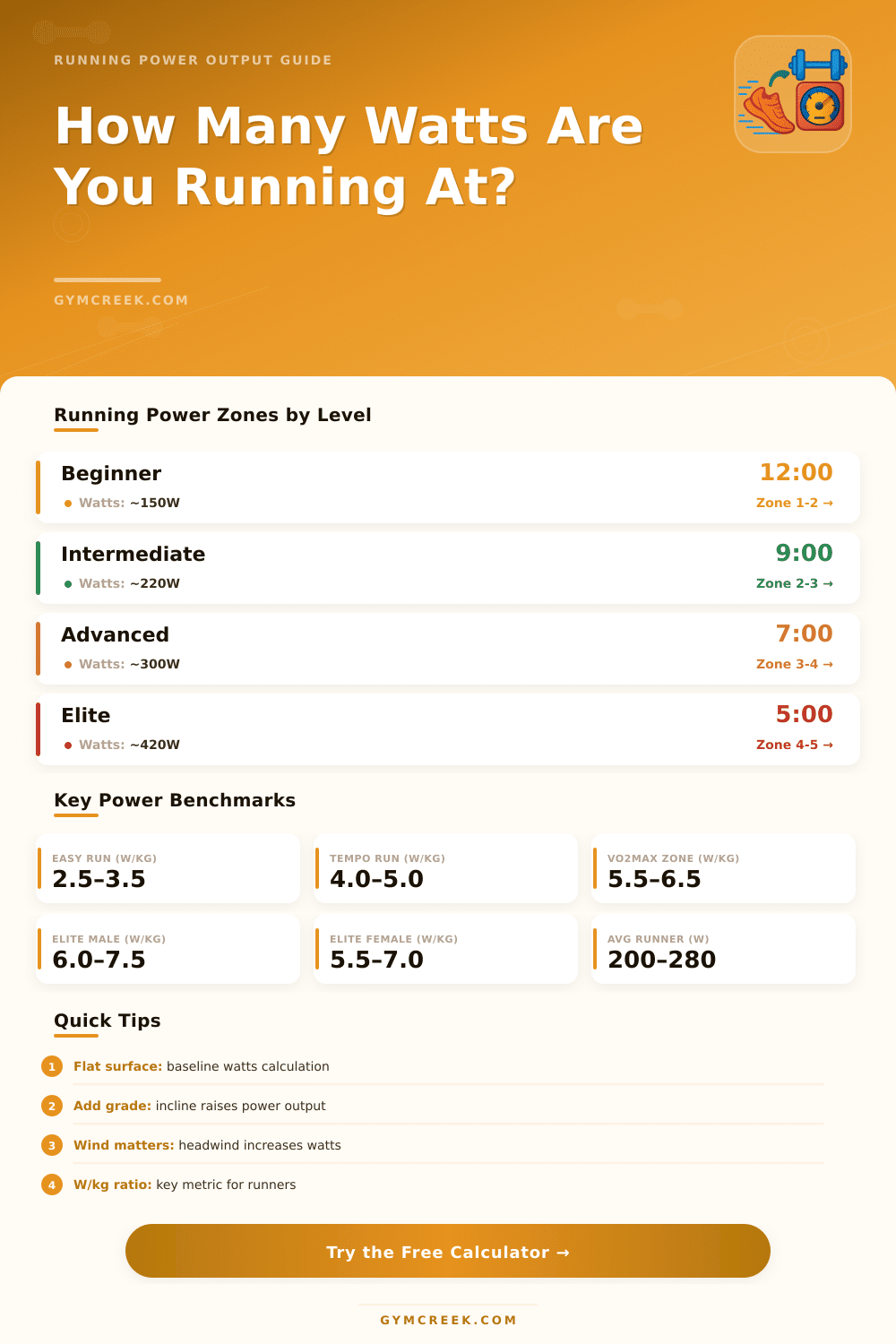
| Pace (min/mile) | Speed (mph) | 130 lbs (59kg) | 160 lbs (73kg) | 190 lbs (86kg) |
|---|---|---|---|---|
| 12:00 | 5.0 | ~135 W | ~166 W | ~197 W |
| 10:00 | 6.0 | ~165 W | ~203 W | ~241 W |
| 9:00 | 6.7 | ~187 W | ~230 W | ~272 W |
| 8:00 | 7.5 | ~213 W | ~262 W | ~311 W |
| 7:00 | 8.6 | ~248 W | ~305 W | ~362 W |
| 6:00 | 10.0 | ~295 W | ~363 W | ~430 W |
| 5:00 | 12.0 | ~365 W | ~449 W | ~533 W |
| Grade (%) | Description | Power Multiplier | Notes |
|---|---|---|---|
| -5% | Slight Downhill | ~0.85x | Less effort, eccentric load |
| 0% | Flat | 1.00x | Baseline calculation |
| +3% | Gentle Uphill | ~1.18x | Noticeable increase |
| +6% | Moderate Uphill | ~1.38x | Significant effort increase |
| +10% | Steep Uphill | ~1.65x | Very high power demand |
| +15% | Very Steep | ~2.10x | Often walk/hike territory |
| Category | Gender | W/kg (Easy) | W/kg (Threshold) | W/kg (Race) |
|---|---|---|---|---|
| Beginner (<1 yr) | Any | 1.8–2.5 | 2.5–3.2 | 3.0–3.8 |
| Recreational | Any | 2.2–3.0 | 3.0–3.8 | 3.5–4.5 |
| Club Runner | Male | 2.8–3.5 | 3.8–4.8 | 4.5–5.5 |
| Club Runner | Female | 2.5–3.2 | 3.5–4.4 | 4.0–5.0 |
| Competitive | Male | 3.2–4.0 | 4.5–5.5 | 5.5–6.5 |
| Competitive | Female | 3.0–3.8 | 4.0–5.0 | 5.0–6.0 |
| Elite / Pro | Male | 3.8–5.0 | 5.5–6.5 | 6.0–7.5 |
| Elite / Pro | Female | 3.5–4.5 | 5.0–6.0 | 5.5–7.0 |
✅ Weigh yourself accurately: Use morning body weight (after bathroom, before eating) for consistent results.
✅ Account for terrain: Trail running can increase power demand 8–35% over flat road running at the same speed.
✅ W/kg is more useful than raw watts: Heavier runners naturally produce more watts — watts per kilogram lets you compare performance across body weights.
Running Pace easily relates to the time that it requires to reach a set distance. The base of it is easy: one shares the time by the covered distance. Assume that you ran 5 kilometers during 30 minutes, that gives a pace of 6 minutes each kilometer.
Like this runners arrange their training and control, whether they truly progress to bigger speed.
Find Your Best Running Pace
But truly, the secret of good Running Pace is not simply a number. It depends on how you control energy during the run. If you push the speed too early, you tire at the finish of the way.
Rather, if you start too carefully, you will leave part of your skill unused. The key is finding that right balance, when you still have force at the end. Surprisingly, often those runners succeed that reach their best parts in the second half, not in the first.
A calculator for Running Pace removes the need of guesses. Enter two from the three parts… Pace, time or distance, and it shows the missing value.
With it you can plan the finish of a contest or count the wanted pace for 10 km., half marathon or whole marathon. Also converters are useful, that allow you to switch between kilometers and miles without the headache of math.
Different lengths of runs require various strategies. The 5 km. Rests at the limit, where your body almost passes to anaerobic work.
For 10 km. It is about stable, mid-to-high aerobic action. If your standard time for 5 km.
Is around 8:30 per mile, then for 10 km. You could hope something around 8:50, during half marathon reach the range of 9:10. Even so those are not strict rules.
Adding 10 or 20 seconds is most reasonable, and truly, it is the safer choice when injury is a risk.
Easy runs build the base for more hard exercises. Every day you probably run a bit more slowly or more quickly then your easy pace, of 20 seconds down or upward, and everything that is fully normal. Run according to what feels truly smart and lasting, not according to some rigid pattern kept in a bag.
The 80/20 rule has solid base. If you lay 80 percent of your weekly distance in easy zone and leave 20 percent for hard efforts, that usually gives good results. Especially newcomers should not care too much about too fast increase of speed or distance.
It comes naturally as time passes. Add to your long run around 500 metres each week, and build the fitness step after step, safely.
For total beginners it helps to mix run with hiking in blocks. Choose a pace that does not leave you gasping for air. Although it sounds weird, slow does help to go more long.
Better to measure training according to time than according to distance, a faster runner covers more ground in one hour than a slow one, so the comparison becomes fair.
The changes of Running Pace depend on age, current fitness and body mass. You will notice steps as you age, but regular run with a good plan stays the best way to improve. Also picturing the contest before is useful.
The main goal is to find your personal pace, insteadof running after some other.