🏃 Zone 2 Running Pace Calculator
Find your optimal aerobic training pace for fat burning, endurance, and long-term cardiovascular fitness
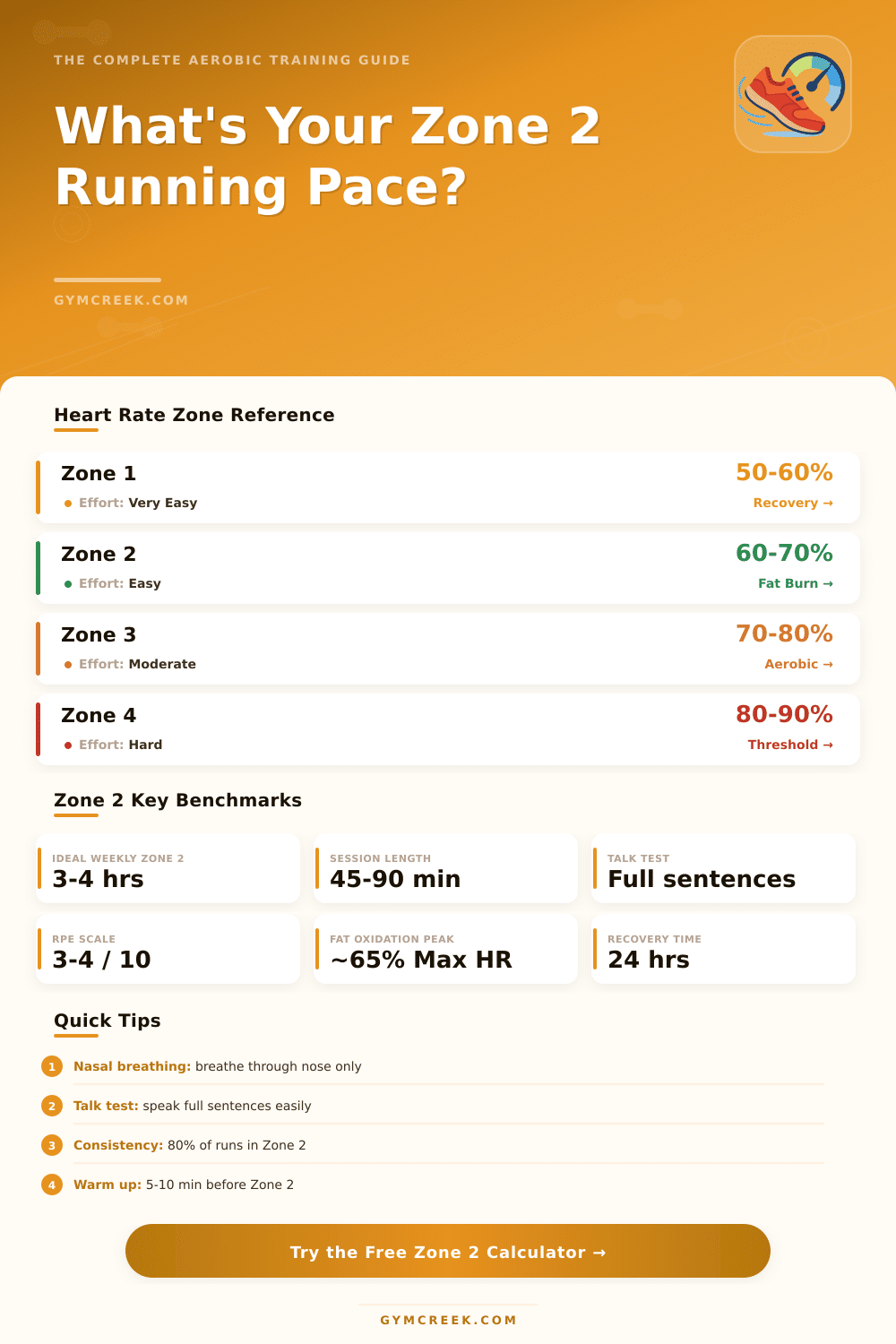
| Zone | Name | % Max HR | Effort (RPE) | Primary Fuel | Key Benefit |
|---|---|---|---|---|---|
| Zone 1 | Active Recovery | 50–60% | 1–2 / 10 | Fat (90%+) | Recovery, blood flow |
| Zone 2 ⭐ | Aerobic Base | 60–70% | 3–4 / 10 | Fat (70–90%) | Mitochondria, fat burn |
| Zone 3 | Aerobic Power | 70–80% | 5–6 / 10 | Mixed 50/50 | Aerobic capacity |
| Zone 4 | Lactate Threshold | 80–90% | 7–8 / 10 | Carbs (70%+) | Speed, VO2 support |
| Zone 5 | VO2 Max / Sprint | 90–100% | 9–10 / 10 | Carbs (95%+) | Peak performance |
| Age | Est. Max HR | Zone 2 Low (60%) | Zone 2 High (70%) | MAF Target |
|---|---|---|---|---|
| 20 | 200 bpm | 120 bpm | 140 bpm | 160 bpm |
| 25 | 195 bpm | 117 bpm | 137 bpm | 155 bpm |
| 30 | 190 bpm | 114 bpm | 133 bpm | 150 bpm |
| 35 | 185 bpm | 111 bpm | 130 bpm | 145 bpm |
| 40 | 180 bpm | 108 bpm | 126 bpm | 140 bpm |
| 45 | 175 bpm | 105 bpm | 123 bpm | 135 bpm |
| 50 | 170 bpm | 102 bpm | 119 bpm | 130 bpm |
| 55 | 165 bpm | 99 bpm | 116 bpm | 125 bpm |
| 60 | 160 bpm | 96 bpm | 112 bpm | 120 bpm |
| 65+ | 155 bpm | 93 bpm | 109 bpm | 115 bpm |
| Fitness Level | Typical Zone 2 Pace | Pace (min/km) |
|---|---|---|
| Beginner | 14–16 min/mile | 8:45–10:00/km |
| Recreational | 11–13 min/mile | 6:50–8:05/km |
| Intermediate | 9–11 min/mile | 5:35–6:50/km |
| Advanced | 7:30–9 min/mile | 4:40–5:35/km |
| Elite | 6–7:30 min/mile | 3:45–4:40/km |
| Goal | Min / Week | Sessions |
|---|---|---|
| General Health | 150 min | 3 x 50 min |
| Fat Burning | 180–240 min | 3–4 x 60 min |
| Endurance Base | 240–300 min | 4 x 60–75 min |
| Marathon Prep | 300–360 min | 4–5 x 60–90 min |
| Elite Build | 360+ min | 5–6 x 60–90 min |
| Method | Formula | Zone 2 Target | Best For | Accuracy |
|---|---|---|---|---|
| % Max HR | 60–70% of MHR | Straight percentage | Quick estimation | Moderate |
| Karvonen (HRR) | RHR + 60–70% (MHR–RHR) | Accounts for fitness | Most individuals | High |
| Maffetone (MAF) | 180 – Age (± adjustments) | Single upper limit | Aerobic base builders | High (with adjustments) |
| Lactate Test | Lab blood lactate 1–2 mmol/L | Precise individual | Serious athletes | Very High |
The base of aerobic exercise is the rhythm of Zone 2 that builds your aerobic system from the base upward. Spending time at that level, you improve the speed and the endurance over time, so the harder efforts will seem more easily handled during the run.
DISCLOSURE: This post may contain affiliate links, meaning when you click the links and make a purchase, I receive a commission. As an Amazon Associate I earn from qualifying purchases.

Do you know, where Zone 2 truly sits? Most runners find it between 60 and 70 percent of their maximum heart frequency, although it can go up to 75 percent depending on the method used. A simple way to estimate your maximum is 220 minus your age.
How to find and train in Zone 2
For thirty-year-old folk that gives around 190 bpm. From that, the calculation of the zone range is simple math.
But here is the main point: Zone 2 is not as strict as it seems. Various models of training split the zones differently. In a three-zone system the limits do not match with those of a seven-zone system, so they move a bit.
Some runners use the heart, others trust more in the pace. A surprisingly reliable way is the nose breathing test. If you manage to breathe only through the nose during your run, you probably stay in the comfortable aerobic area.
What most commonly trips folks is the slowness that Zone 2 truly requires. It is such an easy pace that you could maintain it for 45 minutes or even more, while you talk freely, sometimes even during pauses. A good starting point is to find a Running Pace two to three minutes slower than your race pace.
Pauses during walking are not banned. There is a nice aspect in that loose approach; your mind can attend to the surroundings, almost like meditation four the soul.
Zone 2 does not feel the same every time, and it changes based on conditions. The weather of the day, what you ate the prior night, your present condition… Everything affects it.
There is no single Zone 2 rhythm for all. Younger folk can run Zone 2 at 4:45 to 5:40 per kilometer with heart frequency around 150 to 170. Folk in the middle of their fifties maybe does 5:15 per kilometer at 124 bpm, while another reaches a 12-minute mile.
All of that is valid.
During aerobic training, your body starts real changes. The volume of your muscles grows. The density of capillaries rises, and cells grow more, so oxygen reaches the needed places better.
Your resting heart frequency and the rhythm during hard work drops, because the heart does not need to pump the same amount of blood as strongly. Later you will find that you reach faster times at the same effort. It is as if you add more power to your internal machine.
To reach a faster Zone 2 rhythm you need patience and time. Safely, talk about around two years of regular work. One runner said that efforts that once felt like zone 4 or 5, now became long Zone 2 sessions over two hours.
Another shared that two to two and a half months of steady exercise brought him to a 7:40 mile rhythm at around 135 bpm. The big amount of work in Zone 2 truly helps therace results. It simply needs firmness and attention.