⚖️ BMI Calculator NZ
Calculate your Body Mass Index using New Zealand health guidelines — metric & imperial supported
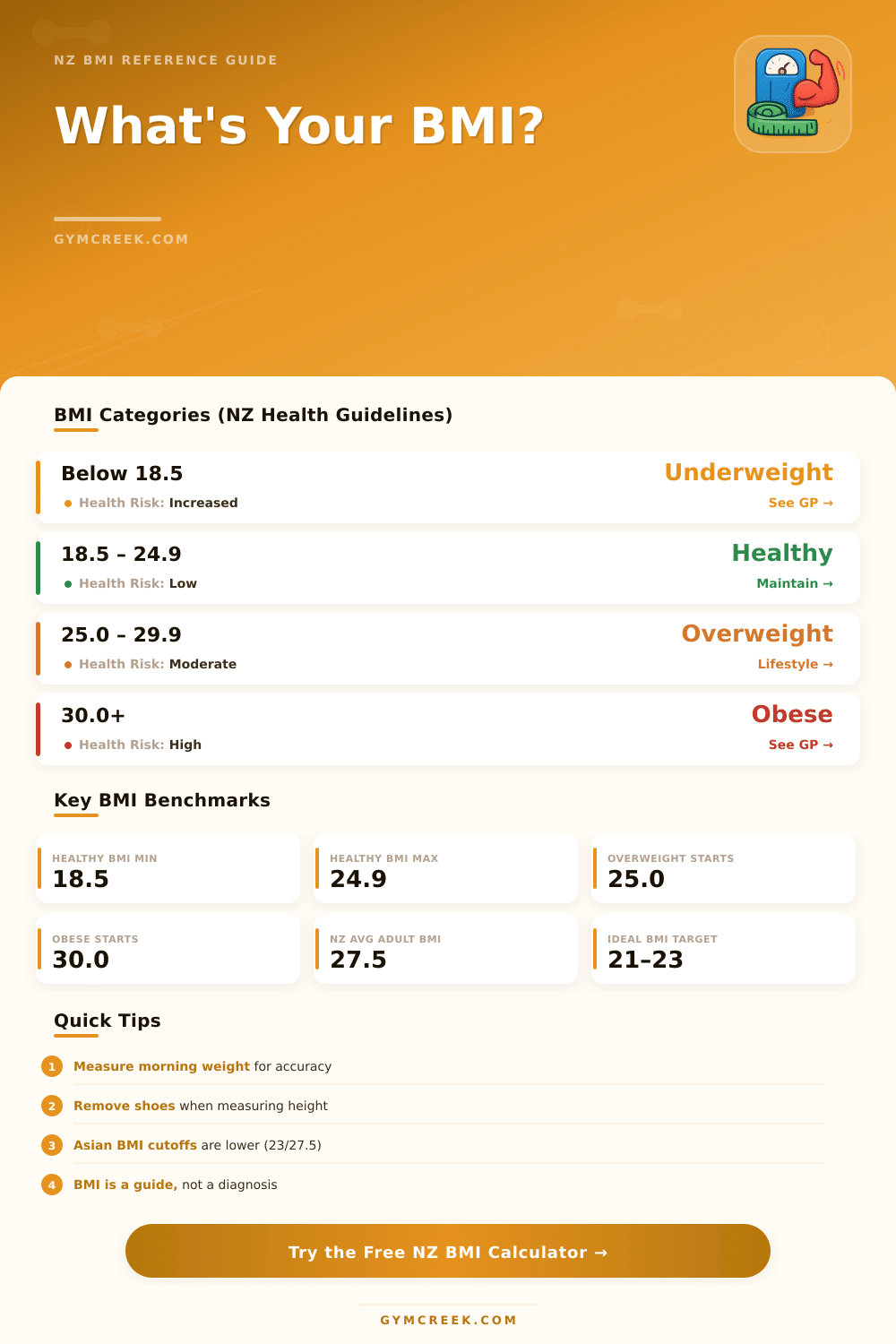
| BMI Range | Category | NZ Health Risk | Recommendation |
|---|---|---|---|
| Below 18.5 | Underweight | Increased risk of malnutrition, osteoporosis | Consult your GP |
| 18.5 – 24.9 | Healthy Weight | Lowest health risk range | Maintain lifestyle |
| 25.0 – 29.9 | Overweight | Moderate — increased diabetes & CVD risk | Diet & activity review |
| 30.0 – 34.9 | Obese Class I | High risk of chronic disease | GP referral recommended |
| 35.0 – 39.9 | Obese Class II | Very high risk | Medical support advised |
| 40.0 and above | Obese Class III | Severe risk — multiple comorbidities likely | Urgent GP review |
| Ethnic Group | Overweight Cutoff | Obese Cutoff | NZ Guideline Source |
|---|---|---|---|
| European / Māori / General | 25.0 | 30.0 | Ministry of Health NZ |
| Pacific (Pasifika) | 26.0 | 32.0 | Pacific Health Guidelines NZ |
| Asian (incl. East & South Asian) | 23.0 | 27.5 | WHO Asian BMI Criteria |
| Height (cm) | Height (ft/in) | Min Weight (kg) | Max Weight (kg) |
|---|---|---|---|
| 155 cm | 5'1" | 44.4 kg | 59.8 kg |
| 160 cm | 5'3" | 47.4 kg | 63.8 kg |
| 165 cm | 5'5" | 50.4 kg | 67.8 kg |
| 170 cm | 5'7" | 53.5 kg | 72.0 kg |
| 175 cm | 5'9" | 56.7 kg | 76.4 kg |
| 180 cm | 5'11" | 59.9 kg | 80.8 kg |
| 185 cm | 6'1" | 63.3 kg | 85.2 kg |
| 190 cm | 6'3" | 66.8 kg | 89.9 kg |
| Limitation | Why It Matters | Better Measure |
|---|---|---|
| Does not measure body fat % | Muscular people may have high BMI but low fat | DEXA scan / skinfold test |
| Does not account for fat distribution | Abdominal fat is most dangerous | Waist-to-height ratio |
| Age & sex not factored in BMI formula | Older adults have more fat at same BMI | Body fat percentage |
| Ethnicity differences | Asian populations have higher risk at lower BMI | Ethnic-adjusted cutoffs |
| Does not assess fitness level | Athletes may be misclassified as overweight | Cardiorespiratory fitness test |
Body Mass Index, or simply BMI, is a number that one counts from your height and mass. It tries to give a general idea about whether your weight stays in a healthy limit. The method itself is quite simple actually.
One shares your weight in kilos by your height in metres squared, and there; you have one number that puts you in a certain group.
What is BMI and why it can be wrong
For adults Body Mass Index sorts folks in clear groups: underweight, healthy mass, overweight and obese. Obesity itself splits into three different grades. If your score falls under 18.5, you enter the underweight zone.
From 18.5 to 24.9 that counts as normal. For children and youngsters from 2 to 18 years the process becomes a bit more rough… Because age and sex affects the result.
The whole history of Body Mass Index started when Ancel Keys published an article in 1972 in the Journal of Chronic Diseases. His work shows, that BMI is the best way to estimate the percentage of body fat, when one considers various studies about mass and height. What woke this attention, was the growing fear about obesity, that spread in rich western nations.
The basic formula however comes from even furhter back, it was first called Quetelet-Index and dates from the 1830s.
Here the main point: Body Mass Index works well as a screening method, but it is far from ideal. It does not measure directly the fat in the body and does not account for muscle mass, bone density or the place of the fat. Those last parts are the core of the problem.
A person with a lot of muscles can fall in the overweight or obese category, although he has really little body fat. In certain research more then a quarter of male sportsmen were classed as overweight by BMI, but less than 4% really had too much fat. That happens because sportsmen have denser bones and stronger muscles, what naturally raises their score.
There is also a problem with older adults, that can have normal BMI, but actually carry more fat, because they lost muscle during the years. During pregnancy and nursing the body changes so strongly, that BMI simply stops working as a reliable measure. And something to note: for black Americans BMI commonly over estimates the obesity, because the higher value comes from muscles instead of real excess fat.
The percentage of body fat gives a much more clear picture about your whole health than BMI ever could. The ratio of waist to height is another good choice to think about. If that ratio passes 0.5, it shows too much fat around the belly.
A new tool called body roundness index recently gains popularity as a more exact way to estimate belly fat, what connects more strongly to risks of cancer and heart disease. BMI stays in the medical exams, do not worry, but it is only one part of abigger picture. The best way to really understand your body?
Ask a doctor that will do proper testing.