⚖️ BMI Calculator for Women
Calculate your Body Mass Index with women—specific healthy ranges, body fat benchmarks, and weight category insights.
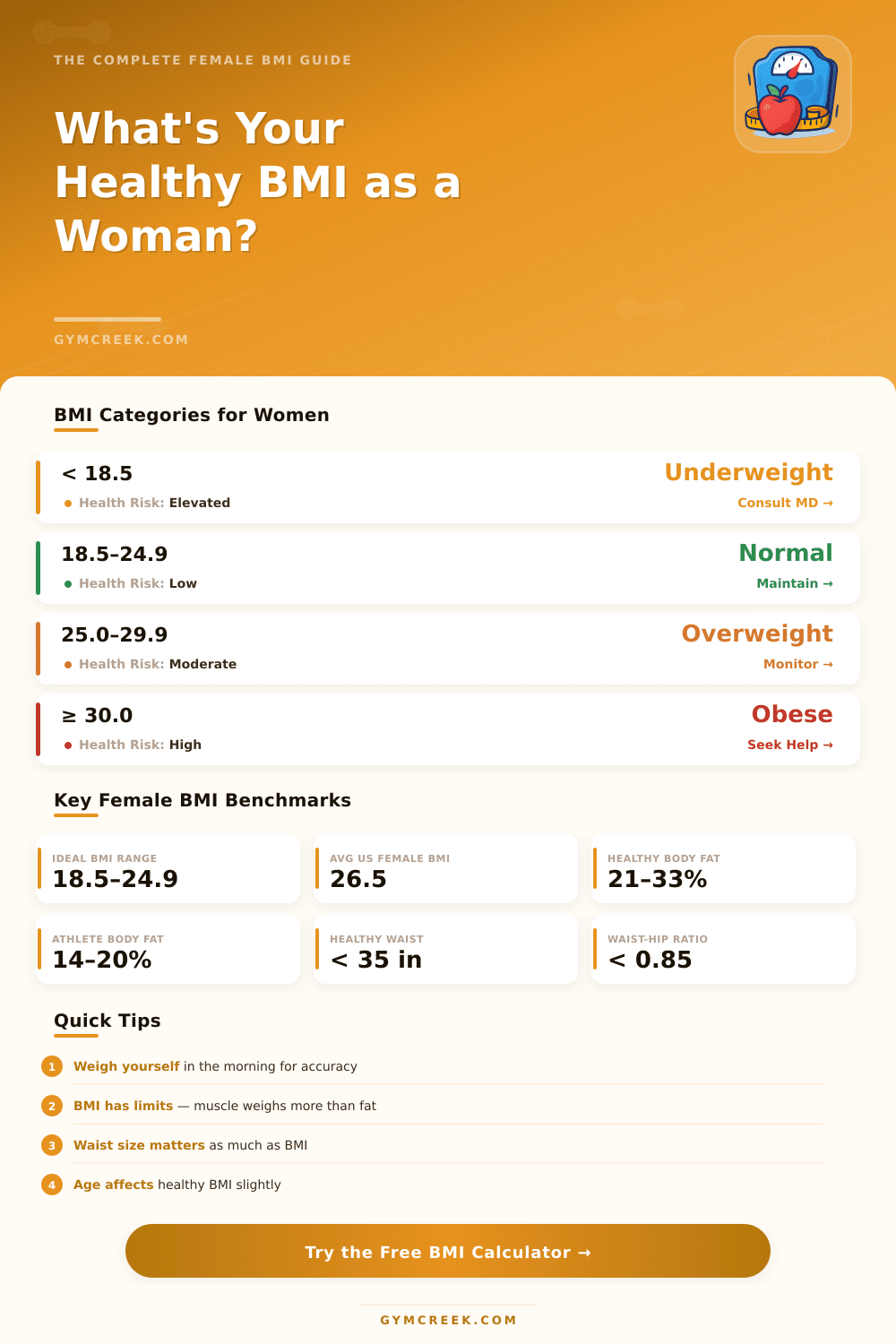
| BMI Range | Category | Health Risk | Ideal Weight (5'4") | Notes for Women |
|---|---|---|---|---|
| < 16.0 | Severely Underweight | Very High | < 93 lb / 42 kg | Risk of bone loss, hormonal disruption |
| 16.0 – 18.4 | Underweight | Elevated | 93–107 lb / 42–49 kg | May affect fertility and immunity |
| 18.5 – 24.9 | Normal Weight | Low | 108–145 lb / 49–66 kg | Optimal health range for most women |
| 25.0 – 29.9 | Overweight | Moderate | 146–174 lb / 66–79 kg | Increased risk of metabolic conditions |
| 30.0 – 34.9 | Obese (Class I) | High | 175–204 lb / 79–93 kg | Consult healthcare provider |
| 35.0 – 39.9 | Obese (Class II) | Very High | 205–232 lb / 93–105 kg | Serious comorbidities likely |
| ≥ 40.0 | Obese (Class III) | Extremely High | > 233 lb / 106 kg | Medical intervention recommended |
| Category | Body Fat % | Description | Typical BMI Range |
|---|---|---|---|
| Essential Fat | 10 – 13% | Minimum for hormonal function | 16 – 19 |
| Athlete | 14 – 20% | Competitive female athletes | 18 – 22 |
| Fitness | 21 – 24% | Active, regular exerciser | 21 – 24 |
| Average | 25 – 31% | Acceptable health range | 23 – 27 |
| Overweight | 32 – 39% | Above average, health risks rise | 27 – 32 |
| Obese | ≥ 40% | Significant health risk | > 32 |
| Height | Small Frame | Medium Frame | Large Frame | BMI 18.5–24.9 |
|---|---|---|---|---|
| 5'0" / 152 cm | 95–107 lb | 106–118 lb | 115–128 lb | 95–128 lb |
| 5'2" / 157 cm | 102–110 lb | 109–121 lb | 118–132 lb | 101–136 lb |
| 5'4" / 163 cm | 108–116 lb | 114–127 lb | 122–137 lb | 108–145 lb |
| 5'6" / 168 cm | 114–123 lb | 120–134 lb | 129–145 lb | 115–154 lb |
| 5'8" / 173 cm | 122–131 lb | 128–143 lb | 137–154 lb | 122–164 lb |
| 5'10" / 178 cm | 128–138 lb | 134–151 lb | 144–163 lb | 129–174 lb |
| 6'0" / 183 cm | 136–147 lb | 143–160 lb | 152–172 lb | 137–184 lb |
The body mass index, or BMI, simply counts what happens with your weight and height to estimate how much fat you probably carry in the body. It tries to guess values for various ages and stays one of the main tools for checking whether folk falls in the groups of lightweight, normal weight, overweight or obese. Even so, it is only the start of the discussion.
There is much more in the whole picture than simply one figure.
Why BMI is not always right for women
For adults those groups split quite exactly. If your BMI is between 18.5 and 24.9 you are in the zone of healthy weight, but interestingly, some Asian lands apply other rules, they set the healthy range at 17.5 until 22.9, and everything above 23 one considers overweight. That shows that limits can adjust according to the place where you live, and who does the rating.
But here is the main problem. The formula of BMI works the same for all, women and men alike, although women naturally have more body fat than men. More seriously, BMI does not measure the fat directly.
It simply misses the muscle, the density of bones and the general shape of the body. For people that do not match the avreage model, that must be a clear gap.
In Female the usual range of body fat sits around 25% until 31%, and a good test of body fat can show what really happens under the skin. If some have more muscle than what BMI points, such a test would catch that. Also there is the menopause side, after menopause muscle commonly drops over the time pass.
One could lose wait, yet stay with high levels of body fat, what raises the risk of disease, even if the BMI seems good on paper.
BMI never meant to be a universal measure of health for every person. It was made for checking groups of folks, and it does not consider shape of body or difference between sexes. A Female that does strong training and stays thin, can still have high BMI only because of her muscles.
Athletes and bodybuilders meet this problem commonly, they have denser bones and stronger muscles, what pushes their BMI in the overweight zone, although they are in good shape. Such extra muscle helps to protect against heart diseases and diabetes.
So, there is also the shape of the body itself. A Female with broad hips or big chest can be really slim and healthy, yet fall in the overweight group according to the scale of BMI. The method simply does not catch such differences.
So many specialists insist on measuring the waist. They advise to also check the main measures like cholesterol, level of sugar in blood, family history, whether one smokes and how much activity happens.
In the end, BMI gives only a rough idea, that works for average groups, but fails for many women according to their build, level of fitness and age. Hormones matter also, and somewomen feel their best at different spots in the so called healthy range.