🚶 Walk Calorie Calculator
Estimate calories burned walking by weight, speed, distance & terrain
Measure distance accurately: Use a fitness tracker, GPS watch, or phone app — don’t estimate.
Pace consistency: Results assume a steady pace. Stopping, traffic lights, and hills all affect your actual burn.
Incline significantly increases burn: A 5% incline can add 30–50% more calories compared to flat walking at the same speed.
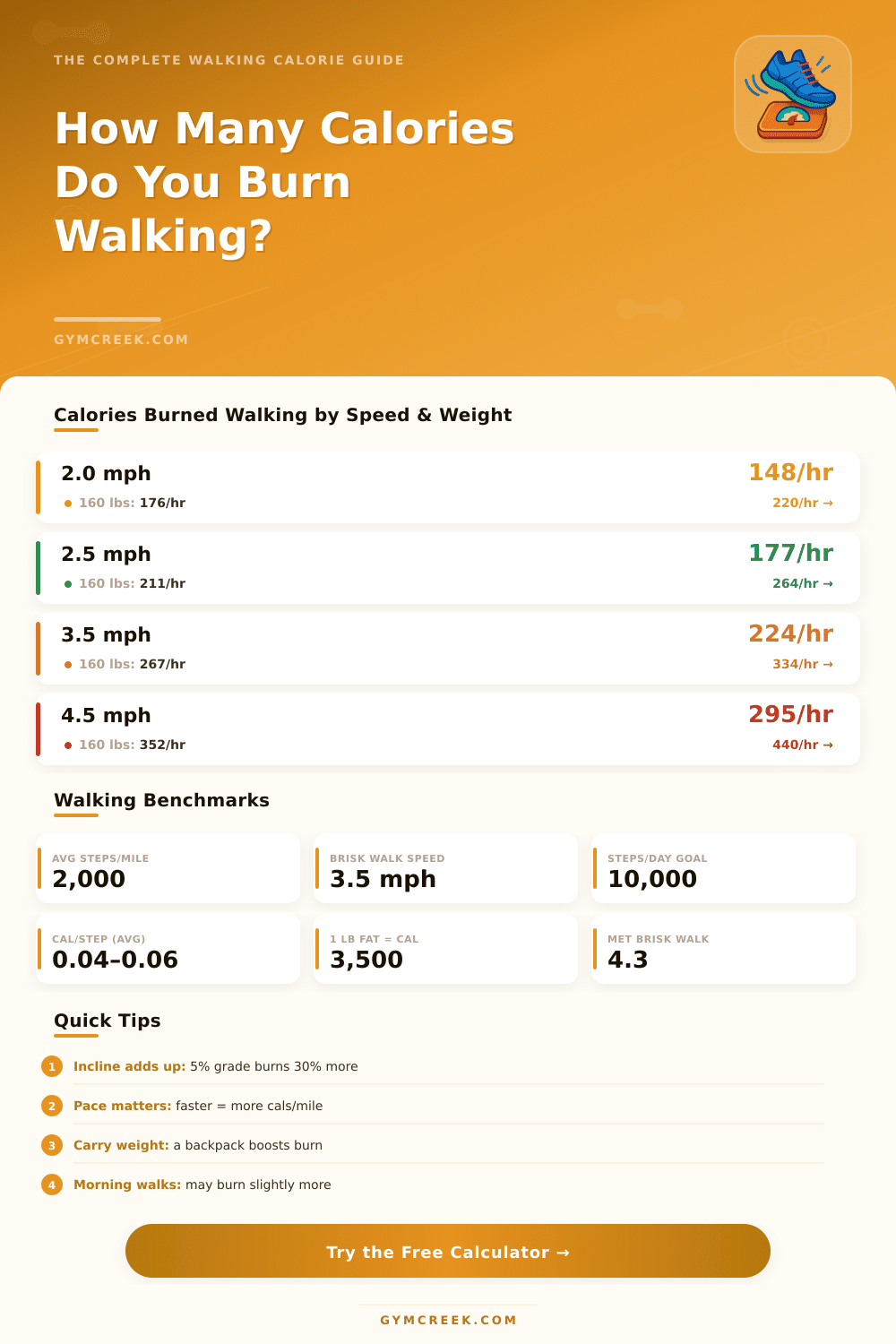
| Walking Type | Speed (mph) | MET Value | Cal / 30 min (160 lbs) |
|---|---|---|---|
| Very Slow | 1.5 mph | 2.0 | 109 |
| Slow | 2.0 mph | 2.8 | 153 |
| Leisurely | 2.5 mph | 3.0 | 164 |
| Moderate | 3.0 mph | 3.5 | 191 |
| Brisk | 3.5 mph | 4.3 | 234 |
| Fast | 4.0 mph | 5.0 | 273 |
| Very Fast | 4.5 mph | 6.3 | 344 |
| Race Walk | 5.0 mph | 7.0 | 382 |
| Nordic Walking | 3.5 mph | 4.8 | 262 |
| Uphill (5%) | 3.0 mph | 5.3 | 289 |
| Body Weight | 2.5 mph | 3.0 mph | 3.5 mph | 4.0 mph |
|---|---|---|---|---|
| 120 lbs (54 kg) | 65 | 71 | 79 | 89 |
| 140 lbs (64 kg) | 76 | 83 | 92 | 104 |
| 160 lbs (73 kg) | 87 | 95 | 105 | 119 |
| 180 lbs (82 kg) | 98 | 107 | 118 | 134 |
| 200 lbs (91 kg) | 109 | 119 | 131 | 149 |
| 220 lbs (100 kg) | 120 | 131 | 145 | 164 |
| 250 lbs (113 kg) | 136 | 149 | 165 | 186 |
| Zone | % Max HR | Walk Type | Primary Benefit |
|---|---|---|---|
| Zone 1 – Recovery | 50–60% | Very slow stroll | Active recovery |
| Zone 2 – Fat Burn | 60–70% | Easy/moderate walk | Fat oxidation, endurance |
| Zone 3 – Aerobic | 70–80% | Brisk/fast walk | Cardiovascular fitness |
| Zone 4 – Threshold | 80–90% | Race walk / hill | Anaerobic threshold |
Walking ranks among the simplest ways to burn Calorie and many calculators help to estimate how many one uses during that. Calculators for Calorie of walking can value the burned Calorie during hiking, run or cycling for any distance. Some of them also consider walking and run.
Others can be used to enter walks of any length, duration and height, included Nordic walks.
How Many Calories You Burn When You Walk
The things that affect such calculations are really important. The best calculators mind to age, sex, mass, height, walking speed and time. They include your basic metabolic rate or BMR, together with the intensity of the exercise, measured in METs.
The real formula looks like this: burned Calorie matches BMR multiplied by METs and divided by 24, then multiplied by the hours of exercise. Some calculators mind also to the slope of the way, so whether one walks upward or down.
Such tools usually show the burned Calorie, covered distance and done steps. One can estimate Calorie according to steps, distance, time or slope.
The physical mass has big influence. Folk of 200 pounds burn more Calorie than folk of 100 pounds, because moving bigger weight requires more energy. A simple rule says that one burns around 0.5 Calorie per mile for every pound of physical mass.
Like this for 200 pounds that does about 100 Calorie per mile. Folk of 150 pounds, walking only one mile, can easily burn around 100 Calorie. The average person loses around 100 Calorie for every mile of Walk, no matter the speed.
However the pace stays important. Fast hiking burns more energy per minute than slow walking. Running burns more Calorie per minute than hiking, but for distance the values are more alike.
Walking Calorie grow more quickly with the pace than running Calorie at pace under 5 miles per hour. The heart rhythm also rises more during running than during walking.
Slopes alter the results strongly. Folk of 180 pounds, walking upward at 3 miles per hour on 10 percent slope, has MET-value of 8.0 and burns about 11.4 Calorie per minute. Sixteen minutes of flat hiking differ much from sixteen minutes on 12 percent slope.
There are even simple tricks that can grow the Calorie burn by 18 percent, without walking any longer distance.
Around 30 to 40 Calorie are burned per 1,000 steps. Hiking of 1,000 steps lasts about 10 minutes. Daily hiking during 30 minutes burns between 90 and 120 Calorie.
Fitness trackers and apps commonly deliver different ratings for Calorie, and most probably are a bit wrong. Burned Calorie always are only a guess. The clearr number matters less than watchingtrends through the time.