🏃 Running Pace Calculator
Calculate your pace, finish time, or distance — with splits, training zones & race benchmarks
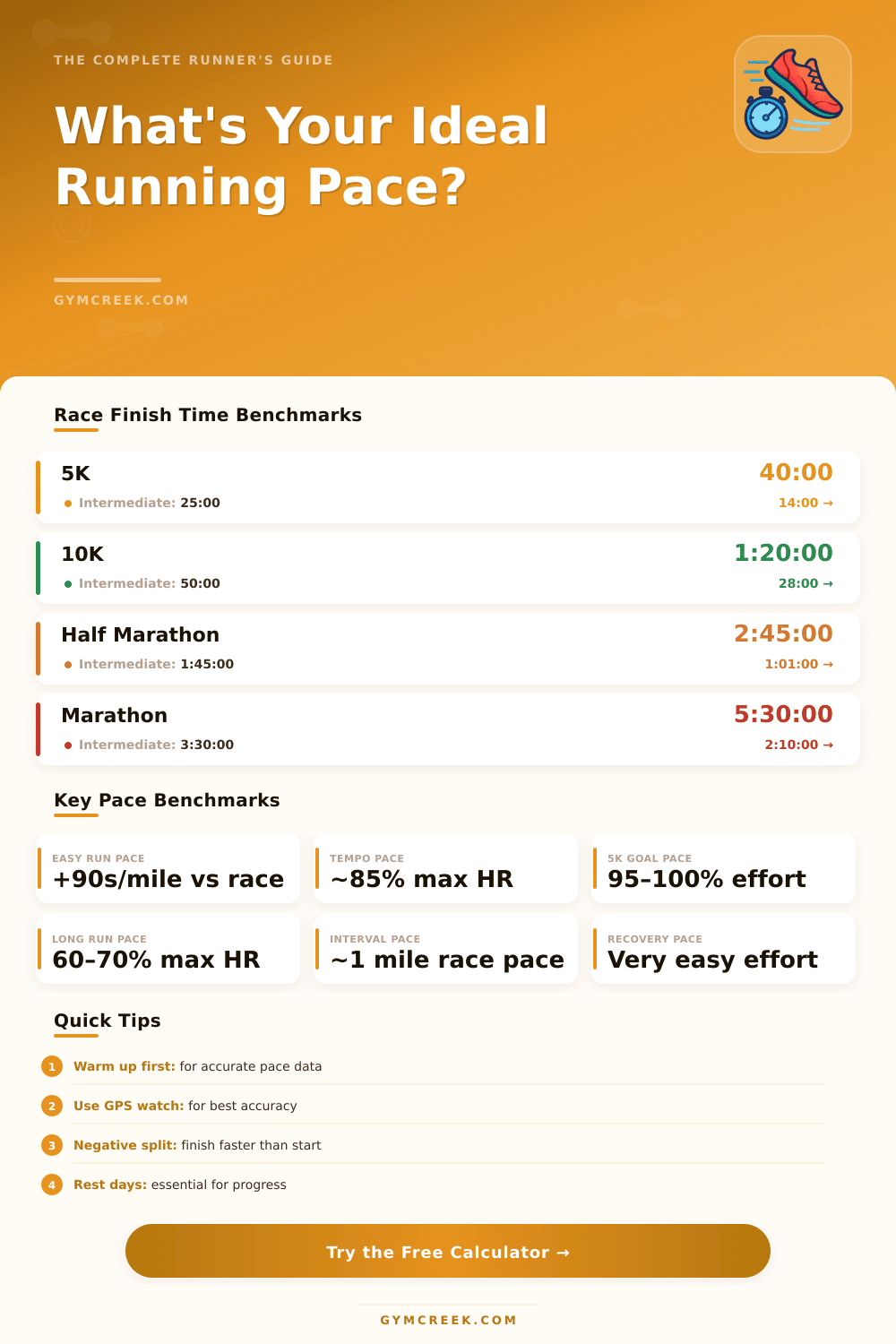
| Distance | Beginner | Intermediate | Advanced | Elite |
|---|---|---|---|---|
| 1 Mile | 12:00 | 8:00 | 6:00 | 4:00 |
| 5K (3.1 mi) | 40:00 | 28:00 | 20:00 | 14:00 |
| 10K (6.2 mi) | 1:20:00 | 55:00 | 40:00 | 28:00 |
| Half Marathon | 2:45:00 | 1:55:00 | 1:30:00 | 1:01:00 |
| Marathon | 5:30:00 | 4:00:00 | 3:10:00 | 2:10:00 |
| Zone | Name | % Max HR | Pace vs 5K Pace | Purpose |
|---|---|---|---|---|
| Zone 1 | Recovery | 50–60% | +3:00/mi or slower | Active recovery |
| Zone 2 | Easy / Base | 60–70% | +2:00/mi | Aerobic base building |
| Zone 3 | Aerobic | 70–80% | +1:00/mi | Aerobic capacity |
| Zone 4 | Tempo / Threshold | 80–90% | +0:20/mi | Lactate threshold |
| Zone 5 | Interval / VO2 | 90–100% | 5K race pace | Max speed & power |
| Finish Goal | Required Pace (min/mi) | Required Pace (min/km) | Speed (mph) | Speed (kph) |
|---|---|---|---|---|
| 5K in 20:00 | 6:26/mi | 4:00/km | 9.3 mph | 15.0 kph |
| 5K in 25:00 | 8:03/mi | 5:00/km | 7.5 mph | 12.0 kph |
| 10K in 50:00 | 8:03/mi | 5:00/km | 7.5 mph | 12.0 kph |
| Half in 1:45 | 8:01/mi | 4:59/km | 7.5 mph | 12.0 kph |
| Half in 2:00 | 9:09/mi | 5:41/km | 6.6 mph | 10.6 kph |
| Marathon in 3:30 | 8:01/mi | 4:59/km | 7.5 mph | 12.0 kph |
| Marathon in 4:00 | 9:09/mi | 5:41/km | 6.6 mph | 10.6 kph |
| Marathon in 5:00 | 11:27/mi | 7:07/km | 5.2 mph | 8.4 kph |
| Age Group | Men BQ Time | Men BQ Pace | Women BQ Time | Women BQ Pace |
|---|---|---|---|---|
| 18–34 | 3:00:00 | 6:52/mi | 3:30:00 | 8:01/mi |
| 35–39 | 3:05:00 | 7:03/mi | 3:35:00 | 8:12/mi |
| 40–44 | 3:10:00 | 7:15/mi | 3:40:00 | 8:23/mi |
| 45–49 | 3:20:00 | 7:38/mi | 3:50:00 | 8:46/mi |
| 50–54 | 3:30:00 | 8:01/mi | 4:00:00 | 9:09/mi |
| 55–59 | 3:45:00 | 8:35/mi | 4:15:00 | 9:44/mi |
| 60–64 | 4:00:00 | 9:09/mi | 4:30:00 | 10:18/mi |
Negative Split: Run the second half slightly faster than the first — most world records are set this way.
Even Split: Maintain a consistent pace throughout — best for beginners and long races.
Positive Split: Starting fast and slowing down — generally leads to worse finish times. Avoid for races over 5K.
Pace in running is the base of everything, how much time you need to go across a fixed distance. It is the opposite of speed. Assume that your watch shows 7.5 miles per hour.
That helps, naturally, even so runners usually think about time per distance, because simply that matters during your run. The math itself is easy: split your whole time by the distance that you covered. Assume you finished 5 km in 30 minutes?
What Is Running Pace and How to Use It
So it results in 6 minutes per kilometer, what becomes your standard Running Pace.
Simple calculators help you with the hard part, enter two of three elements, like Running Pace, time or distance, and it gives the third. Such tools come handy for guessing when you will reach the target, for setting your wanted Running Pace and for making more exact training for events from a fast 10K until a whole marathon. Many of them also have converters, so you can check your Running Pace in kilomteres and miles, without forcing you to do the math yourself.
Here the key spot: various race distances need different paces. Your speed for 5K almost always beats that, what you can keep during 10K. 5K puts you in anaerobic zone, while Running Pace for 10K is more steady, medium to a bit heavy aerobic work. If your basic 5K pace is around 8:30 per mile, likely you will aim something like 8:50 for 10K and about 9:10 for half marathon.
But nothing from all this is a set rule. Adding 10 or 20 seconds for longer distances is totally fine and commonly wise.
Pushing too early too hard can cause injury. The key to finish strongly? Run the second half more quickly then the first.
That means start a bit less quickly, than you believe possible, and boost slowly. Your mind always pushes you to give everything, but controlling yourself early needs real discipline.
The training approach usually follows a split of 80-20. Around 80 percent of your weekly distance should feel truly light, while the other 20 percent goes to work for building speed. Top athletes spend almost 80 percent of their training time at a Running Pace that raises the heart yet leaves them talking easily with a training partner.
Easy runs form the aerobic base that fuels more hard efforts. Ranging 10 or 20 seconds per mile above or under your planned easy Running Pace on some day? That is most normal.
For middle paces in your range, everything that feels relaxed and steady works well for such runs. Follow what seems right on that specific day, instead of stressing about perfect numbers. Other view: look at Running Pace as time spent, not only as kilometers.
A faster runner reaches more distance in an hour than a slow one, so total time on feet commonly is a better sign of training amount.
Aiming to keep your Running Pace opens ways to bigger distances. A slower time lets you go more long. Many runners find that setting something like 6 minutes per kilometer for everyday runs, while slowly extending the weekly distance, buildsreal endurance.